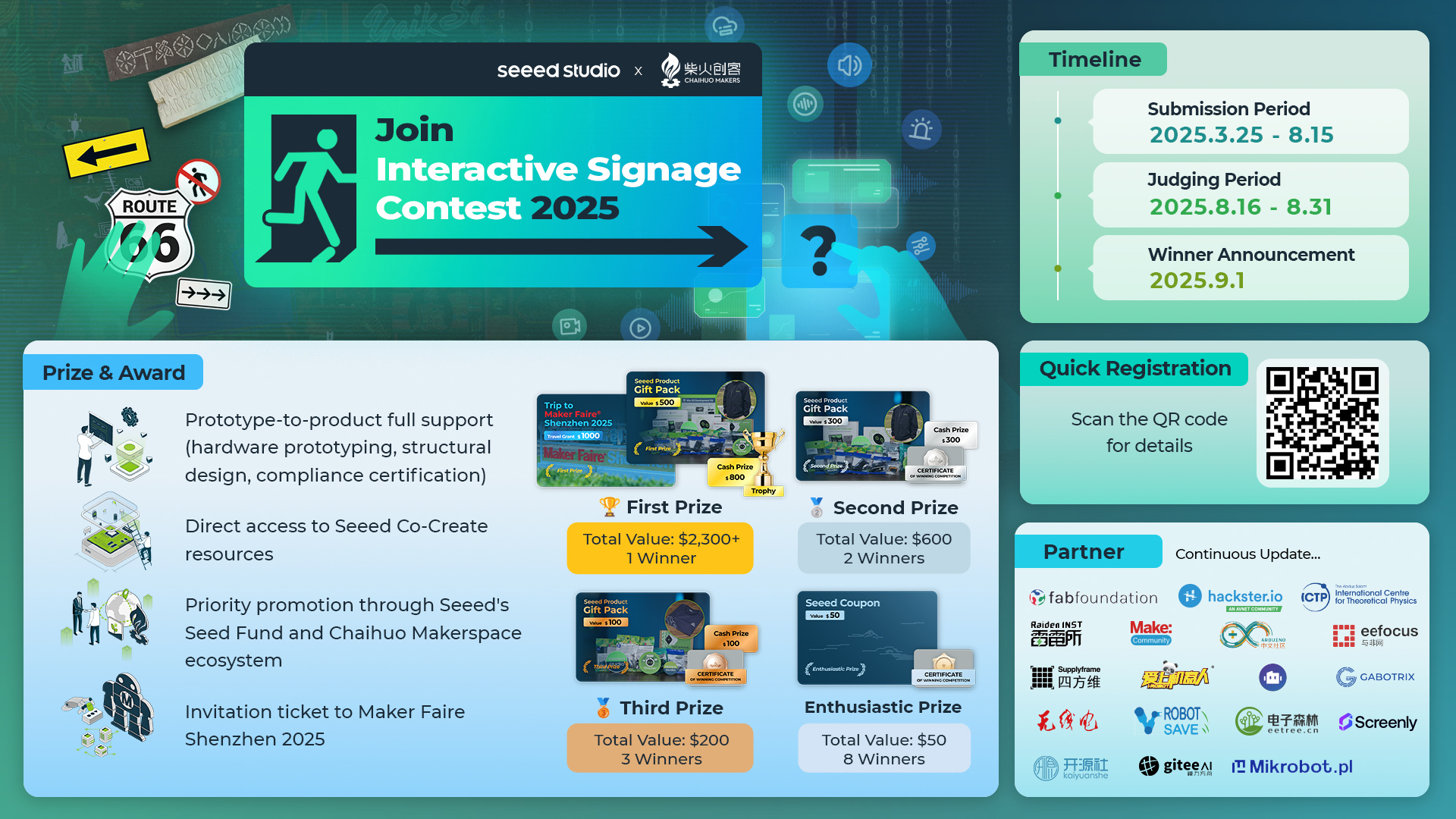
In today’s world of DIY tech and creative coding, building a beautiful gadget is no longer the hard part. The real challenge? Creating something that matters—something that resonates with real people, serves real communities, and shares knowledge freely.
That’s the heart of the Seeed Interactive Signage Contest. And that’s why, beyond the circuits and screens, we’re inviting judges who bring not just technical expertise, but a human perspective.
Today, we’re spotlighting insights from Jinger Zeng, program manager at Hackster.io, where she leads innovation campaigns and supports a global network of developers. She’s also a strong advocate for open source, meaningful design, and projects that blend technology with purpose.
Jinger Zeng — Program Manager of Hackster
In the Seeed contest, Jinger is evaluating entries through the lens of open source contribution and community impact, but what does that actually mean?
“At the heart of open source lies a spirit of sharing and collaboration,” she explains. “High-quality documentation is essential for effective knowledge transfer and clear communication.”
In other words, it’s not just about what you build—it’s about how you share it, and why you built it in the first place.
“I look for:
Documentation quality – How is the project communicated? Through text, visuals, and videos?
Impact – Is this just a cute tech gadget, or is it solving a meaningful problem in society and enhancing humanity?”
Projects That Leave a Mark
When asked about past projects that stuck with her, Jinger immediately mentioned two powerful examples:
Foldscope – An ultra-low-cost paper microscope, open source and built for science education in underserved regions.
Mothbox – A simple yet impactful tool for observing moths, designed with education and community science in mind.
These projects go beyond hardware—they create ecosystems of learning, tools for exploration, and inspiration for future creators.
Advice for Makers: Focus on the Human
“Design with ‘human in the loop’ as your core mindset,” she encourages. “Think less about the tech, and more about the human aspect.”
In a world where digital signage can quickly become noisy or ornamental, this is a critical reminder: the best interactive signage serves—it informs, invites, empowers.
What She Hopes to See
Looking ahead, Jinger is excited about signage projects that reflect local cultures and serve specific community needs.
“I’d love to see culturally unique projects, especially ones that address regional or environmental challenges—like conserving power, working off-grid, or blending sustainability with great UX design.”
She’s also drawn to projects that combine aesthetics and function, proving that good design doesn’t have to sacrifice beauty for practicality—or vice versa.
Make it Meaningful
So what makes a great interactive signage project? According to Jinger, it’s not just about clever code or slick screens. It’s about sharing your knowledge, amplifying community voices, and building for people—not just users.
The Seeed Interactive Signage Contest is open until August 15, 2025. If you’re designing something that informs, delights, or empowers—we want to see it.
And if you’re wondering where to start, maybe just ask yourself:
Who will this help? How will I share it? And what would make it beautiful—not just to look at, but to live with?