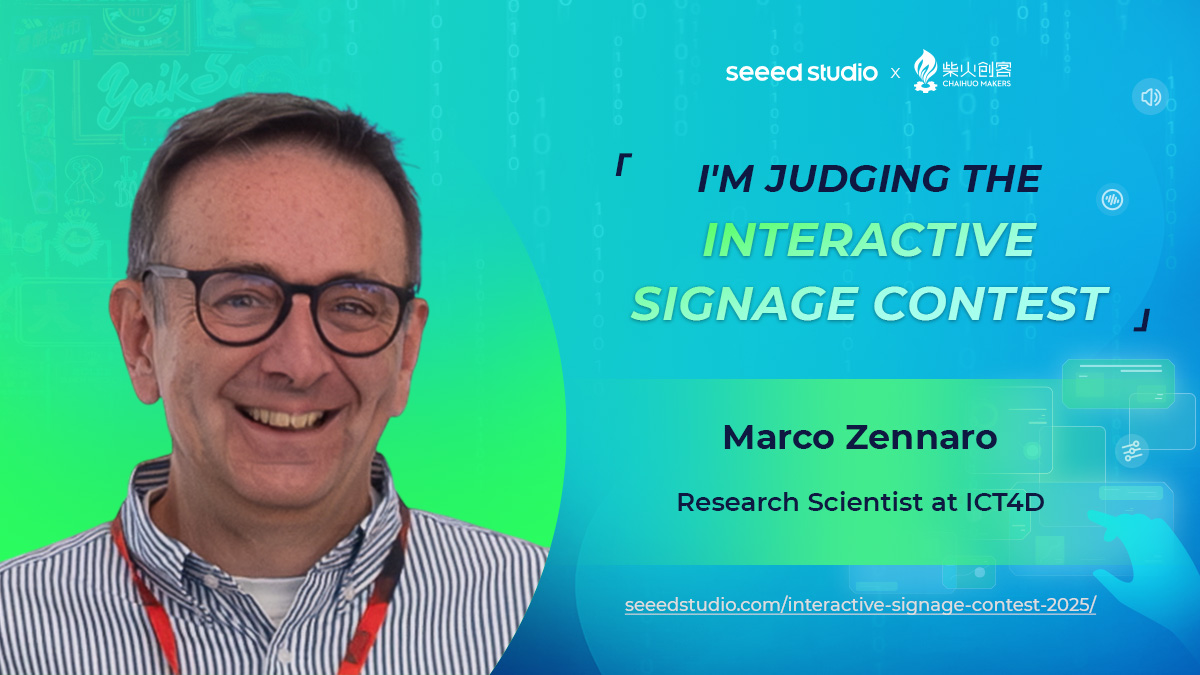
As the Seeed Interactive Signage Contest continues to shine a light on creativity from around the world, we’re honored to have Marco Zennaro join our jury panel.
With a deep background in sustainable technology for global development, Marco brings a thoughtful and forward-looking perspective to the evaluation process.
Research Scientist at ICT4D
Marco Zennaro is a Research Scientist at the International Centre for Theoretical Physics (ICTP), where he explores how emerging technologies, such as IoT, wireless communications, and TinyML, can help tackle real-world challenges in developing regions. His work emphasizes scalable, low-power, and sustainable solutions that not only innovate but also make a lasting impact.
In this contest, Marco is focusing on sustainability, not only in the environmental sense, but also in economic and social terms.
A Scientist Bridging Technology & Sustainability
“Innovation and technical merit are important,” Marco shared, “but the real standouts are those that show long-term thinking.” Projects that minimize resource use, support local communities, and are built for resilience in everyday contexts are the ones that catch his eye. “We’re looking for solutions that can scale, endure, and make a difference.”
The Beauty of Reuse
When asked about impactful projects he’s encountered, Marco spoke passionately about those that reuse existing materials in smart, meaningful ways.
“Sometimes the best solution is the one that you have in front of you and needs to be reused in a smarter way!”
He said. This mindset is at the heart of sustainability: not always inventing from scratch, but reimagining what’s already around us.
A Note to Participants
His advice to contestants? “Be clear about how your project addresses all three pillars of sustainability: environmental, economic, and social.” Whether you’re building with recycled parts, designing for off-grid communities, or creating affordable solutions, every detail counts.
What He's Hoping to See
Marco’s especially excited to see innovative use of materials—projects that challenge our assumptions and show how signage can do more with less. For him, signage isn’t just a display—it’s a tool for awareness, inclusion, and progress.