How Accurate is the SenseCAP T2000 GNSS Positioning?
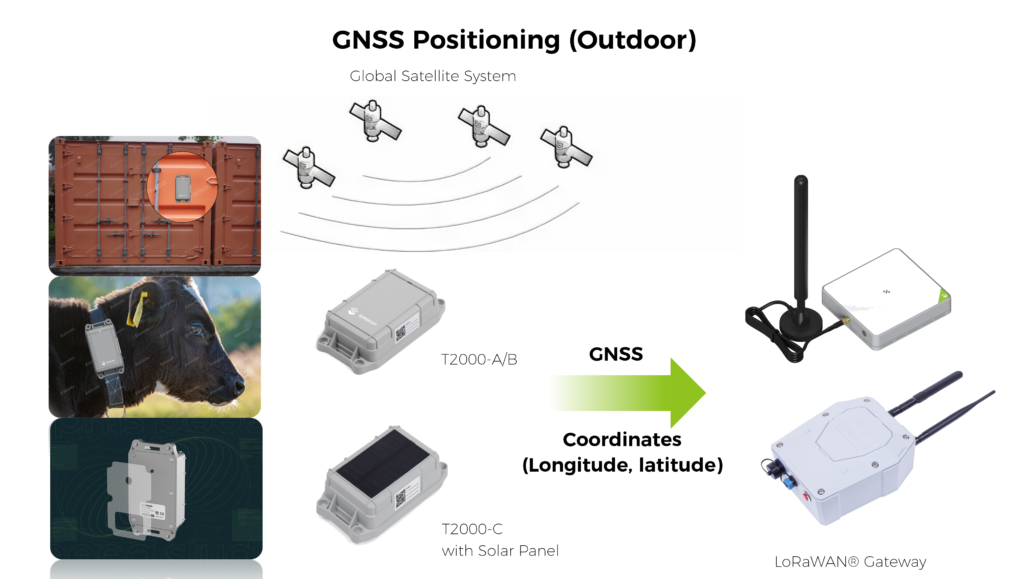
Introduction to the T2000 GNSS module
The SenseCAP T2000 is equipped with the L76K GNSS module, a proven and widely used multi-constellation positioning solution designed for IoT and asset tracking applications.
The L76K module is known for its stability, reliability, and balanced performance, making it well suited for long-term outdoor deployment and real-world positioning scenarios.
Supported Satellite Navigation Systems
The GNSS module in the T2000 supports multiple global satellite navigation systems and frequencies:
- GPS L1 C/A (1575.42 MHz)
- QZSS L1 (1575.42 MHz)
- GLONASS L1 (1602.5625 MHz)
- BeiDou B1 (1561.098 MHz)
By leveraging multiple satellite constellations simultaneously, the T2000 can significantly increase satellite availability and positioning robustness, especially in challenging environments such as urban areas, partial sky obstruction, or complex terrain.
1. What is CEP50?
In GNSS positioning, CEP50 (Circular Error Probable, 50%) is a commonly used metric to describe real-world positioning accuracy.
CEP50 represents a radius within which 50% of all reported location points fall, measured from the true position.
For example: If a device has a CEP50 of 2.5 meters. It means that more than half of the positioning results are within 2.5 meters of the actual location.
2. T2000 CEP50 Test Results
(1)Test Setup
The test was conducted under static conditions to evaluate the GNSS positioning accuracy of the T2000. The test parameters are listed below:
- GNSS scan timeout: 60 seconds
- Uplink interval: 1 minute
- Device status: Stationary
- Number of samples per device: Approximately 1,000 positioning records
Two pieces of T2000 devices were tested under the same conditions.
(2)CEP50 Test Results
Based on the collected GNSS positioning data, statistical error analysis was performed for both devices, with the following results:
- Device A
- CEP50: 7.1 m
- Maximum drift distance: 71 m
- Device B
- CEP50: 5.7 m
- Maximum drift distance: 57.9 m
The results show that both T2000 devices produced a relatively concentrated distribution of positioning points under the test environment. More than half of the recorded positions fall within an error range of approximately 5–7 meters, indicating stable and consistent GNSS positioning performance.
3. Factors Affecting GNSS Positioning Accuracy
GNSS positioning accuracy is influenced by several factors. Some of them are inherent to the GNSS system and atmospheric conditions and cannot be completely eliminated, while others are related to device installation and usage and can be optimized in real-world deployments.
(1)Obstructions
Buildings, trees, or vehicles may block or weaken satellite signals, reducing the number of satellites available for positioning and affecting accuracy. To minimize this impact, the device should be installed in an open area with a clear view of the sky.
(2) Electromagnetic Interference
Nearby electronic equipment or large metal objects can introduce electromagnetic interference, which may affect GNSS signal reception. It is recommended to keep the device away from strong electronic sources and large metallic structures whenever possible.
(3)Multipath Effects
GNSS signals may be reflected by buildings, walls, or metal surfaces before reaching the device. These reflected signals can cause positioning errors, commonly referred to as multipath effects. To reduce multipath interference, the device should not be placed too close to walls or surrounding structures.
(4) Antenna Orientation and Placement
The performance of the GNSS antenna also plays an important role in positioning accuracy.
The device should be placed facing upward, and the antenna area should not be covered or obstructed to ensure optimal signal reception.
Summary
Overall, GNSS positioning performance is highly dependent on the surrounding environment. Small variations and positioning drift are normal characteristics of GNSS systems and should be evaluated using statistical metrics such as CEP50 rather than individual positioning points.
About Author
