Designing a XIAO Expansion Board — Using a Schottky Diode to Prevent Power Backfeeding
Introduction
In many portable projects, devices often need to support both battery power and external charger power.
While this dual-power structure is convenient, improper handling can lead to backfeeding—where current flows backward from the XIAO’s USB port into the external power source or even the main control circuitry, potentially causing damage.
Problem Scenario
In an (XIAO ESP32S3/Sense/XIAO with 5V pin) expansion board, the system supports both USB (XIAO_5V) power input and external 5V (EXT_5V) input.
If both sources are connected at the same time without proper isolation, current may flow back from the XIAO USB port into the EXT_5V rail, causing over-current issues or even permanent damage.
Solution Approach
Use a low forward-voltage Schottky diode (e.g., SS14 or BAT54) in series with the EXT_5V input to achieve automatic isolation.
When only EXT_5V is connected:
The diode is forward-biased, supplying: EXT_5V → XIAO ESP32S3 (or other XIAO) 5V input.
When USB Type-C is connected: The diode becomes reverse-biased, blocking current from flowing back into EXT_5V.
When both USB Type-C and EXT_5V are connected:
1.The two voltages are very close.
2.The Schottky diode sees almost no forward voltage and stays reverse-biased or nearly off.
3.The system automatically draws power from the XIAO USB Type-C (XIAO_5V).
4.The Schottky diode effectively blocks any backfeeding from the USB 5V rail into the external EXT_5V input.
This ensures USB has priority while maintaining safe power-source isolation.
Design Considerations / Risks & Decisions
Design Goal 1 (Common Requirement): USB 5V Priority
USB should be the main power source.
This is normally achieved if EXT_5V is fed through a diode, causing its voltage to be slightly lower than XIAO_5V.
Design Goal 2 (Backfeed Prevention):
If you must guarantee that EXT_5V never exceeds the USB 5V rail (e.g., the external adapter might output >5V), you should:
1.clamp/limit the EXT_5V voltage or add isolation on the XIAO_5V side as well.
Charging Path Consideration:
If the system contains a battery charging IC (with a BAT terminal), then:
1.When USB is plugged in, VBUS typically powers the battery charging.
2.When USB and EXT_5V coexist, the charger’s input must be correctly tied to XIAO_5V (or a power-path IC) to avoid abnormal charging behavior.
Advantages:
Low cost and easy to implement
Low forward voltage drop, efficient and reliable
No additional control logic required
⚙️ Why Schottky?
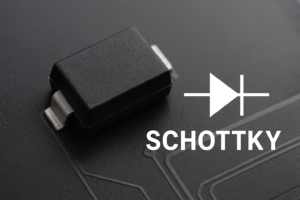
We choose a Schottky diode not simply because it can “block” reverse current—any diode can do that—but because it performs this task more efficiently and with better overall characteristics.
Recommended models: SS14 / BAT54 / MBRS340, all available in the OPL.
| Features | Standard Diode | Schottky |
| Forward voltage drop | ≈0.7V | ≈0.3V |
| Fast switching response | Normal | Fast |
| Low-voltage systems | Normal | Suitable |
Extension board Quick Prototyping-Seeed Fusion
After finalizing your schematic, Seeed Fusion PCBA service helps you:
1. Get official XIAO design verification;
2. Receive prototype boards within 7–15 days;
-
- Free functionality testing;
4. Ensure reliability through DFA review to save time and effort.
Conclusion
A simple Schottky diode can eliminate USB↔VIN backfeeding and secure stable power switching.
Combined with Seeed Fusion’s fast PCBA and testing, you can validate designs quickly, save development time, and ensure project success.
Seeed Fusion 30% off PCBA
If you’re building with Seeed XIAO modules, don’t miss our current Fusion PCBA Sponsorship Program.
✔️ 30% off PCBA for designs using XIAO modules
Ideal for expansion boards, sensor nodes, wearables, IoT devices, and rapid prototyping.
✔️ Free DFA Review & Function Testing
We check your design for manufacturability and test your assembled boards before shipping.
✔️ Fast Turnaround: 7-15 Bussiness Days
Perfect for makers, startups, and engineers who need reliable prototypes ASAP.
About Author

I am curious why the Schottky diode isn’t already installed on the Expansion Board if it is so important and so easy to implement? Why should the end user be responsible for something that should have been included in the original design of the Expansion Board? I am confused on the design logic here.
This article discusses the design considerations for creating an expansion board based on the XIAO. Seeed’s official expansion boards include reverse-current protection. If your custom expansion board exposes both USB and an external 5V input, and you cannot ensure that users won’t connect both at the same time, it is recommended to include reverse-current protection in your design.