Case Study Blog for Cliff Stability Project in UK
A community-led cliff stability project on the south coast of England uses LoRaWAN sensors and Seeed Studio’s SenseCAP S2120 to monitor ground movement, soil conditions, and hyperlocal weather. The data supports early warnings, digital twin modelling, and safer, data-driven cliff stabilisation planning.
Coastal landslips are a growing risk across the UK, affecting hundreds of thousands of properties and placing increasing pressure on communities exposed to extreme weather and climate change. On the south coast of England, a residential community facing repeated cliff instability adopted a community-led, data-driven approach to better understand and manage this risk.
The solution was designed and deployed by Thingitude, using a LoRaWAN-based monitoring system to continuously track ground movement, soil moisture, groundwater levels, and on-site weather conditions. SenseCAP S2120 8-in-1 LoRaWAN Weather Sensor was chosen and deployed to provide accurate, ultra-local weather data, enabling precise correlation between rainfall events and changes in cliff conditions.
By combining real-time IoT data with historical and newly conducted geological surveys, the project is building a digital twin of the cliff. This enables early warning alerts for residents and supports safer, more informed cliff stabilisation planning. Designed to be scalable and cost-effective, the approach provides a practical template for other landslip-prone communities across the UK.
Solution: Community-Led Cliff Stability Monitoring in the UK Using Seeed’s LoRaWAN Sensors
Participating Partner: Thingitude
Seeed Products Used: SenseCAP S2120
Industry: Smart Infrastructure / Environmental Monitoring
Solution Deployed in: South Coast of England, United Kingdom
Background
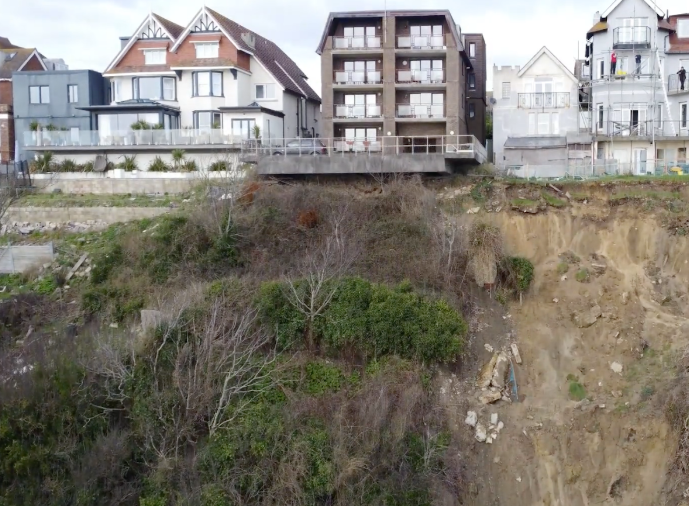
Land slips pose a serious and growing risk to communities across the UK, with over 350,000 properties estimated to be vulnerable. This challenge is particularly acute in coastal regions, where a combination of soft geology, heavy rainfall, and climate change is accelerating cliff erosion.
On the south coast of England, a residential community sits both above and below a steep coastal cliff. In 2024, following a period of heavy rainfall, part of the cliff collapsed. Material from beneath properties at the top slid into the back gardens of homes below, causing physical damage and leaving residents living with ongoing uncertainty and fear of further collapse.
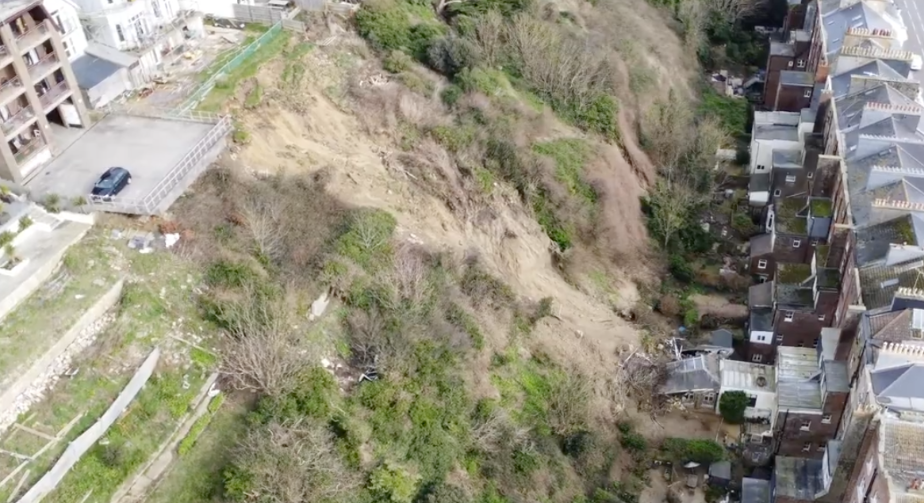
While this specific incident is local, the underlying issue is national and increasingly global. Landslips affect coastal and hillside communities across the UK, and existing mitigation approaches are often reactive, slow, and prohibitively expensive.
In response, local residents formed a community led action group called HASTE, with a bold goal to develop a data driven, repeatable approach to cliff monitoring and stabilization that could be reused by other at-risk communities.
Challenges: High Costs, Slow Responses, and Limited Data
Traditional approaches to landslip mitigation face several critical limitations:
- High upfront engineering costs, often running into millions
- Lengthy assessment timelines, delaying meaningful action
- A strong focus on liability and responsibility, rather than prevention
- Limited access to continuous, site-specific environmental data
Although historical geological surveys existed, they provided only static snapshots, not real time insight into how the cliff responds to rainfall, groundwater changes, and seasonal weather patterns.
The community recognized that many of the required skills already existed locally and that modern IoT sensor technology could deliver the missing data at a fraction of the cost of traditional monitoring systems.
Solution: A LoRaWAN-Based Digital Twin of the Cliff
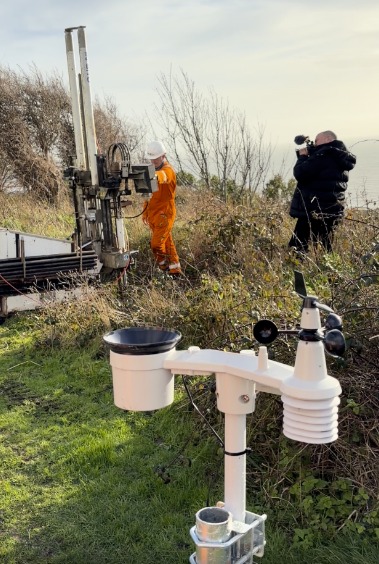
To deliver this solution, the HASTE community partnered with local experts, including Thingitude, an Internet of Things (IoT) consultancy founded by Mark Stanley.
The solution combines existing geological surveys, a new professional site survey by In-Situ, and continuous real-time monitoring using IoT sensors. Instead of relying on occasional inspections, the project introduces an always-on monitoring system that captures how the cliff behaves throughout the year.
A range of sensors has been installed at carefully selected locations along the cliff to measure the main factors that influence stability:
- Tilt sensors detect small movements in the ground that may indicate early signs of instability
- Water pressure sensors monitor groundwater levels and changes in the water table
- Soil moisture sensors measure how wet the soil is at different depths, helping identify saturation risk
- SenseCAP S2120 provides ultra-local weather data, including rainfall, temperature, humidity, wind speed, wind direction, and air pressure
Together, these sensors provide a complete picture of the environmental and ground conditions that affect the cliff, especially during and after heavy rainfall.
The sensors transmit data using a community LoRaWAN network established by Thingitude across the region. LoRaWAN was chosen because it offers:
- Long-range communication, suitable for challenging coastal terrain
- Low power consumption, enabling long-term outdoor operation
- Reliable data transmission with minimal maintenance
The data is sent to a cloud-based platform, where it is automatically stored, visualised, and analysed. Dashboards allow both engineers and community members to access up-to-date information without needing specialist technical skills.
By combining real-time sensor data with historical and newly collected geological information, the project is building a digital twin of the cliff. This digital model represents how the cliff responds to different environmental conditions over time.
As more data is collected, the digital twin will help:
- Understand how rainfall and groundwater affect cliff stability
- Identify early warning signs of increased landslip risk
- Evaluate different cliff stabilisation design options
- Reduce uncertainty before committing to costly engineering works
In addition to long-term analysis, the platform also functions as an early warning system. If ground movement or environmental conditions change in a way that increases risk, alerts can be generated to notify residents living both above and below the cliff. While long-term stabilisation plans are still being developed, this system already provides greater awareness and peace of mind for the community.
Why Seeed Studio?
For this community-led cliff monitoring project, Thingitude chose and deployed our SenseCAP S2120 to support reliable, long-term environmental data collection in a challenging coastal environment. The SenseCAP S2120 plays a key role in the solution by providing accurate, ultra-local weather data directly from the site.
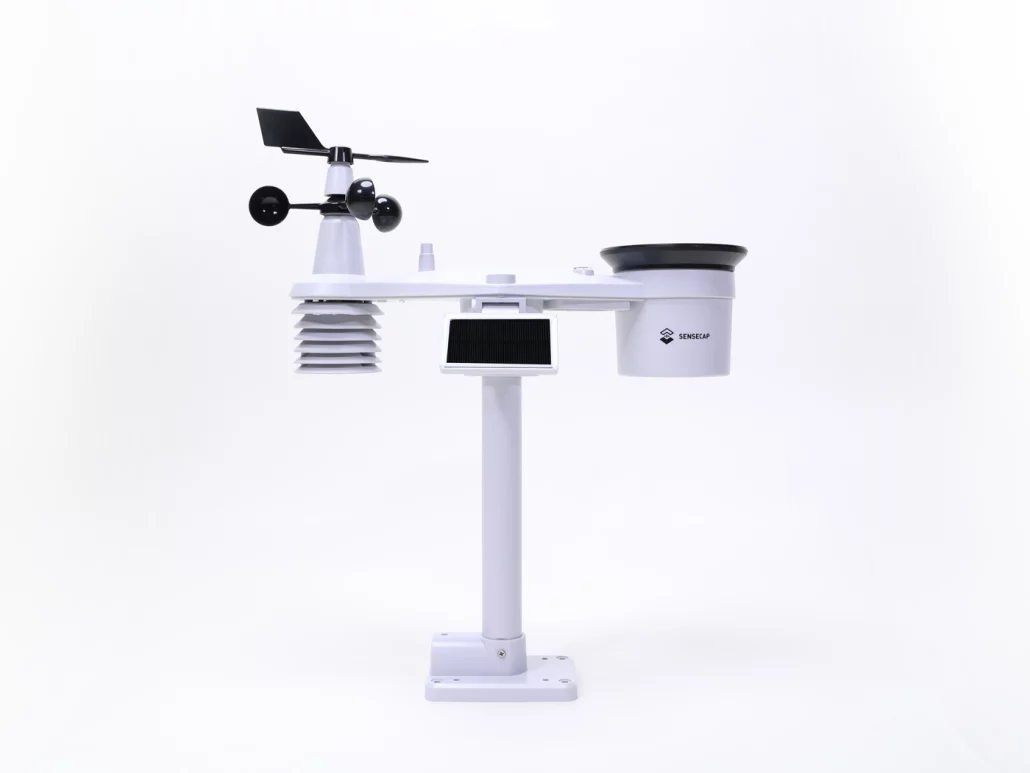
The SenseCAP S2120 is an 8-in-1 LoRaWAN weather sensor designed to deliver hyperlocal weather insights with minimal maintenance. It measures critical parameters such as rainfall, temperature, humidity, wind speed, wind direction, and air pressure data that is essential for understanding how weather conditions influence cliff stability and ground movement.
In this project, the SenseCAP S2120 enables the community and engineers to move beyond regional weather data and instead rely on site-specific measurements taken directly at the cliff. This level of accuracy is particularly important when analysing rainfall-driven landslip risk, where even small differences in precipitation can significantly affect soil saturation and groundwater levels.
Why SenseCAP S2120 Was the Right Fit?
It is:
- Ultra-low power consumption, supporting long-term outdoor deployment with minimal maintenance
- Reliable LoRaWAN connectivity, suitable for remote and exposed coastal locations
- Built-in Bluetooth, enabling easy configuration, OTA updates, and remote device management
- Industrial-grade, weather-resistant design for continuous operation outdoors
- Flexible multi-scenario use, supporting environmental monitoring, infrastructure safety, and climate resilience projects
By integrating the SenseCAP S2120 with ground movement, soil moisture, and groundwater sensors, the project benefits from a complete and accurate environmental dataset. This data forms a critical layer of the cliff’s digital twin and supports both early warning alerts and long-term engineering analysis.
Through this deployment, our SenseCAP ecosystem demonstrates how reliable, scalable IoT hardware can empower communities and solution providers to address real-world environmental and infrastructure challenges in a practical and cost-effective way.
SenseCAP in Action: Proven Performance in Global Climate Monitoring Projects
Beyond this UK cliff stability project, Seeed Studio’s SenseCAP technology is already being used in globally recognized climate and environmental monitoring initiatives, demonstrating its reliability in some of the world’s most challenging environments.
In 2025, the Internet Society Kyrgyz Chapter and its partners were awarded the International Mountain Future Award 2025, presented as part of the Mountain Partnership of the United Nations. The award was announced on International Mountain Day, recognizing one of the most innovative initiatives addressing climate change and glacier preservation in high-altitude regions.
For that project, the team chose and deployed the SenseCAP S2120 8-in-1 LoRaWAN Weather Station to enable hyperlocal weather and microclimate monitoring in remote, mountainous terrain. Powered by LoRaWAN® connectivity, the deployment supports long-range, low-power data transmission, making it well suited for off-grid and hard-to-access environments such as the Pan–Third Pole region.
This recognition highlights a critical challenge in climate science, less than 10% of weather stations globally operate above 2,000 meters, and only around 5% above 3,000 meters. By helping close this data gap, SenseCAP-enabled deployments contribute directly to climate resilience, disaster-risk forecasting, and environmental protection.
We are proud that the same SenseCAP S2120 technology used in high-altitude glacier monitoring is also supporting community-led infrastructure resilience projects, such as this cliff stability initiative in the UK. Together, these projects demonstrate how open, secure, and scalable IoT solutions can deliver real-world environmental impact from mountain regions to coastal communities.
Project Status and Early Insights
The project is currently in its early deployment stage. The monitoring system has been installed and is actively collecting data. As a full seasonal cycle has not yet been completed, it is too early to measure long-term outcomes such as reduced landslip risk or cost savings.
However, important foundations are already in place:
- Continuous real-time monitoring is operational
- The LoRaWAN network is stable and reliable
- Early warning alerts are available
- Engineers now have access to site-specific data
Scalability and Future Plans
Their plan is to prove and refine this approach at the current site, then replicate it at other landslip-prone locations across the UK. By using standard IoT and LoRaWAN technologies, the solution is designed to be scalable, adaptable, and reusable for other communities.
Supporting the UN Sustainable Development Goals (SDGs)
This project contributes to the following UN SDGs:



SDG 9 – Industry, Innovation and Infrastructure
SDG 11 – Sustainable Cities and Communities
SDG 13 – Climate Action
By improving resilience to climate-related environmental risks, the project supports safer and more sustainable communities.
Partner Introduction: Thingitude
Thingitude was founded by Mark Stanley in 2016, Thingitude is an award-winning small business based in Hastings (UK) that primarily helps Regional Government and Local Government use the Internet of Things (IoT) to deliver more efficient operations and improve services for their customers. It offers consultancy, training, workshops, technical support, and bespoke IoT solutions.
Mark Stanley is an advocate for community-led innovation with smart technology, and UK ambassador for The Things Network. Consequently, Thingitude is actively involved in community projects across the UK, including a crowd-funded hydro-electric plant, a personal safety initiative, sewage spill monitoring, and recently cliff stabilization.
Thingitude has helped over 40 startup businesses bring their IoT solutions closer to market-readiness, through its work with Digital Catapult, the Welsh Government, and regional innovation networks
To date Thingitude has also hired 18 young people and given them their first paid work in the tech industry.
🌐 Website: https://thingitude.com
📧 Email: [email protected]
About Author
