Wearable BLE + LoRaWAN Trackers: The Ultimate Hybrid for Seamless Indoor Personal Safety
Why Smarter Tracking Is Key to Personal Safety Today?
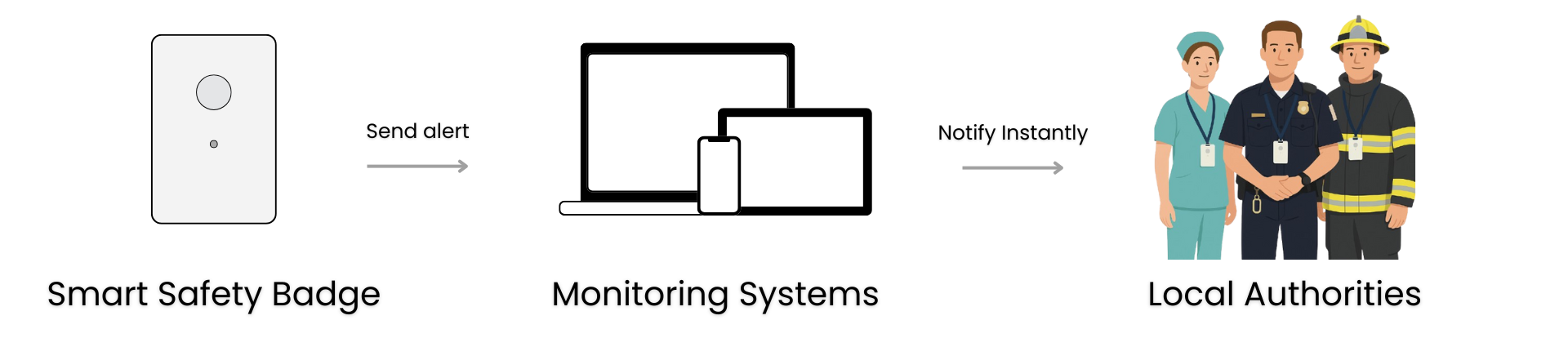
From workplace hazards to ageing populations, traditional tools—CCTVs, walkie-talkies, even mobile phones—can’t keep up. In 2025 and beyond, smarter solutions like Bluetooth Low Energy (BLE) beacons and LoRaWAN safety devices are redefining personal protection with faster responses and safer environments.
What is a Wearable BLE and LoRaWAN Location Tracker?
A wearable BLE and LoRaWAN location tracker, often called a Smart Safety Badge, works as part of an ecosystem of BLE beacons, the badge itself and LoRaWAN gateways. Together, they combine two proven wireless technologies to deliver accurate positioning and instant emergency alerts through a built-in panic button. For solution providers, this hybrid approach offers the reliability and scalability needed to support a wide range of safety and tracking applications.
What is Bluetooth Low Energy (BLE)?
BLE is a wireless communication standard designed for short-range, low-power data exchange. Unlike classic Bluetooth, BLE focuses on energy efficiency, which allows devices like beacons and trackers to run on small batteries for months. When paired with a Smart Safety Badge and LoRaWAN gateways, BLE beacons form the foundation of precise indoor tracking.
- Indoor Precision: BLE is widely used for room-level or zone-level positioning. By measuring the signal strength (RSSI) from multiple BLE beacons, often referred to as BLE beacon location tracking the system can triangulate a tracker’s exact location.
- Low Cost, Easy Deployment: BLE beacons are inexpensive and easy to install, making BLE one of the most accessible indoor positioning techniques.
- Low Power Consumption: BLE devices are highly energy-efficient. Even with a panic button, wearable trackers can often run for 3-12 months depending on usage frequency.
What is Long Range Wide Area Network (LoRaWAN)?
LoRaWAN is a low-power wireless protocol designed to send small amounts of data efficiently over long distances. In the context of Smart Safety Badges, LoRaWAN acts as the communication backbone that transmits data and panic alerts from the wearable to the server, without relying on Wi-Fi or cellular.
- Ultra-Low Power: Devices can run on a single charge for months to years, unlike cellular-based trackers that require high levels of electricity and constant recharging, reducing maintenance and replacement costs.
- Secure and Scalable: Each LoRaWAN large numbers of devices per gateway. Actual capacity depends on data upload frequency, and multiple gateways can be used to cover wider areas or higher traffic.
- Reliable Transmission: By design, LoRaWAN handles small, critical data packets (like alert signals and beacon IDs) with high reliability, ensuring emergency messages always get through.
- Lower Operating Costs: Compared to Wi-Fi or cellular networks, LoRaWAN is far cheaper to operate, allowing large-scale safety deployments without high recurring fees.
In Seeed’s ecosystem, LoRaWAN gateways are the , offering long-range communication and an independently managed infrstructure that transmits data from the Smart Safety Badge to the cloud, completing the link between BLE beacons, the badge, and monitoring platforms.
Read more in How Far Can BLE and LoRaWAN Signals Reach.
How BLE + LoRaWAN Work Together
When the panic button on a Smart Safety Tag is pressed, the device scans nearby BLE beacons and captures their identifiers (MAC addresses) and signal strengths (RSSI), forming the basis of BLE beacon location tracking. Because these beacons are pre-installed at fixed points across the campus or site, the data provides precise location context.The tag then transmits this information through the LoRaWAN network, where gateways forward it to the server. The server processes the data in real time, maps the wearer’s location, and instantly alerts the relevant response teams.
See our deployment guide on Planning BLE Beacons and LoRaWAN Gateways Placement for setup tips.
Why Smart Safety Badge should use LoRaWAN and BLE?
BLE beacons, the badge, and LoRaWAN gateways are designed to work together, solution providers can deliver accurate indoor positioning through a reliable, low-power data and cost-effective approach. BLE beacons provide room-level accuracy, while LoRaWAN ensures that location data and panic alerts are sent to the server without relying on Wi-Fi or cellular. This reduces maintenance with long battery life, supports large-scale deployments at low cost, and provides a flexible safety solution.
Comparing Tracking Methods
| Method | Pros | Cons |
| GPS + Cellular | Accurate outdoors (meter-level precision), globally available | Poor indoors, prone to blind spots in dense urban/underground areas, high battery drain, expensive costs |
| Wi-Fi Positioning | Works indoors where Wi-Fi is dense, uses existing infrastructure | Building-level accuracy; drains more power than BLE, incurs ongoing bandwidth costs |
| RFID / NFC | Extremely low-cost, passive tags need no batteries, reliable for short-range uses (e.g. access control) | Only works at very close range (cm to a few meters), not suitable for continuous tracking or safety alerts |
| Ultra-Wideband (UWB) | Very high accuracy, excellent for indoor asset tracking | Expensive hardware, higher power consumption, limited scalability for large deployments |
| BLE + LoRaWAN | Room-level indoor precision (BLE) with reliable, low-power data transmission (LoRaWAN). Long battery life, scalable, and cost-efficient for large deployments. | Requires beacon infrastructure for BLE, and LoRaWAN gateways must be installed for coverage. |
Situations Where BLE + LoRaWAN Saves Time and Lives
These Smart Safety Badges come into play across many scenarios: in schools, it provides discreet panic systems required under laws like Alyssa’s Law, enabling faster response to emergencies. In workplaces, they protect lone or temporary workers in hazardous areas by offering real-time tracking and instant alerts. In elderly care, they help monitor dementia patients, psychiatric ward residents, or seniors prone to wandering, ensuring caregivers can intervene quickly when needed.
Custom BLE and LoRaWAN Location Tracking for Personal Safety
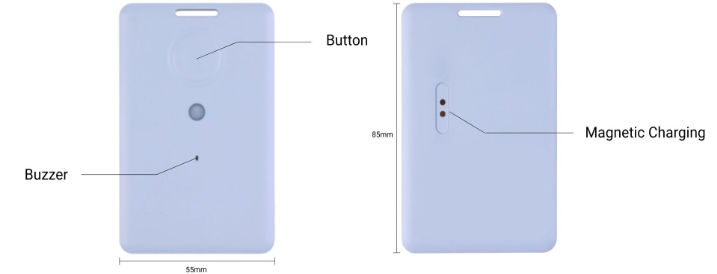
Seeed’s LoRaWAN Tracking Badge brings together BLE and LoRaWAN into one reliable, scalable solution for personal safety. Seeed delivers the full ecosystem—BLE beacons, LoRaWAN Tracking Badge, and gateways—ready for integration into safety and emergency systems. The badge scans signals from BLE beacons installed across the campus and transmits the data via LoRaWAN, enabling real-time indoor positioning and instant emergency alerts without depending on Wi-Fi or cellular.
Unlike off-the-shelf wearables, Seeed offers a complete, customizable ecosystem. Solution providers can deploy not only Seeed’s LoRaWAN Tracking Badge but also Seeed’s BLE beacon and LoRaWAN gateways, ensuring smooth integration and consistent quality.
The badge can also be integrated with existing safety and emergency systems while being tailored for different client needs:
- Configurable Triggers: Define button-press patterns that match specific safety protocols.
- System Integration: Customize firmware for compatibility with existing IT platforms, dashboards, or safety workflows.
- Design Flexibility: White-label options for casing, colors, and packaging to align with enterprise branding.
- Power Choices: Select extended battery options to match different deployment needs, balancing longevity with device size and weight.
- Global Compliance: Certified for major regions (FCC, CE, TELEC, SRRC) to support worldwide deployments.
By combining the Tracking Badge with Seeed’s beacons and gateways, solution providers can provide a solution that is customizable, scalable, and ready for diverse environments from schools to factories to healthcare facilities.
Safety needs are evolving—make sure your solutions evolve too. Discover how Seeed can power your next deployment.
About Author
