LoRa Module for Drone Light Shows: How E5 Module Delivering RTK Corrections Across the Fleet
For a drone light show operator, a formation must hold its shape as the aircraft move. Position errors can blur an outline or pull individual lights away from the intended image. Accurate position feedback helps the flight-control system keep each aircraft on its planned path.
Many solution providers in the drone industry are using the Wio-E5 LoRa module in their wireless communication designs. In drone light shows, one application is broadcasting real-time GNSS correction data across a fleet, providing the reference information that onboard RTK receivers use for precise positioning.
The module’s contribution is the wireless connection between the correction-data source and the aircraft. It delivers a reference-data input that the RTK positioning process depends on.
How LoRa Delivers the Reference Data for RTK Positioning
GNSS, or Global Navigation Satellite System, is the umbrella term for satellite navigation systems such as GPS. Each aircraft receives satellite signals through its own GNSS antenna and receiver.
RTK, short for Real-Time Kinematic, adds reference data from a base station or reference-station network. The aircraft combines that data with its own satellite observations to calculate a more precise position.
RTK uses carrier-phase measurements and resolves the number of complete signal wavelengths between satellites and receivers. Reference observations help reduce shared errors and support this calculation.
The functional data path is straightforward:
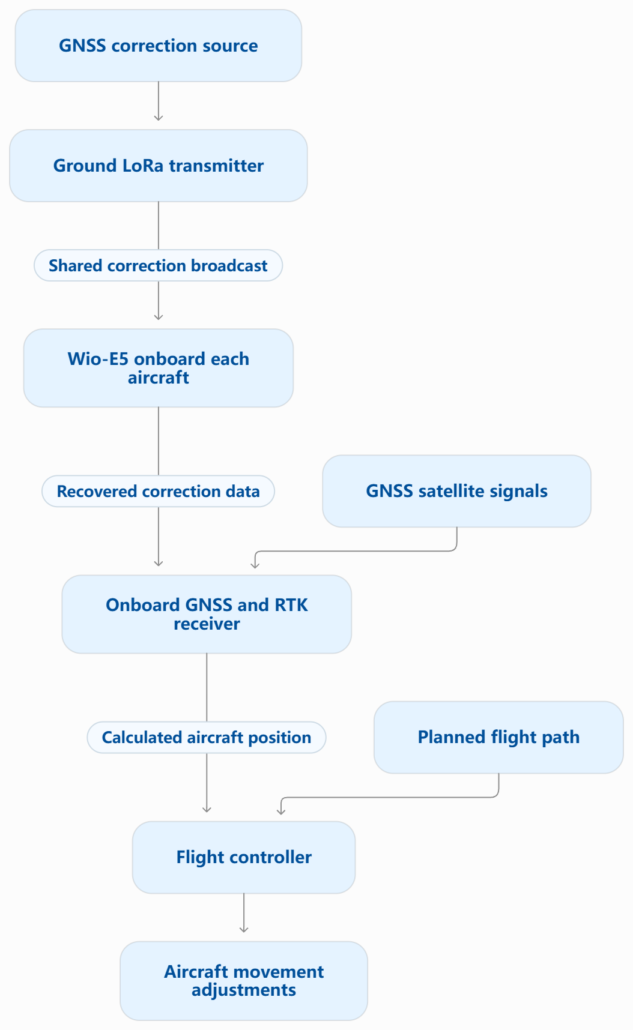
The ground system obtains the reference data. In a typical RTK implementation, this information includes reference-station coordinates and satellite observations, often carried in RTCM messages.
The LoRa link distributes it. A ground transmitter sends the data as radio packets. On each equipped aircraft, the module receives and demodulates the signal. Application firmware then passes the recovered data to the onboard positioning system.
Each aircraft calculates its own position. Its RTK receiver combines the incoming reference information with locally observed satellite signals. The flight controller uses the resulting position alongside the planned path and other onboard measurements.
Why a Shared LoRa Broadcast Fits This Task
Nearby aircraft can use the same reference data while calculating different positions. A broadcast therefore lets multiple receivers listen to the same transmission. Adding a receiving aircraft does not require a separate copy of that shared correction message to be transmitted specifically for it.
For the operator, this architecture supports a fleet-wide positioning input. Each aircraft receives a common reference and combines it with its own observations.
LoRa’s chirp spread spectrum modulation provides a configurable trade-off between receive sensitivity and data rate. For correction delivery, the useful design target is enough link margin and throughput to deliver the selected messages while they remain useful to the RTK receiver. Radio settings, packet handling, and the correction stream are designed together.
The E5’s role here is therefore centered on reception and data transfer. Its RF capability supports the link; its interfaces and programmable MCU provide resources for integration. For an airborne radio, both sides of the connection matter: transmitting data with enough power and detecting the signal when it reaches the receiver. Wio-E5 supports transmit power up to +22 dBm at 915 MHz, giving designers an output-power option when budgeting a ground-to-air or air-to-ground link. On the receiving side, its specified sensitivity reaches -136.5 dBm at SF12 and 125 kHz bandwidth. For a correction-data application, receive sensitivity helps determine how weak an incoming signal can become while its data can still be recovered.
Power consumption deserves attention during reception too. The module’s typical receiver-plus-MCU current is 6.7 mA at 125 kHz bandwidth on 868/915 MHz, providing a useful figure when budgeting for an aircraft radio that listens for correction broadcasts. For applications with planned inactive periods, sleep current can fall to 2.1 µA with the watchdog enabled, reducing the energy used while the communication function is idle.
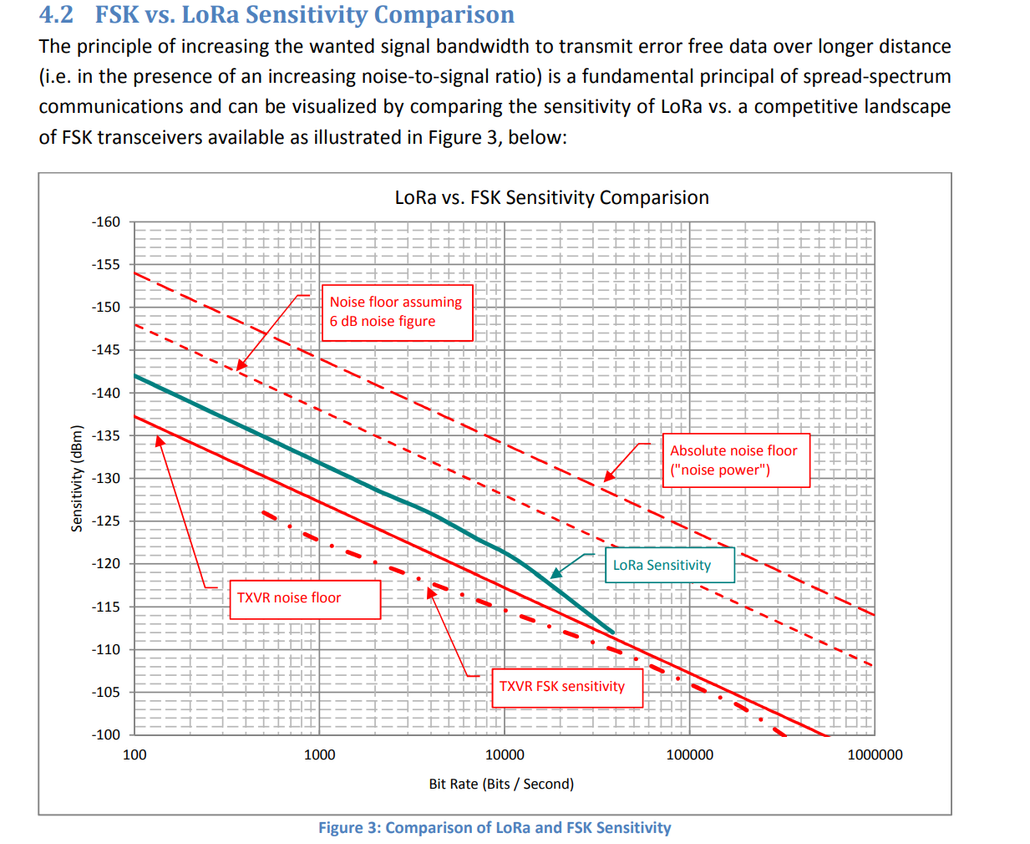
LoRa offers a configurable trade-off between data rate and receiver sensitivity, allowing the radio link to be tailored to the application. Source: Semtech, AN1200.22, Figure 3.
Meet the Wio-E5 LoRa Module
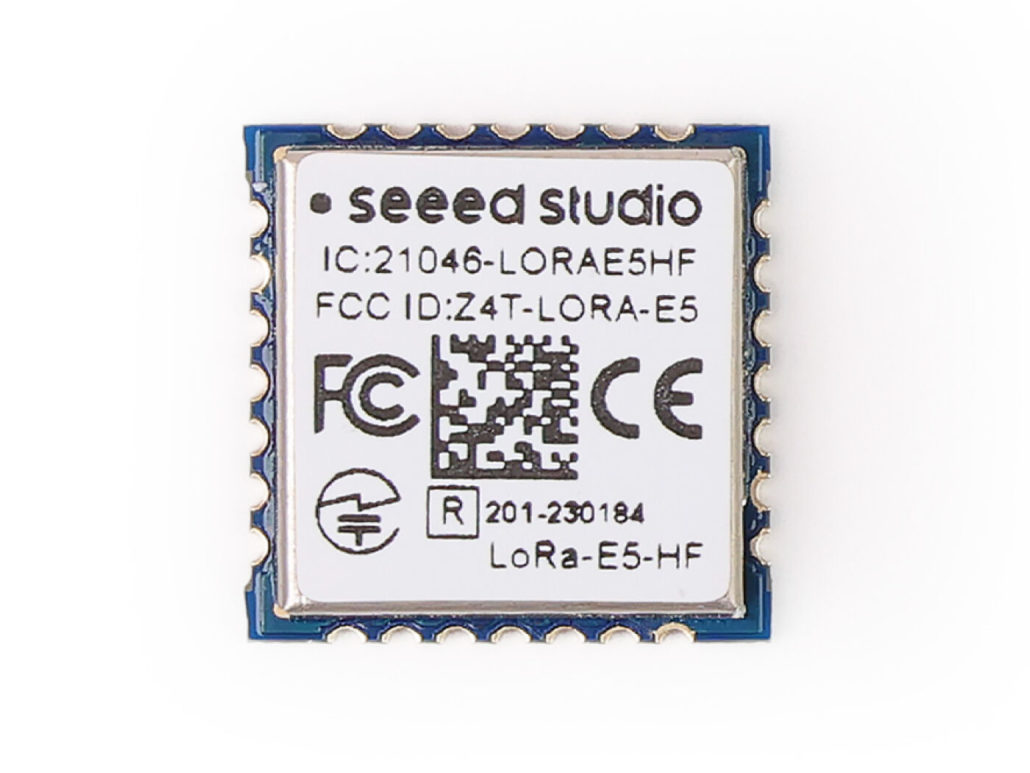
The Wio-E5 LoRa module brings the radio and processing resources together in a small package. It combines an STM32WLE5JC system-on-chip, an Arm Cortex-M4 MCU, and an integrated LoRa radio. With support for both LoRa and (G)FSK modulation, it gives teams options when developing the wireless connection between aircraft and ground equipment.
Beyond the low power consumption and high transmit power discussed above, which support energy-efficient wireless communication during drone fleet rehearsals and performances, the E5 also offers several other strengths. At 12 × 12 × 2.5 mm, Wio-E5 uses a 28-pin surface-mount package that occupies little board space. Its integrated MCU and radio give the communication function a compact foundation alongside the aircraft’s positioning, sensing, and control electronics.
Once a packet arrives, its data needs to reach the next component. Wio-E5 provides UART, I²C, SPI, ADC, and GPIO interfaces for connections to host controllers and peripherals. In a correction-data design, UART offers a practical route for passing recovered data to a positioning receiver, either directly or through a host controller, depending on the application’s hardware and firmware.
For LoRaWAN products, the factory AT-command firmware lets a host controller configure and operate the module over a serial connection. Teams developing an application-specific LoRa link can instead program the onboard MCU to handle tasks such as packet buffering, framing, and data transfer. This gives developers control over how information moves between the radio and the rest of their product.
Outdoor equipment also needs components with clearly specified operating conditions. Wio-E5 supports an operating temperature range of -40°C to +85°C and carries FCC, CE, IC, and Telec certifications. These give teams temperature specifications and radio certification resources to work with as they prepare products for different operating environments and markets.
Beyond the hardware itself, Seeed supports ongoing product builds with consistent module production, dependable delivery, and after-sales technical support. For teams purchasing the Wio-E5 LoRa module across successive production runs, that continuity matters alongside the radio specifications.
Get your first Wio-E5 Wireless Module for just $6.49 now!
Related Communication Needs Across Civil UAV Operations
The customer’s use of Wio-E5 shows how a communication module can support a commercial drone product through one clearly defined task: delivering correction data to the positioning system.
Fleet hardware also needs continuity beyond an initial build. Later production runs and replacement aircraft depend on a repeatable module supply. Seeed supports customers with consistent module production, dependable delivery, and technical resources for ongoing integration.
We also see opportunities for similar wireless links across other civil UAV applications. For example, a surveying drone may need RTK correction data as it maps a site, while a drone flying over a coastal monitoring area may collect readings from scattered sensor buoys. If a buoy drifts away, exchanging position reports and data requests could help the field team locate and recover it. Each scenario gives the wireless link a specific job: getting useful data between equipment in the field.
Published research provides a concrete example of the latter two needs. A study of UAV-assisted marine monitoring developed a system in which a drone used LoRa to locate sensing buoys and retrieve their stored environmental measurements.
These applications raise the same practical question: beyond conventional telemetry radios or Wi-Fi, what compact, power-efficient options can support reliable data exchange between aircraft, ground equipment, and remote sensors? Exploring that question gives teams a clear starting point for evaluating a LoRa module.
Discuss Your Wireless Link with Seeed
Seeed is committed to helping IoT teams turn specific communication needs into working products, with accessible hardware, practical documentation, and manufacturing support.
Discover how the Seeed LoRa Modules supports your journey from early evaluation to real-world deployment, with setup guides, reference designs, SDKs, KiCad libraries, hands-on testing, and projects built by developers. Explore connectivity options across LoRa, Wi-Fi, BLE, GNSS, and more, then find the module and purchasing path that match your technical requirements, location, and development stage.
Explore the Wio-E5 LoRa module, visit the Wio module portfolio, or contact [email protected] to discuss your project.

About Author
