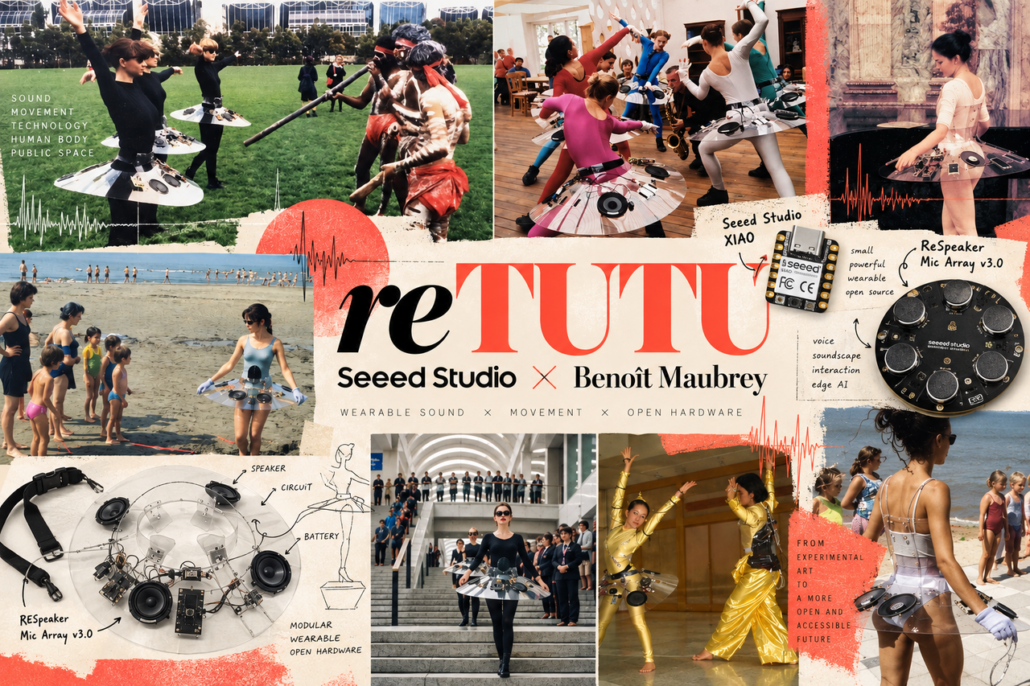
🔈From Shenzhen to Wuppertal, Germany: On October 31, 2026, we are partnering with sound artist Benoît Maubrey at the Repair & Share Festival to restore and reimagine 32 vintage Audio Tutus — wearable electroacoustic sculptures born in 1989 — powered by today’s open-source hardware.
In 1989, a German avant-garde artist sewed speakers into a ballet tutu.
More than three decades later, those skirts are coming back — this time to a repair festival in Germany, where we will help give them new circuits, new voices, and a second life on stage.
A Sound Sculpture You Can Wear
The Audio Ballerina is a series of wearable electroacoustic sculptures created by sound artist Benoît Maubrey. Each “Audio Tutu” is a complete sound installation in itself: built-in speakers, samplers, light-frequency controllers, preamplifiers, amplifiers, and radio receivers. Put it on, and your body becomes an instrument — movement, light, and radio waves all turn into sound.
Benoît Maubrey, German contemporary artist born in the United States, has been working with speakers, amplifiers, sensors, and discarded electronics since the early 1980s, calling his works “Electroacoustic Sculptures.” For him, the speaker is not just a device — it is a material, like wood or clay, that can shape bodies and spaces.
Recently, while clearing his archive near Berlin, Benoît uncovered 32 Audio Tutus spanning generations — from 1989 to today, all fully functional. With just a 12V 2Ah battery and a belt, they sing again.
Wuppertal's Repair & Share Festival is Here!
Repair & Share Festival · Event Details
- Date: October 31, 2026
- Venue: Utopiastadt, Mirker Straße 48, 42105 Wuppertal
- Organizer: Fab Region (Bergisches Stadtentwicklung), funded by the EU and the NRW Ministry of Environment
- Theme: “Dein Tag zum Entdecken, Selbermachen und Weiterlieben” — a day to discover, make, and keep loving
- Highlights: Participatory workshops, repair sessions, exhibitions, second-hand swap, vintage fashion, and a giant Reparatur-Café XXL — family-friendly for all ages
- Admission: Free. Bring one beloved broken item, and we’ll fix it together.
👉Register here: Repair & Share Festival — Free Eventbrite Registration
On October 31, 2026, the Repair & Share Festival takes over Utopiastadt in Wuppertal, Germany. Part of European Circular Week, the festival revolves around three simple but powerful words: Repair, Reuse, Share.
This festival is also the climax of a world record challenge in North Rhine-Westphalia (NRW). Throughout October, communities across NRW will mobilize to repair more items than ever before — saying no to disposable culture, and bringing repair and reuse back into everyday life.
The event is open to the local public, inviting everyone to roll up their sleeves and participate. The day before (October 30), the Fab City Gathering also takes place at Bergische Universität Wuppertal, bringing together city representatives, makers, and innovators from the global Fab City network to explore a more circular and sustainable future.
A circular economy doesn’t always start with making something new — it can start with treasuring what already exists. Repair is the most humble, and the most easily practiced, form of the circular economy. When something breaks, it doesn’t mean its life is over. Fix it, let the materials, the technology, and the memory keep flowing — that is itself a form of creation.
This is especially true for electronics. Many discarded devices only suffer from an aging battery, a loose connector, or a failed small component. We are used to constant technological upgrades, but rarely stop to ask: How long can an electronic artwork actually live?
Artist Benoît Maubrey’s Audio Ballerina is a powerful answer.
Born more than thirty years ago, this electronic dance skirt still produces sound today. It carries the bold imagination of its era — of sound, of the body, of electronic technology — and thirty-plus years later, it still has the possibility to create, to perform, to move people.
This is exactly why we wanted to collaborate with the artist. We believe that with open-source hardware, the Audio Ballerina can keep its original artistic soul while absorbing new technology and new interactive experiences — stepping back into public view in a brand-new way.
A 30-year-old electronic artwork doesn’t have to exit the stage because its technology is dated. Through repair, upgrade, and re-creation, it can return to the stage and forge new connections with today’s audiences.
The Workshop: Giving an Old Skirt a New Voice
Together with our co-organizers CSCP / Fab Region Bergisches Städtedreieck, we are bringing a hands-on repair workshop — “Repair & Re-sound: Give an Audio Ballerina a Second Life”.
The workshop flow is simple and practical:
- Check-up — Listen closely to find out what sonic abilities the skirt still holds
- Diagnosis — Identify the circuits and components that need repair
- Repair & Upgrade — Restore the original electronic structure, then add new connectivity with Seeed’s modern hardware
- Resound — Put the skirt on and let the audience hear, for the first time, the “upgraded old voice”
No hardware knowledge, no programming experience required. The goal of this workshop isn’t to “explain the theory” — it’s to let everyone complete a repair with their own hands, and actually put the skirt on and hear it sound.
Benoît will be on site in person, co-creating with our reSpeaker and XIAO series.
One Repair, Two Generations of Technology
The meeting between the Audio Ballerina and Seeed is no coincidence.
Just a few months ago, Benoît’s SPEAKERS ARENA won the Fab City Awards 2026 in the Technology category — a public sound stage made of 400 speakers that the public can plug into and play. Seeed Studio is a long-time sponsor and technology partner of the awards, providing product support, mentor resources, and lab connections to winning projects. In the SPEAKERS ARENA upgrade, our reCamera and reRouter added network connectivity and live video streaming — letting people from afar join the sound performance in real time.
Benoît had this to say about that collaboration:
“The Seeed technology was outstanding and essential for this artwork.”
This time, the same story takes a different form: instead of connecting to the internet, we’re plugging back into a 30-plus-year-old artwork. Repairing an Audio Tutu is using today’s hardware to extend the life of an old piece.
Why We Do This
At Seeed, we practice sustainability through concrete action — putting hardware into the hands of creators and communities, so that through their hands it becomes something the public can participate in, use, interact with, co-create, and enjoy.
The Audio Ballerina repair workshop is just one part of our presence at this festival. On site, Bianca, our EU Application Engineer, will also host two workshops:
- “Vibe Coding with Wio Terminal: New Life for Old Hardware” — learning to code with vintage devices
- “Off-Grid Communication with Meshtastic: Community Resilience in Action” — staying connected when the internet goes down
Both carry the same spirit: giving old devices a second life.
Robert, our Seeed Ranger/Techsmith for Germany, will also be on site to support — with German-language assistance available throughout the event.
Let the Old Voices Keep Ringing
What these vintage skirts will actually sound like — there is no fixed answer yet. The artist’s innovation of 30 years ago, carried forward by Seeed, will be shaped together with everyone willing to roll up their sleeves and make something new.
When repair replaces disposal, technology’s value is no longer just about faster iterations — it can also be about longer companionship. Let old technology keep making sound. Let old works dance again. This is where open-source hardware meets the circular economy.
