LeRobot v0.7.0 Opens New Possibilities for Robot Learning with Language, New Models, and Seeed reBot Arm B601-RS Support
A robot is picking up a red block when its operator changes the goal: “Put everything back in the box.” Understanding that request takes more than recognizing a few words. The system needs to interpret the scene, choose a next step and translate that step into motions the arm can execute.
LeRobot v0.7.0 brings these parts of robot learning closer together. Released by Hugging Face on November 5, 2026, it adds interactive language-guided rollouts, new robot models, larger-scale data and training workflows, and remote policy inference. For Seeed developers, it also expands reBot Arm B601 support to RobStride Dynamics alongside DAMIAO, with configurable single-arm and bimanual setups.
Our reading of this release is that its lasting value lies in the connections between these features. Language gives a task structure; demonstrations connect that structure to observations and actions; training turns those examples into a policy; deployment brings the policy back to a physical robot. Improving those connections makes it easier to investigate why an experiment works—and what to change when it does not.
Credit: Hugging Face / LeRobot. Official announcement
1. Language Becomes Part of the Robot’s Working Loop
For an operator, changing a task should be a practical interaction. In v0.7.0, interactive sessions keep the robot connection, policy weights and processors loaded between commands. That creates a more convenient setting for trying instructions and observing their effects.
Three commands illustrate different levels of interaction. /subtask changes the current instruction while the robot runs. /vqa asks a question about the observed scene. /autosteer supplies a higher-level goal so the system can select subsequent subtasks. The last two require a text-generating policy or an external vision-language model planner; the release’s language-in-the-loop explanation describes both options.
Consider “clear the table.” A planning layer might identify an object, select a container and issue a specific placement instruction. An action policy then needs to turn camera observations and robot state into appropriate movements. These are different responsibilities. A plausible plan is useful only when the action policy can carry out the resulting instruction in the physical scene.
This distinction gives developers a better way to examine a failure. If the robot selects the wrong object, inspect the observation and task interpretation. If it selects the right object but misses the grasp, examine the demonstrated behavior, camera coverage and control execution. Language makes the intended task easier to express and inspect; it also makes the boundary between planning and manipulation more visible.
An external VLM can supply high-level reasoning through an OpenAI-compatible API, served locally or remotely. This lets a team explore language planning without requiring the action model itself to generate text. Its instructions still need to describe behaviors the action policy can perform.
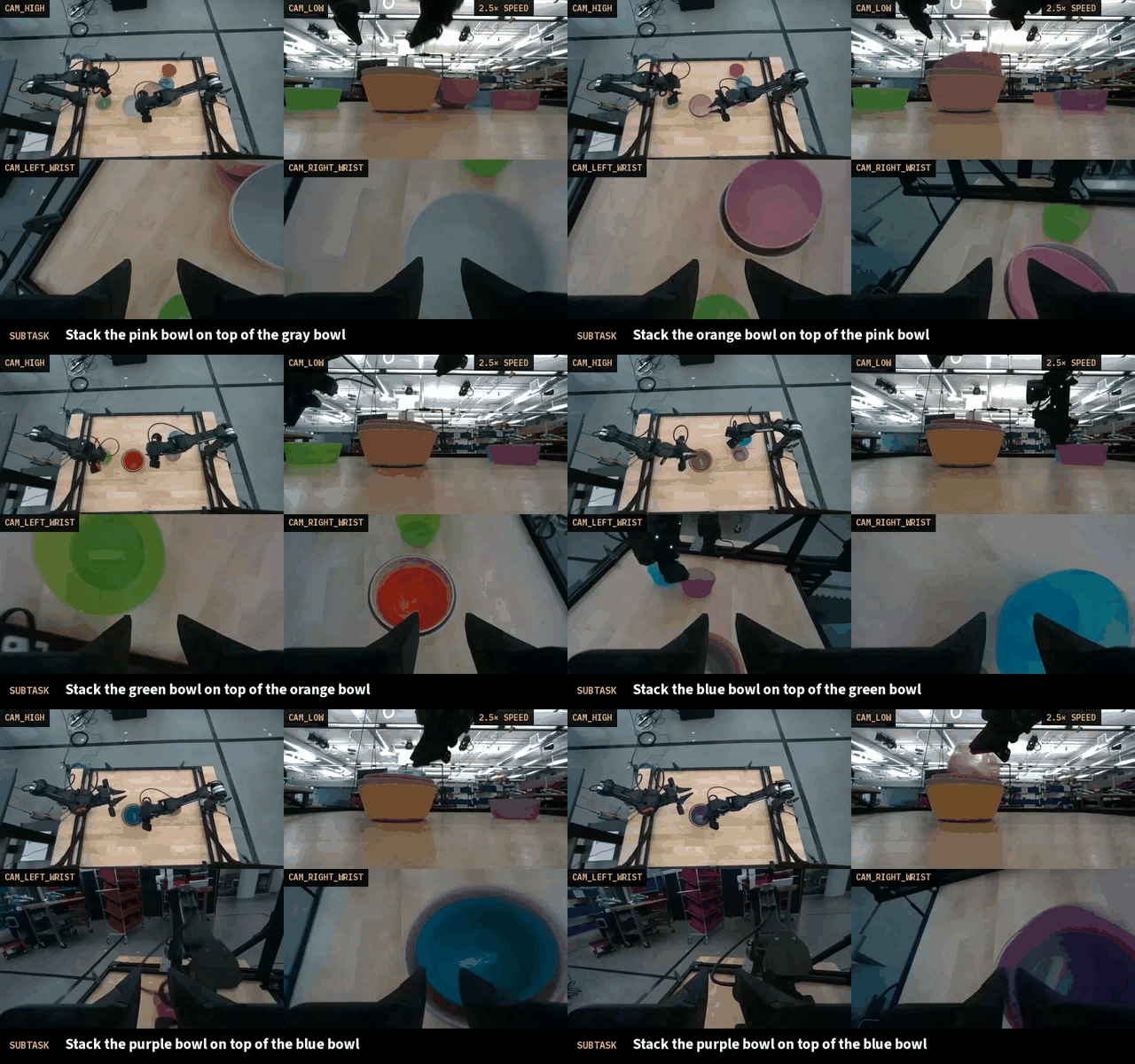
Credit: Hugging Face / LeRobot. Source
Why the Language Attached to Demonstrations Matters
Instructions also need to make sense during training. A recording of someone tidying a table contains several distinct behaviors: reaching, grasping, moving and releasing. Associating meaningful subtasks with the relevant observations makes the relationship between an instruction and an action more explicit.
The release includes recipe-driven language supervision and highlights FineART, a Scale AI and Hugging Face dataset with more than 40,000 bimanual episodes, 1,718 hours and over 533,000 subtask annotations. FineART-VLA extends π0.5 with a language head. The official description connects these annotations to a system that predicts a subtask in words and an action expert that carries it out.
For a smaller reBot project, the useful lesson is about structure. Consistent task descriptions and clearly identified transitions are worth planning before collecting a large volume of demonstrations. A collection of motions becomes more useful when another researcher can understand what the operator intended at each stage.
2. Data Infrastructure Changes How Quickly You Can Learn from an Experiment
As robot datasets grow, moving and decoding video can take substantial effort before training begins. That matters because robot learning is iterative: collect a behavior, inspect the examples, train, evaluate, then return to the data with a more specific question.
LeRobot v0.7.0 addresses several stages of this cycle. Its disk-less streaming reader fetches the video byte ranges needed for training from the Hub or a Storage Bucket. LanceDB support offers another storage path, keeping original MP4s as blobs rather than re-encoding them. GPU image augmentation moves transforms onto the accelerator. These changes address data access and preparation as well as model computation. See the official dataset and training overview.
The reported numbers need their context: Hugging Face reports 2.1–2.5× more samples per second with four DataLoader workers for the streaming reader, and 2.8× faster ACT training on H100 / 3.3× on A100 with GPU image transforms. These describe the upstream workloads, rather than measured speedups for a B601 or Jetson system.
The engineering implication is to identify which resource limits your experiment. Streaming reduces the need to stage an entire dataset locally, while its behavior still depends on data access. GPU augmentation addresses a different bottleneck from policy inference or motor control. Measuring these stages separately helps a team choose the relevant improvement instead of treating a training-speed figure as an end-to-end robot-performance claim.
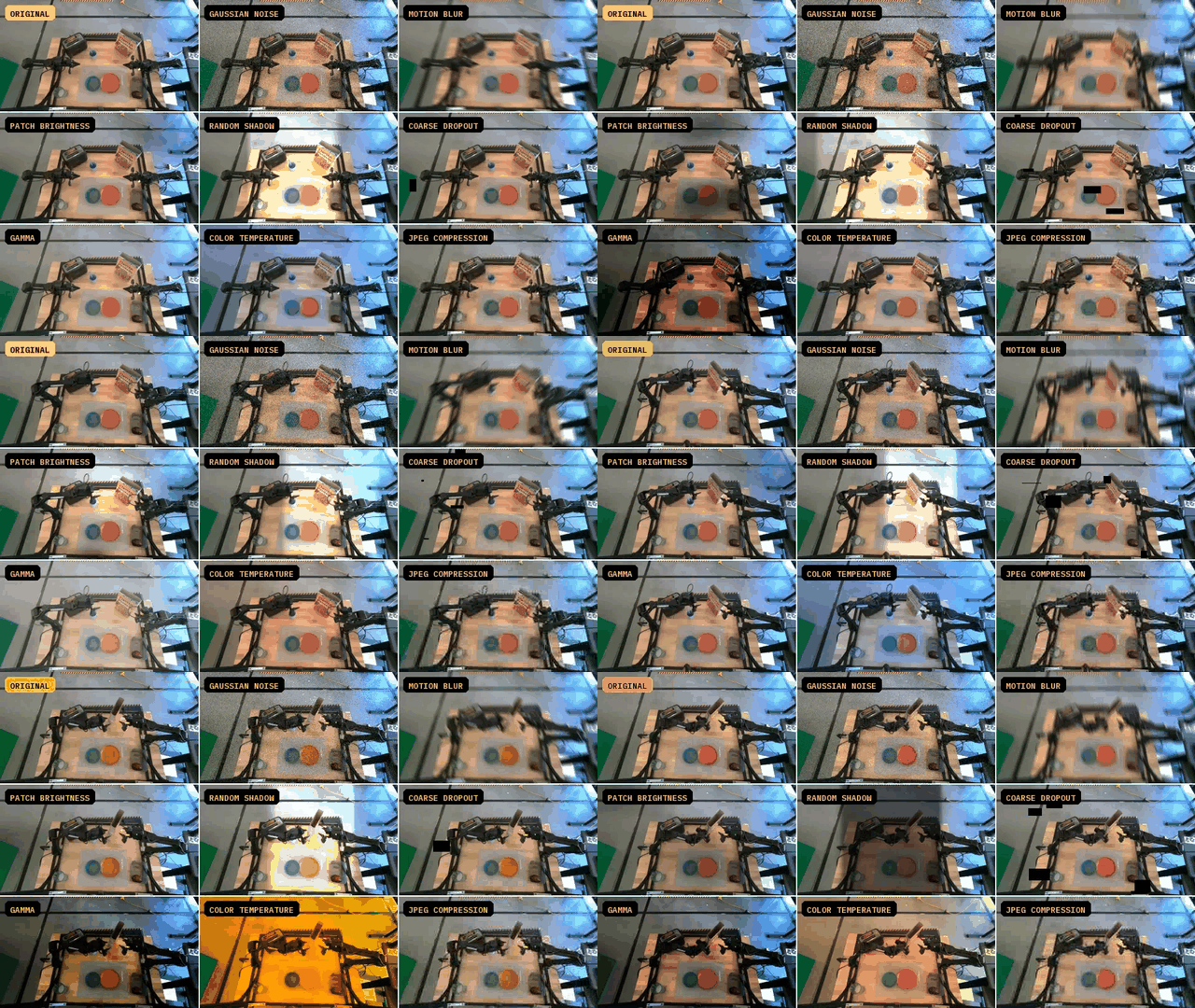
Credit: Hugging Face / LeRobot. Source
FSDP2, HSDP and distributed checkpoints support larger training jobs, alongside Trackio experiment tracking. For teams exploring large models, these infrastructure choices affect memory use, recovery and reproducibility. For a developer collecting an initial B601 dataset, careful demonstrations and an inspectable baseline remain the immediate priorities.
The wider data ecosystem also provides useful reference material. Examples from different camera arrangements, robots and tasks can help you decide what your own collection should record. Moving data between embodiments requires attention to the action representation and physical setup.
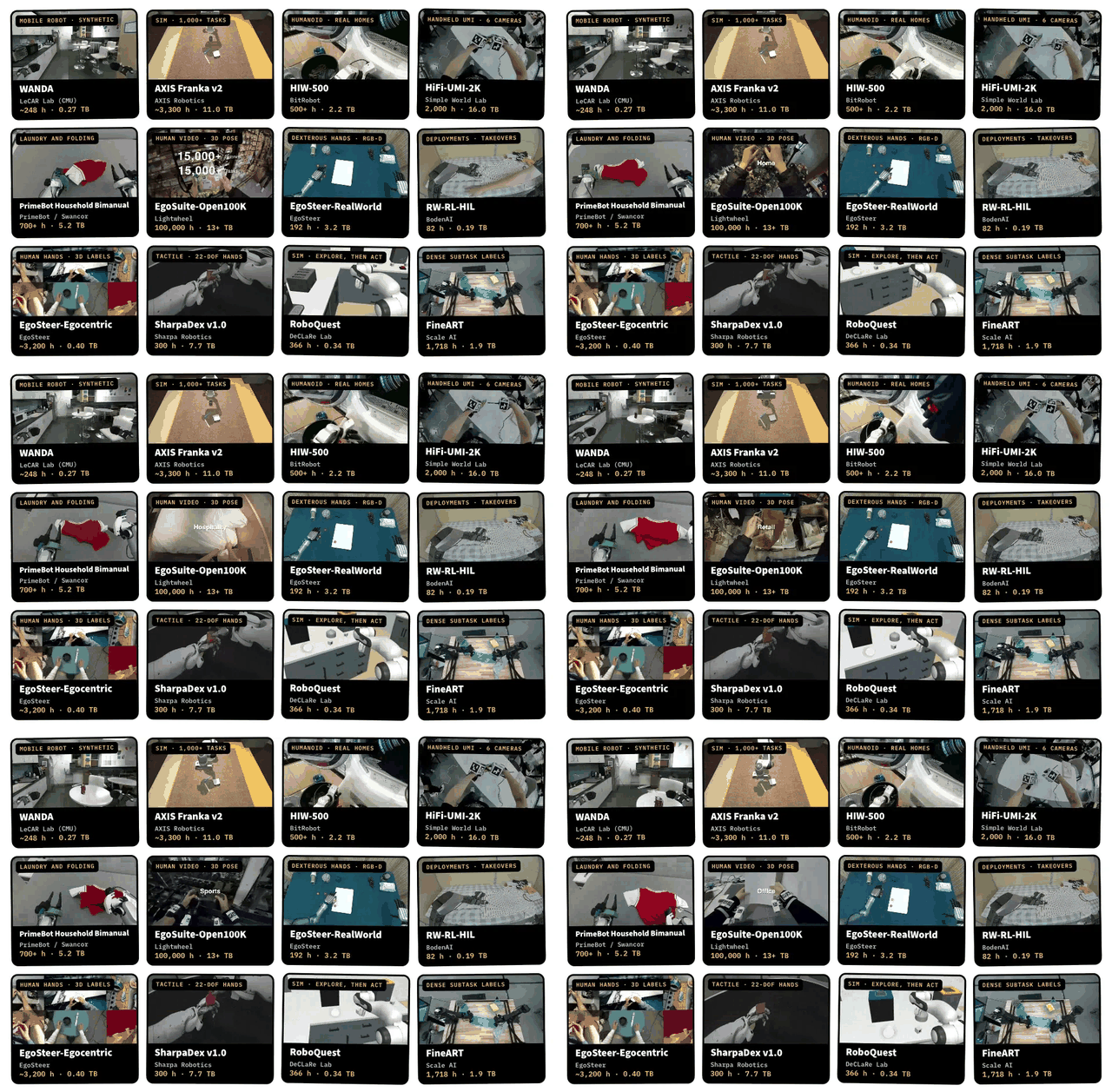
Credit: Hugging Face / LeRobot. Source
3. New Models Expand the Questions a Developer Can Ask
The release adds four world action models and four vision-language-action models. These categories describe useful research directions, although their approaches can overlap: a policy can combine language understanding, visual prediction and action generation in different ways.
A VLA connects visual observations and language to actions. World action models also investigate how predictions of future visual or latent states can inform action. That raises a practical question: what representation of the scene and its possible changes helps the robot choose its next movement?
The official model descriptions show why “world action model” encompasses several architectures:
| Addition | Distinction highlighted in the release |
| Cosmos 3 | Predicts future video frames and an action chunk from camera views and an instruction |
| FLUX 3 Action | Trains with joint video-latent and action prediction; inference produces actions |
| LaWAM | Uses a latent action and world model with a flow-matching action head |
| Long-WAM | Explores long context and how previous observations inform future actions |
The VLA additions—G0.5, LingBot-VLA 2.0, DM0.5 and Wall-OSS-0.5—broaden the available language and action-model options. The release describes text generation as part of Wall-OSS-0.5’s vision-language expert, connecting it to interactive rollouts after suitable fine-tuning.
For a researcher, an expanded model collection creates more ways to test a hypothesis within LeRobot. You might investigate whether subtask descriptions help a multi-step task, or whether temporal context is useful when a single image leaves the task ambiguous. Those questions give model selection a purpose beyond choosing the highest published benchmark score.
For reBot deployment, compare a checkpoint with your own experiment: camera inputs, action dimensions, state ordering, processors, training data and available compute. A simulator result on another embodiment does not establish a B601 outcome. Model licenses also remain individual: the release identifies G0.5’s Community License as non-commercial, a condition that matters when moving from research to a commercial application.
4. Remote Inference Separates Compute Placement from Robot Placement
Large-model experiments create a physical constraint: the computer connected to the robot may not be the machine best suited to running the policy. With lerobot-policy-server, cameras, motors, teleoperation and recording remain local while a GPU workstation runs inference.
Observations and instructions go to the server; chunks of upcoming actions return to the client. The robot can follow buffered actions while the server computes another chunk. The release describes how the client aligns incoming predictions with the remaining trajectory, discards expired steps and blends overlapping targets. The remote-inference overview links to supported configurations and setup.
This changes where a team can put its compute resources. A shared workstation becomes an option for experiments with several robot stations, subject to capacity and timing requirements. The local computer still handles hardware interfaces, so the policy and physical setup remain connected through an observation/action boundary.
There are two useful distinctions here. An external VLM planner supplies high-level task guidance; a remote policy server supplies action predictions. They solve different parts of the system. Buffering also trades waiting time against the freshness of a prediction. A chunk generated from an earlier observation may become less appropriate when a person moves an object or the scene changes.
For a reBot experiment, evaluate that tradeoff in a controlled task: examine observation-to-action delay, consistency at chunk transitions and behavior when the scene changes. Remote inference provides a way to explore larger policies without requiring all compute beside the arm; the appropriate update rate and network arrangement remain properties of the actual experiment.
5. What’s New for the reBot B601 Series in LeRobot v0.7.0?
LeRobot v0.7.0 adds built-in support for the RobStride Dynamics-powered B601-RS alongside the DAMIAO-powered B601-DM.The v0.6.1 guide already covered leader–follower teleoperation and demonstration recording for the DM. With v0.7.0, RS users can follow the same LeRobot workflow with a reBot Arm 102 leader and record demonstrations on their own hardware.
One LeRobot Interface for Two Motor Variants
The B601-DM has a 1.5 kg rated payload for lighter tabletop tasks. The B601-RS is rated for 2.5 kg and suits tasks that involve heavier objects. Check Seeed reBot B601 hardware comparison.
Both variants use the same LeRobot robot type and joint names. Select motor_family=dm for DAMIAO or motor_family=rs for RobStride Dynamics. DM defaults to the Damiao serial bridge and can also use native CAN. RS requires native CAN. In a dual-arm setup, select the motor family for each side so a DM and an RS can work in the same configuration.
A shared interface lets a team keep the same recording and dataset inspection workflow across variants. The arms still differ in geometry, gains and dynamics. If you plan to use recordings or a policy from one variant on the other, evaluate the target arm on the same task before comparing results.
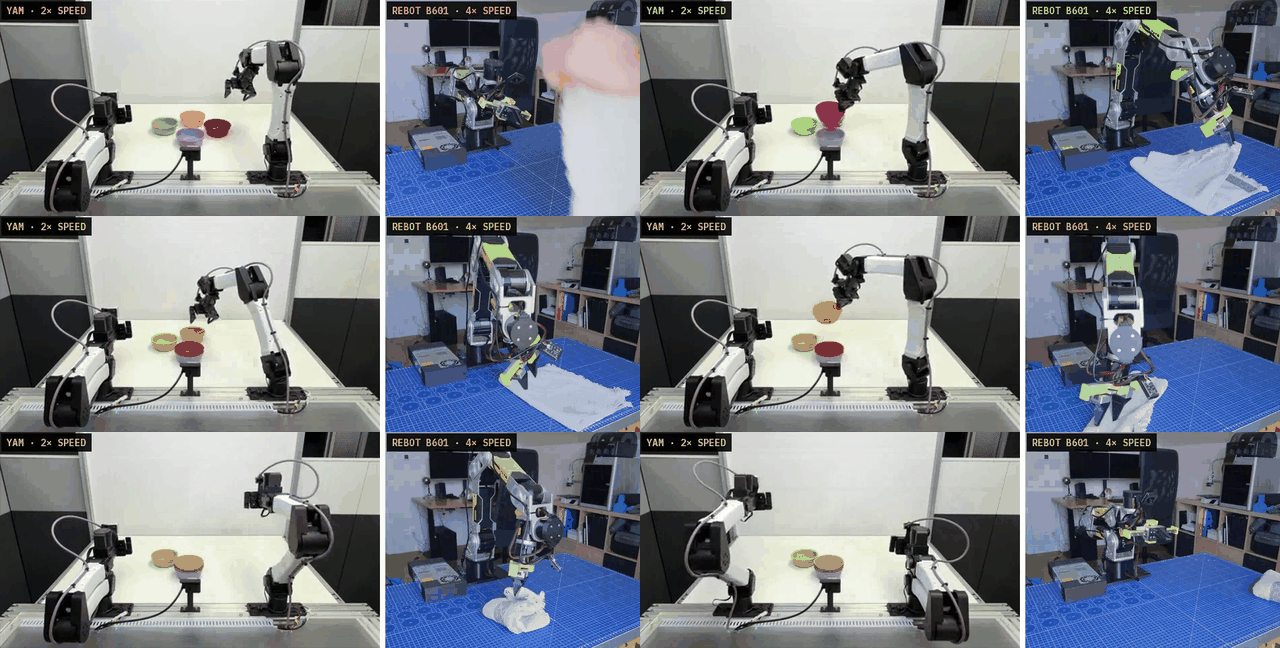
Credit: Hugging Face / LeRobot. Source.
Verify Your Setup with One Recorded Task
Pick a task with a visible outcome, such as placing a block fully inside a box. After connecting and calibrating your variant, teleoperate the arm and record a short episode. Inspect the camera frames and joint data together. Check that the object and target stay in view during the grasp and release, and that the recorded gripper action matches the video. Save that episode as a reference when you change a camera position, update the arm configuration or evaluate a policy.
If you’re upgrading an existing B601 project, check the motor_family setting and any custom motor gains. Version 0.7.0 removes gripper_mit_kp and gripper_mit_kd, and per-joint gains use joint names as keys. Run the same short recording again after updating the configuration before collecting a larger dataset. v0.7.0 breaking changes
Explore the arm configurations and included items for reBot B601-DM and reBot B601-RS, or browse the design files in reBot-DevArm.
Meet Hugging Face and the Robotics Community at Maker Faire Shenzhen
Want to continue the conversation beyond the release notes? Maker Faire Shenzhen takes place on December 12–13, 2026, with Hugging Face at booth A07 and Seeed Studio at A06. Explore the official exhibitor guide to plan your route through the open-source robotics exhibits.
The organizer’s announced “Physical AI: From Intelligence to Real-World Action” panel includes Tom Mulder and Nikodem Bartnik, bringing perspectives from robotics development and hands-on open-source making. See the official program announcement for the published guest lineup and program updates.
Tom Mulder — Pollen Robotics, Part of Hugging Face
Tom works at the intersection of AI and robotics at Pollen Robotics. His work focuses on developer-friendly systems that connect AI models to real robots—a relevant perspective for anyone moving from a trained model to an interactive physical device.
Follow Tom Mulder on LinkedIn for his robotics updates and projects from the Pollen Robotics and Hugging Face ecosystem.
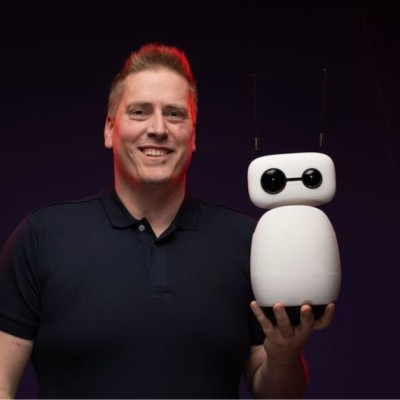
Tom Mulder with Reachy Mini
Nikodem Bartnik — Hugging Face Engineer, Maker and YouTube Creator
Nikodem combines robotics, electronics, 3D printing and machine learning in projects that developers can learn from and recreate. His open-source work includes the IndyMill CNC and other practical hardware builds, making his approach especially relevant to readers starting their own robot-learning experiments.
Explore his YouTube channel, follow him on LinkedIn, or browse his GitHub projects before the event.
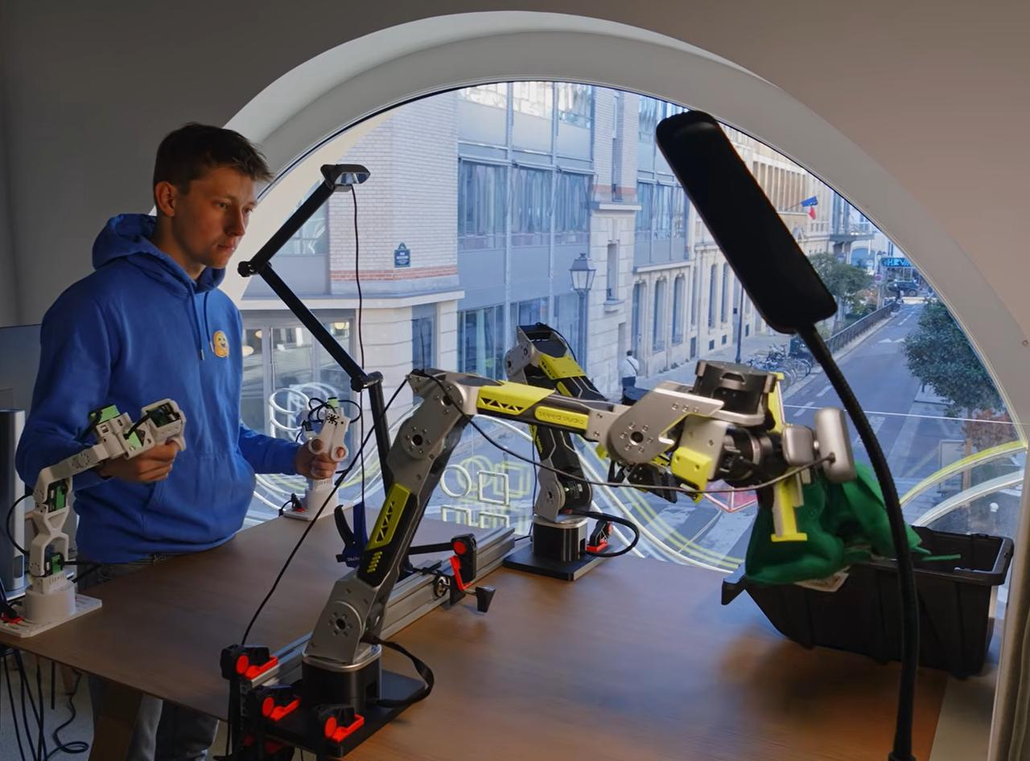
Nikodem Bartnik with the dual-arm of reBot B601-RS
Bring a Question from Your Own Build
Whether you are exploring reBot, Seeed SO-101 or a desktop companion robot, come with a concrete question:
- What makes a demonstration dataset useful for a new task?
- How should you choose a policy and compute setup for your robot?
- Which parts of your hardware or software workflow could you contribute back to an open-source project?
The event is a chance to connect the models and tools discussed here with the people building the ecosystem. Check the organizer’s exhibitor and program updates for the current schedule and plan your visit to Shenzhen.
About Author
