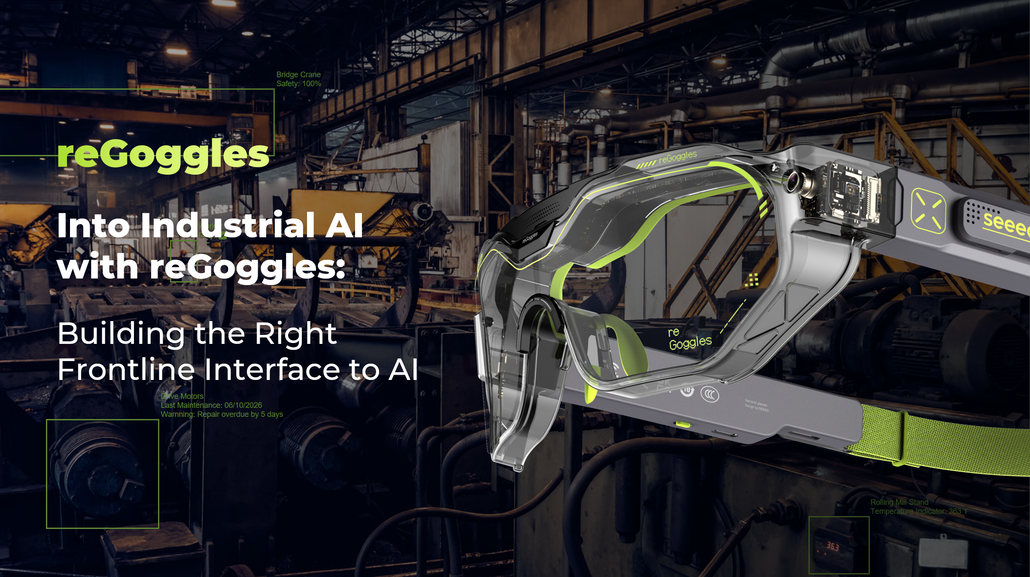
Into Industrial AI with reGoggles: Building the Right Frontline Interface to AI
80% of workers are on the frontline, yet they adopt AI only at half the rate of desk workers. Models and software are not the problem — the real gap is a frontline interface to industrial AI. Workers need an industrial-grade, hands-free device, AI needs field understanding, and enterprises need flexibility, continuity and affordability. None of the devices available today meets all these requirements; they all fall short. That is why we built reGoggles — a product meant to fill this gap.
Frontline Workers Are Left Behind
Frontline workers lag far behind in AI adoption. Roughly 80% of workers are deskless. Yet Workvivo finds only 32% of frontline workers use AI regularly or occasionally, versus 62% of desk workers. The cost shows up in hard numbers. Superkind estimates each frontline worker loses about 376 hours a year. Poor information access, constant searching, and rework add up to an estimated loss of $80.6 billion. Making AI work for them is now a critical task for industrial productivity.
The Missing Piece Is Hardware
The gap in Industrial AI is not the model, not the software. Established Connected Worker platforms such as TeamViewer Frontline and Augmentir have made frontline AI access a core focus. AI-native frontline tools like Navigate.ai and OpenSpace go even further — they build their entire products around AI.
What is missing is hardware — a frontline interface to industrial AI. Weavix surveyed 300 U.S. frontline manufacturing workers in 2025. The results show a clear gap: 74% accept AI tools, and 87% accept work-data collection. Yet 67% still depend mostly on outdated two-way radios.
Frontline Interface to AI: What It Must Deliver
Easy for Workers to Adopt and Use
Fit for Industrial Environments: An AI interface should never become an extra burden for the worker. Every extra device a worker must wear cuts adoption sharply. The best design merges into gear workers already wear: hard hats, goggles, and safety vests. It must also meet industrial protection demands, including impact, water, and fog resistance.
No Interruption to the Job: The tool should never pull a worker off the job, so hands-free operation is essential. No worker should free a hand — let alone both — just to record data or interact. That slows the job and can even create dangerous situations.
Field Understanding for AI
See What the Workers See: First-person capture from the frontline is the richest data source for AI analysis. A wearable camera moves with the worker, covering angles no fixed camera can reach. The AI follows the worker’s attention and targets its analysis accordingly. Workers get help with the problem in front of them, plus details their eyes might miss.
Free Choice of AI: Enterprises, not vendors, should decide which AI runs their frontline. That choice spans three layers. On-device models handle basic checks, where reactions must be instant. Edge models take decisions that cannot wait for the cloud. Large cloud models run deeper analysis across shifts and sites. The hardware must let each enterprise combine these layers on its own terms.
Flexibility, Continuity and Affordability
Flexible Architecture: Demands vary by industry, by site, and by task. One site wants more data types than a camera alone provides. Another pushes one function beyond the standard build. A third needs a design that survives heat, dust, or heavy washdown. A flexible architecture keeps every scenario within reach.
Service Continuity: In industrial applications, the enterprise must stay in full control. Lock-in to any closed hardware or software ecosystem creates vulnerability. Even Microsoft stopped manufacturing HoloLens in December 2024, with support ending in December 2027. A vendor’s exit becomes the enterprise’s problem — stranded devices, frozen features, and a migration nobody budgeted for.
Affordable Deployment: Cost decides adoption once you multiply by the workforce. A plant with thousands of workers cannot absorb a premium device per head. Industrial XR headsets never scaled because each unit costs thousands of dollars. Bring the unit cost down to a few hundred dollars, and broad deployment becomes possible.
Why Existing Hardware Falls Short
None of today’s alternatives meets all seven requirements. Industrial XR glasses cost thousands per unit and remain closed-source. Rugged tablets occupy a worker’s hands and miss the first-person view. Consumer smart glasses offer good value but lack industrial robustness and customization.
| Industrial XR glasses | Rugged tablets | Consumer smart glasses | reGoggles | |
| Fit for Industrial Environments | ✅ | ✅ | ❌ | ✅ |
| No Interruption to the Job | ✅ | ❌ | ✅ | ✅ |
| See What the Workers See | ✅ | ❌ | ✅ | ✅ |
| Free Choice of Models | ❌ | ✅ | ❌ | ✅ |
| Flexible Architecture | ❌ | ❌ | ❌ | ✅ |
| Service Continuity | ❌ | ✅ | ❌ | ✅ |
| Affordable Deployment | ❌ | ✅ | ✅ | ✅ |
Note: Evaluations in the table are for mainstream products of relevant categories.
How reGoggles Fills the Gap
reGoggles was designed around these requirements from day one. Every feature traces back to a real frontline need, which makes it the right frontline interface to industrial AI.
Designed to Be Adopted By Frontline
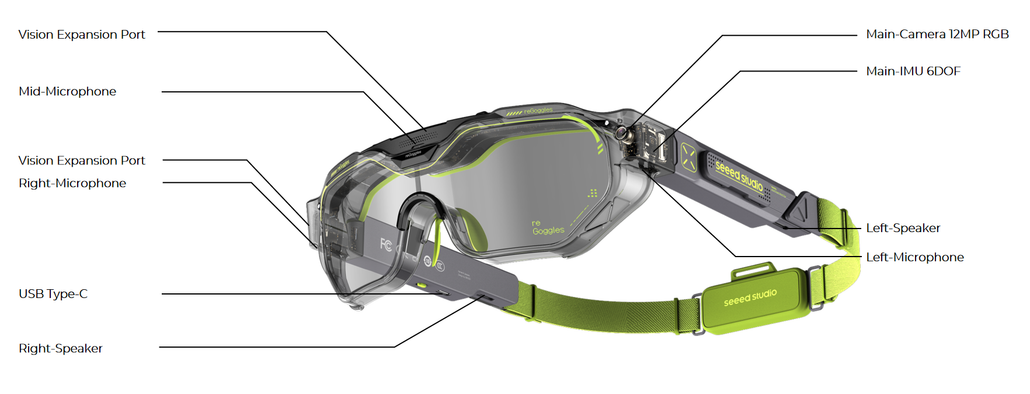
Capture and Protection in One Device: It replaces standard safety goggles by combining protection and capture in one device. In many cases, it adds nothing extra to wear — adoption comes for free.
Hands-Free Interaction: Three microphones and two speakers enable voice control and audio feedback while keeping both hands free. Voice control lets workers keep their eyes on the task, without pausing to record data or interact.
Capturing the Field, Connecting the AI
First-Person Multimodal Capture: reGoggles packs an HD camera and microphones, streaming first-person audio and video in sync. AI sees conditions as they are, analyzes them, and feeds assistance back to the worker.
Universal Data Connectivity: Standard Wi-Fi and BLE interfaces send data to edge AI, cloud AI, and other applications. Open connectivity lets industrial data stay on-site whenever compliance requires it. That is what makes free model choice real: data reaches any layer the enterprise picks.
Flexible to Adapt, Open to Last, Affordable to Scale
Expandable Design: Two expansion ports accept additional cameras, ToF depth sensors, IMUs, or custom modules. That covers multi-view vision, depth detection, and SLAM — whatever the site demands. This open, flexible design leaves room for site-specific customization as needs evolve.
Open Firmware and SDK: reGoggles runs on a dual-chip open architecture built around the Allwinner V881M3-WB2 and WQ7036AX. Its firmware and SDK are open-source, so enterprises can maintain and extend the stack themselves. The device needs no vendor cloud to run, so a vendor exit cannot strand it. Continuity rests on the enterprise’s own choices, not a vendor’s promise.
Cost-Effective for AI Functions: reGoggles concentrates its BOM on the functions industrial AI actually needs. Parts that add cost without frontline value get cut. That discipline brings the unit price down to where fleet-wide deployment makes sense.
Join Now
We are launching the Early Builder Program! We invite enterprises and developers to shape reGoggles from the start. Bring your real field needs, and let’s build the frontline AI interface together. Pick your entry point below.
- Join our Discord community: https://discord.gg/jb5qdrnAVU
- Subscribe to email updates on the landing page: www.seeedstudio.com/regoggles
- Industrial customers or potential partners can reach us directly at: https://www.seeedstudio.com/contacts, or fill out our enterprise application form: https://docs.google.com/forms/d/e/1FAIpQLSdeWjPPHA_orgoDbsES4A_fsP4bHeOsbbtGSKGhObkvSF_pjg/viewform?usp=header
About Author
