The Kitchen That Reads Your Hands: Gesture AI Meets ePaper in a Touch-Free Restaurant System
By Ameya Angadi’s PaperDine Project | Seeed Studio Blog Draft | October 2026
In a busy restaurant kitchen, rhythm is everything. A chef flips a pan, plating a dish, then reaches for a touchscreen to mark the order complete. Greasy fingers smear the screen. The chef pauses, washes hands, touches the screen again, and breaks the flow. It is a small friction, repeated hundreds of times per shift, and it is both a hygiene problem and a productivity drain.
Maker Ameya Angadi set out to eliminate that friction entirely. The result is PaperDine, a touch-free restaurant management system that lets kitchen staff control order displays with hand gestures, while customers browse menus and place orders through ePaper screens and QR codes. The entire system runs on compact development boards from Seeed Studio, a cloud database, and a 3D-printed frame.
Three Pieces, One Workflow
PaperDine is not a single device. It is a small ecosystem of three interconnected components, each targeting a different person in the restaurant workflow.
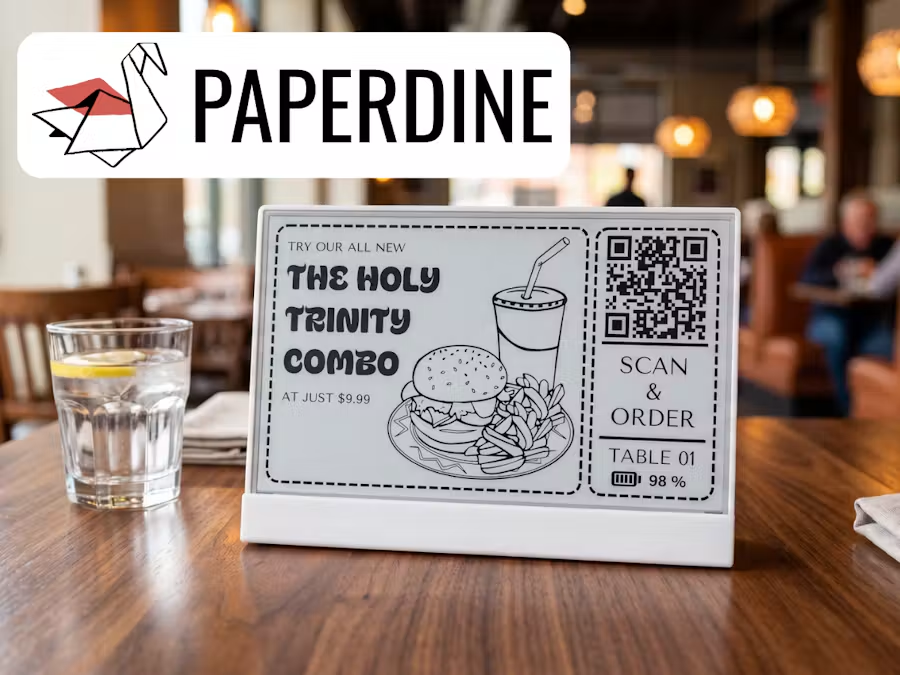
TableSpot is the customer-facing piece: an ePaper display that shows promotional content and menu information at the table. It uses the TRMNL 7.5-inch ePaper kit and updates wirelessly through SenseCraft Seeedash, Seeed Studio’s zero-code over-the-air update platform. No wiring, no app to install, and the content can be changed from a browser in seconds.
The ordering portal is a simple web page that customers access by scanning a QR code. Orders flow into a Firebase Realtime Database and are automatically sorted by preparation speed, so the kitchen sees a prioritized queue rather than a flat list. Quick items and slow dishes are grouped separately, helping the chef plan the workflow.
ChefAssist is where the interesting hardware lives. Mounted above the kitchen workstation, a second ePaper display shows pending orders. Beside it, a XIAO Vision AI Camera Module watches for hand gestures. A wave of the hand — rock, paper, or scissors — dismisses a completed order from the board. No screen is touched. No gloves need to come off.
Gesture AI That Runs Where It Watches
The gesture recognition in ChefAssist is not a cloud API call. An AI model runs directly on the XIAO Vision AI Camera, which pairs a Grove Vision AI V2 sensor with the XIAO ESP32-C3 microcontroller and an OV5647 camera. The model detects and classifies hand gestures locally, with no round-trip to a server. In a kitchen where WiFi drops are common and seconds matter during a rush, local inference is not a luxury — it is the only option that works reliably.
When the camera recognizes a gesture, the ESP32-C3 processes the command and updates the order status in the Firebase database. The customer-facing ePaper displays refresh within roughly two seconds. The developer also implemented partial-update logic for the ePaper panels, so removing a single order does not cause the kind of full-screen flash that would distract a busy kitchen.
The XIAO Vision AI Camera bundles an image sensor, an AI accelerator, and a RISC-V microcontroller into a module roughly the size of a thumb drive. For a project like this, the appeal is straightforward: one board handles both the vision input and the inference, and it is small enough to mount discreetly above a workstation without getting in the way.
Built From Accessible Parts
What makes PaperDine notable as a community project is not just the concept, but how ordinary the parts are. Two XIAO boards, a pair of TRMNL ePaper kits, a PLA-printed frame, a LiPo battery, and open-source code. The customer menu graphics are designed in Canva at 800 by 480 pixels. The AI model is loaded over USB. The ESP32-C3 is programmed in Arduino IDE. Nothing requires custom fabrication or proprietary tooling.
This is the kind of build that rewards systems thinking. Each component is simple on its own. The interesting work is in connecting them: the ePaper refresh timing, the Firebase data structure, the gesture-to-command mapping, and the OTA update pipeline all need to work together smoothly. It is a practical lesson in how edge AI, low-power displays, and cloud sync can meet in a real application.
Where This Pattern Could Go
PaperDine is a working prototype, not a deployed product. The gesture recognition handles a small set of commands, and the ePaper displays show relatively static information. But the underlying pattern — local AI inference on a compact vision board, networked low-power displays, and real-time cloud coordination — is one that extends well beyond restaurants.
Manufacturing cleanrooms, healthcare environments, and maker spaces all have situations where touch-free interaction improves both hygiene and efficiency. One could imagine extending the gesture model beyond rock-paper-scissors to recognize more nuanced commands: signaling that a prep stage is done, triggering a timer, or flagging an ingredient running low. The ePaper infrastructure could double as an inventory board or an equipment status monitor. These are possibilities rather than implemented features, but the hardware foundation is already in place.
PaperDine is a reminder that some of the most compelling edge AI applications are not the ones with the biggest models. They are the ones where a small, local inference task solves a real problem at exactly the point where it matters. A chef’s hands should stay on the food, not on a screen. Sometimes the best technology is the one you never have to touch.
Explore the full project: PaperDine on Hackster.io
About Author
