BLE vs UWB vs GPS vs WiFi: Which is the Best Indoor Positioning Technology for Personal Safety?
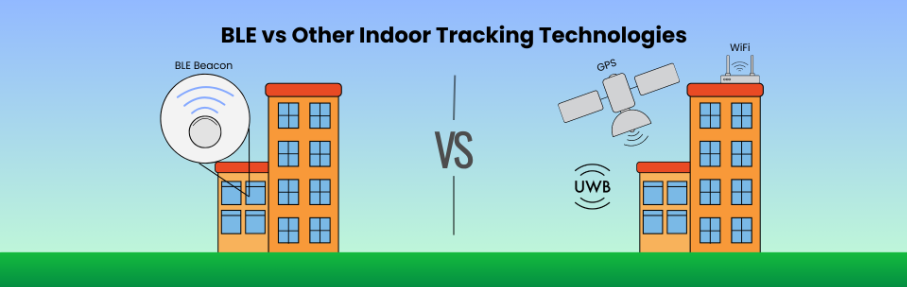
In smart personnel safety systems, accurately tracking people’s real-time locations is critical for fast and effective emergency response. While indoor positioning technologies like Bluetooth Low Energy (BLE), Ultra-Wideband (UWB), GPS, and WiFi can all enable positioning, not all perform well indoors.
For indoor personnel safety, BLE stands out as the most practical choice. It offers reliability, room-level accuracy with low cost and power consumption, making it ideal for large-scale deployments. In contrast, GPS and WiFi often struggle inside buildings, walls block signals accuracy drops, and installation becomes complex. UWB can achieve higher precision, but its high cost and limited coverage make it less suitable for widespread use.
In the table below, we will compare these different indoor positioning technologies and explore which is most practical for real-world safety systems.
Indoor Tracking Technologies Comparison
| Tech | Accuracy | Coverage | Cost | Power Use | Indoor Compatibility |
| BLE | 5-10 m | 10-50 m | Low | Very Low | Excellent |
| UWB | 10-30 cm | 5-15 m | High | Medium | Excellent |
| GPS | 10-50 m (indoors, weak signals) | Outdoor | Medium | Medium | Poor |
| WiFi | Building Level | 20-50 m | Medium | High | Moderate |
When to Choose UWB Instead
While UWB may not be ideal for large-scale indoor safety systems due to its higher cost and shorter range, it excels in high-precision use cases where centimeter-level accuracy is essential. Examples include robot navigation, asset tracking in laboratories or manufactoring lines, and short-range positioning within confined areas. In these scenarios, UWB’s precision can outperform BLE, though it often requires more infrastructure and maintenance.
Why WiFi and GPS Are Less Suitable Indoors
WiFi is built for data transfer, not positioning. Its location accuracy is usually 5-15 m, easily disrupted by walls, metal and other networks. It also drains more power, making it impractical for wearable devices that must run for long periods on battery.
GPS relies on satellites that don’t penetrate buildings, causing large errors or complete signal loss. It works well outdoors but can’t deliver the consistent, room-level accuracy needed for indoor safety tracking.
Why BLE Fit Indoor Personal Safety Best
Simple, Low-Cost Deployment: BLE networks are easy to scale across entire buildings or facilities. Devices communicate without complex wiring, reducing setup time and cost across large facilities.
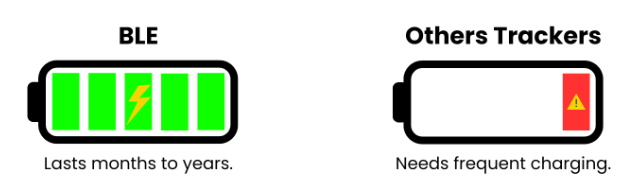
Energy Efficient with Long Battery Life: BLE devices run on very low energy, allowing their batteries to last months or even years depending on how frequently they broadcast signals. This makes them practical for large deployments that need consistent uptime.
Room-Level Accuracy That Actually Matters: BLE delivers reliable room-level accuracy through the strategic deployment of beacons in each room. This precision depends on beacon density, the more appropriately placed beacons, the finer the accuracy. It also remains stable even through walls where WiFi or GPS signals often fail. Unlike UWB, it achieves this accuracy without requiring close-range deployment or high power consumption. When combined with LoRaWAN, it extends coverage across multiple floors or buildings for real-time visibility and faster, coordinated emergency response.
In summary, BLE delivers precise indoor accuracy without the high cost or heavy power use of other options like UWB. When paired with LoRaWAN, coverage can stretch across entire campuses or multi-site facilities, creating a truly connected safety network.
How BLE and LoRaWAN Work Together for Smart Safety System
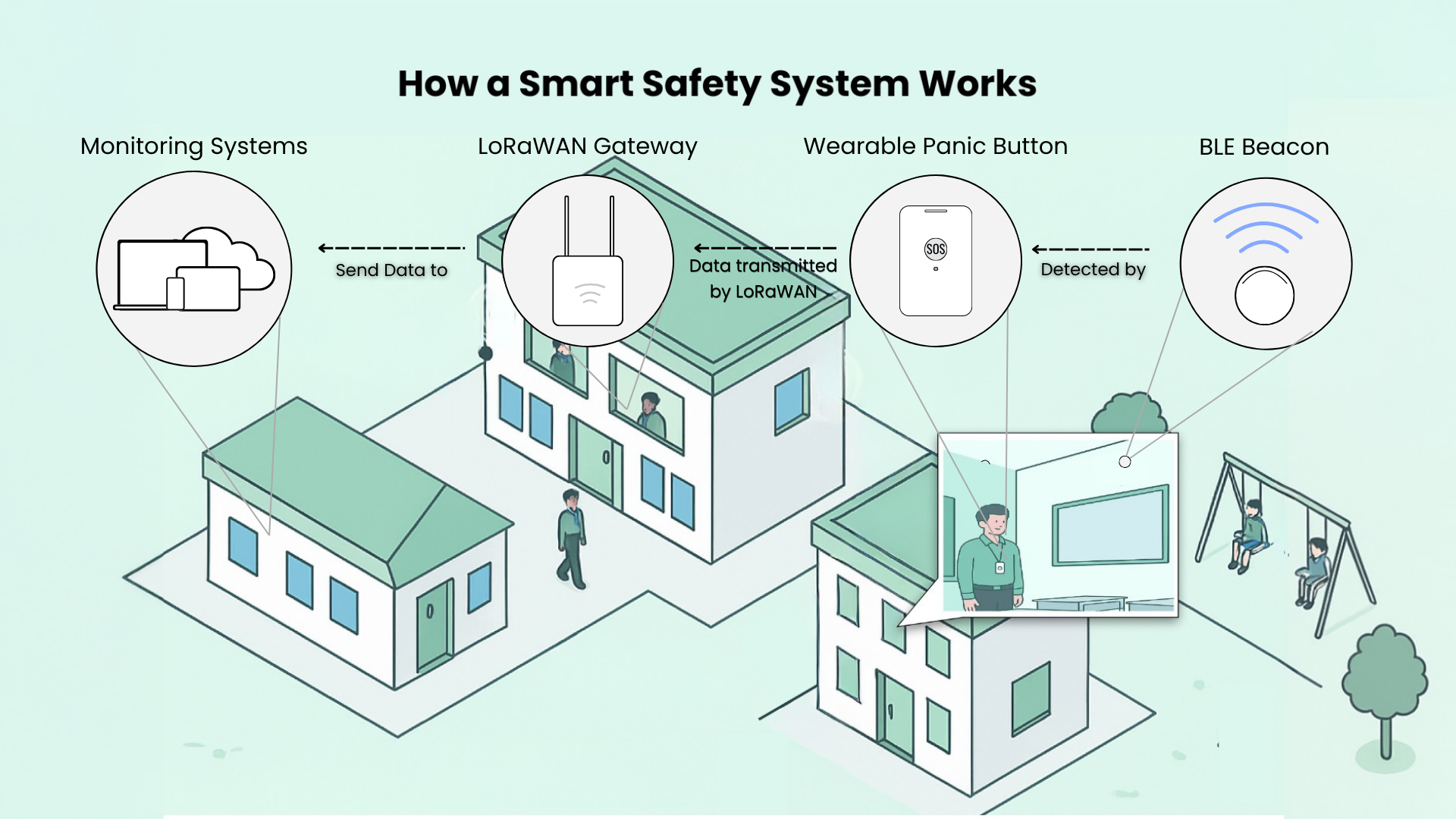
BLE alone handles the close-range part, pinpointing who is in which room. Beacons around the site broadcast short signals, and Smart Safety Badges use those signals to figure out which room a person is in.
What BLE doesn’t handle well is transmitting that location data over long distances or between floors. That’s where LoRaWAN gateways come in. Each gateway collects data packets and alerts from the Smart Safety Badges, then sends them securely to a central dashboard. This allows organizations to monitor staff and respond to emergencies across entire buildings, campuses, or factories, without depending on WiFi or cellular networks.
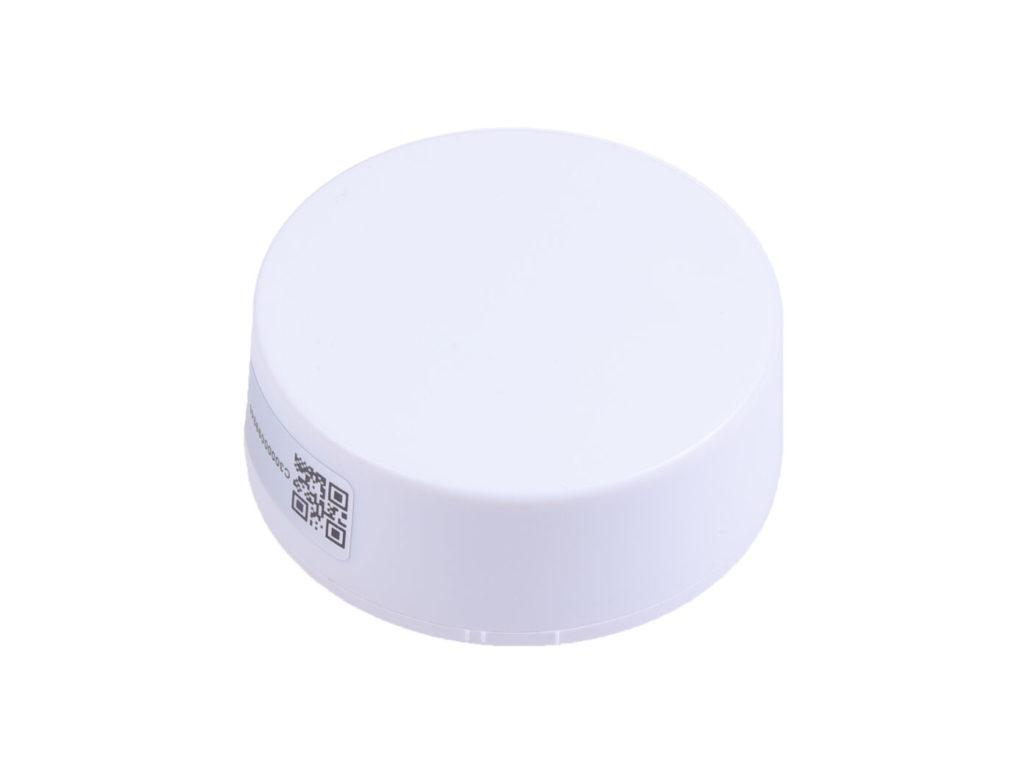
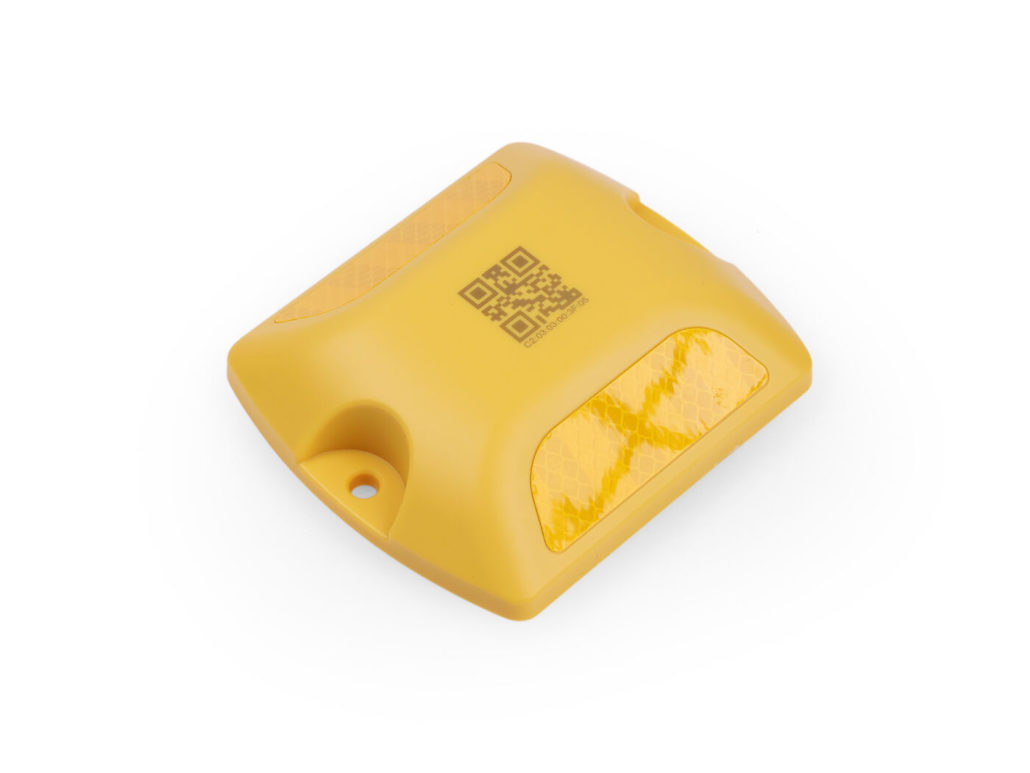
Together, BLE and LoRaWAN form a complete indoor safety system that’s accurate, reliable, and easily scalable. To support real-world deployments, BLE beacons come in both indoor and outdoor versions designed for different coverage needs.
BC01 Indoor BLE Beacon
BC02 Outdoor BLE Beacon
To achieve precise indoor personnel positioning with Bluetooth beacons, the placement of the beacons is just as important. You can refer to this article to learn the best practices for properly positioning Bluetooth beacons and gateways.
Explore How BLE + LoRaWAN Can Be Customized for Your Needs
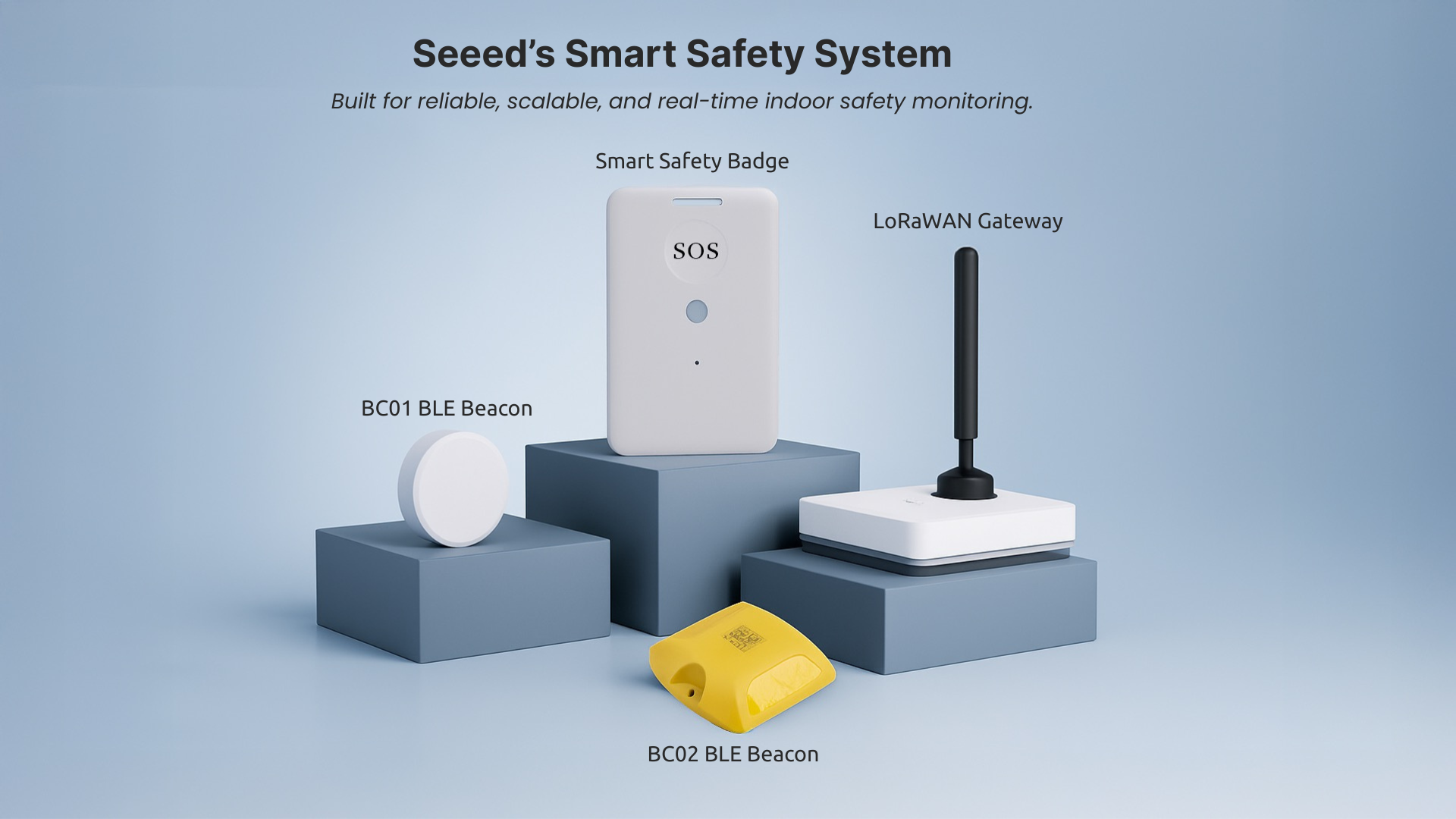
Seeed offers a one-stop BLE + LoRaWAN safety solution that includes BLE beacons, LoRaWAN gateways, and Smart Safety Badges, all designed to work seamlessly together. Backed by real-world deployment experience, most clients choose BLE beacons as their preferred solution for indoor personnel positioning. Each setup is customizable, from white labeling to hardware configurations. Contact us to customize your setup.
About Author
