Build AI-Powered Robots with reBot Arm and NVIDIA Isaac ROS 5.0
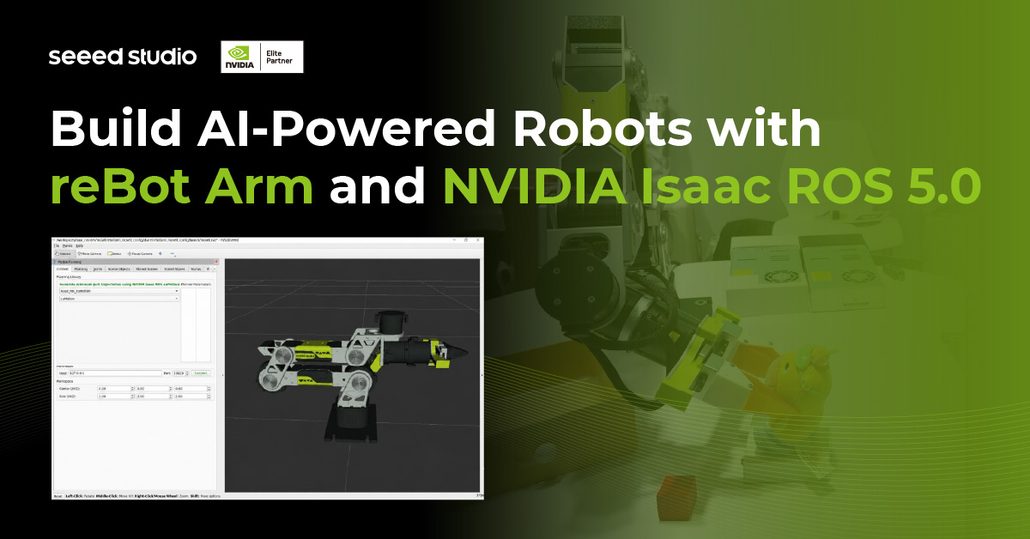
Robotics is moving beyond fixed automation toward systems that can perceive, reason, plan, and act in dynamic environments. NVIDIA Isaac ROS 5.0 brings new agentic workflows, GPU-accelerated robotics software, and expanded platform support to help developers build, customize, and deploy Physical AI applications faster.
At Seeed Studio, we are bringing these capabilities to the reBot Arm, creating an accessible robotic manipulation platform that connects open-source ROS development with GPU-accelerated robotics on the NVIDIA Jetson platform, including NVIDIA Jetson AGX Thor.
By combining reBot Arm with NVIDIA Isaac ROS, developers can build practical robotics workflows ranging from object localization and 3D perception to collision-aware motion planning and autonomous pick-and-place.
What’s New in NVIDIA Isaac ROS 5.0?
NVIDIA Isaac ROS is a collection of GPU-accelerated packages built on ROS, bringing NVIDIA accelerated computing, Physical AI models, and production-ready robotics libraries into the open ROS ecosystem.
With Isaac ROS 5.0, NVIDIA extends this foundation with new capabilities for agentic robotics development, perception, manipulation, and edge deployment.
Build with Isaac ROS 5.0
Isaac ROS 5.0 introduces support for ROS 2 Lyrical and Ubuntu 24.04, giving developers a path to adopt the latest ROS platform while continuing to accelerate demanding robotics workloads with NVIDIA accelerated computing.
Developers can continue working with familiar ROS tools, libraries, sensors, controllers, and planning frameworks while using GPU acceleration for computationally intensive robotics workloads.
This makes it easier to extend existing ROS applications with advanced perception and Physical AI capabilities without rebuilding the entire robotics software stack.
Accelerate Robotics Development with AI Agents
Isaac ROS 5.0 introduces new NVIDIA Isaac Skills for setup and manipulation, providing reusable workflows that both developers and AI agents can use to complete robotics development tasks.
Agent-ready documentation also helps AI agents better understand Isaac ROS tools and workflows, making it easier to translate developer intent into working robotics applications.
Some of these capabilities go beyond coding assistance:
- FoundationStereo Fine-Tuning Skill — Enables an AI agent to help adapt a stereo perception model to a developer’s cameras, environment, and robotics application.
- FoundationPose — Provides an agent-ready inference library for 6D object pose estimation and tracking, with inference performance up to 5.5× faster.
- Pick-and-Place Skill — Connects detection, depth estimation, and pose outputs into a standalone, agent-ready manipulation workflow.
Together, these capabilities make it easier to move from individual perception components toward complete robotics applications.
From Perception to Manipulation with reBot Arm
Seeed Studio is using NVIDIA Isaac ROS with reBot Arm to bring perception, spatial awareness, and intelligent motion together in a real-world robotic manipulation platform.
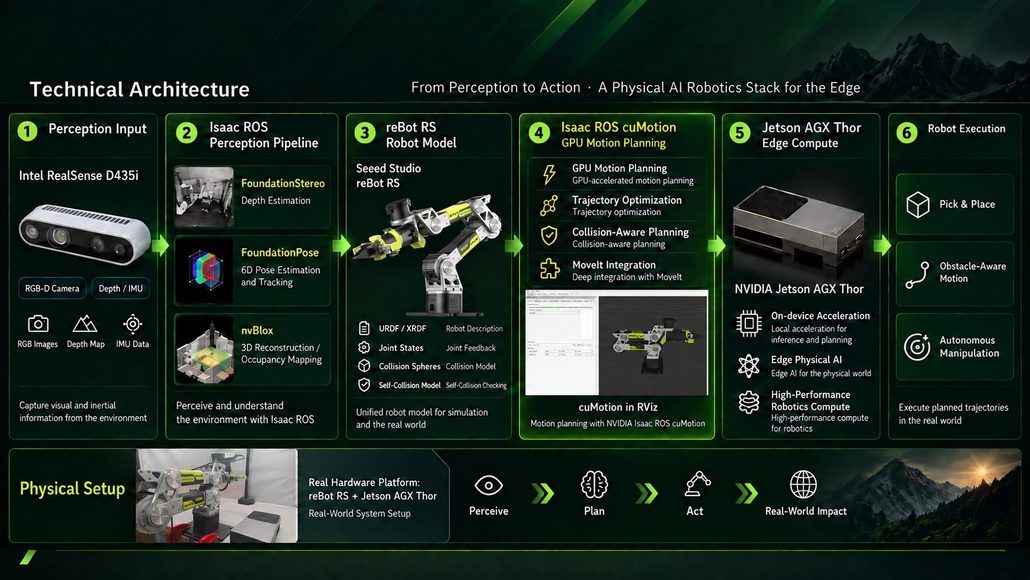
With NVIDIA Isaac ROS, developers can build a complete perception-to-action pipeline on reBot Arm:
- Perceive with Isaac ROS FoundationPose — Estimate and track the 6D pose of target objects, enabling the robot to understand their position and orientation in real-world environments.
- Understand the workspace with Isaac ROS Nvblox — Build real-time 3D representations of the environment, providing spatial information and obstacle geometry for downstream motion planning.
- Plan with Isaac ROS cuMotion + MoveIt 2 — Generate GPU-accelerated, collision-aware robot trajectories based on the robot model and perceived environment.
- Act with reBot Arm — Execute planned trajectories and precise grasping actions on the physical robot.
Together, these capabilities create an end-to-end autonomous manipulation workflow:
Perceive → Understand → Plan → Act
From recognizing and locating objects to planning collision-aware motion and executing precise grasps, reBot Arm provides developers with a practical platform for building adaptive pick-and-place and intelligent robotic manipulation applications.
Running Isaac ROS at the Edge with NVIDIA Jetson
Modern robots increasingly need to process perception and planning workloads directly at the edge rather than relying entirely on remote computing.
Isaac ROS brings GPU-accelerated robotics capabilities to the NVIDIA Jetson platform, allowing developers to scale onboard computing according to the complexity of their applications.
For reBot Arm, NVIDIA Jetson AGX Thor provides a powerful edge computing platform for running AI perception, spatial understanding, and GPU-accelerated motion planning close to the robot.
A typical Physical AI architecture can look like this:
Sensors → Jetson (ROS 2 + Isaac ROS) → MoveIt 2 / Robot Control → reBot Arm
By bringing perception, planning, and robot control into a unified ROS 2 workflow, developers can turn sensor data into collision-aware motion and real-world robotic manipulation.
Get Started with ROS 2 on reBot Arm
Before adding advanced Isaac ROS perception and planning capabilities, developers can start by bringing reBot Arm into a standard ROS 2 workflow.
Seeed Studio provides a complete reBot Arm B601-RS ROS 2 Integration Guide covering robot configuration, ROS 2 control, visualization, trajectory execution, and integration with higher-level robotics applications.
This provides the foundation for connecting reBot Arm with MoveIt 2, perception systems, and NVIDIA Isaac ROS.
What You Can Build Next
Once the basic ROS 2 environment is running, developers can progressively add NVIDIA Isaac ROS components to build a complete manipulation workflow.
Step 1 — Control reBot Arm with ROS 2
Verify joint control, robot state publishing, trajectory execution, RViz visualization, and MoveIt 2 integration.
Step 2 — Add RGB-D or Stereo Perception
Connect a supported camera and bring sensor streams into the ROS 2 graph.
Step 3 — Add Depth Perception
Use Isaac ROS FoundationStereo for stereo depth estimation, or bring depth data from an RGB-D camera into the perception pipeline.
Step 4 — Add FoundationPose
Estimate and track the 6D pose of objects that the robot needs to manipulate.
Step 5 — Build a 3D Environment Representation
Use Isaac ROS Nvblox to reconstruct the robot workspace and provide obstacle geometry for motion planning.
Step 6 — Plan with cuMotion and MoveIt 2
Use Isaac ROS cuMotion together with MoveIt 2 to generate GPU-accelerated, collision-aware robot trajectories.
Step 7 — Close the Loop on the Real Robot
Send the planned trajectory through ROS 2 to reBot Arm and execute an autonomous manipulation task.
The result is a complete Physical AI loop:
Perceive → Understand → Plan → Act → Observe → Re-plan
Developers can also use NVIDIA Isaac Sim to build and validate robot environments, test perception pipelines, and experiment with manipulation workflows in simulation before deploying them to NVIDIA Jetson and reBot Arm.
Start Building with reBot Arm
Ready to bring GPU-accelerated perception and motion planning to a real robot?
Get started with reBot Arm and follow the reBot Arm ROS 2 Integration Guide to start building your own Physical AI applications with NVIDIA Isaac ROS.
About Seeed Studio

Seeed Studio is a global provider of open hardware and AI solutions, empowering developers and enterprises to build and deploy edge AI, IoT, and robotics applications at scale. As an NVIDIA Elite Partner, Seeed Studio provides a comprehensive ecosystem of carrier boards, industrial computing systems, developer tools, and educational resources built on the NVIDIA Jetson Orin platform — from entry-level edge AI to production-grade robotics. For more information, visit seeedstudio.com about reComputer Jetson.
About Author
