Introducing XIAO STM32C5: The First STM32-Powered XIAO with Native CAN FD and Programmable IMU Heating

Meet the first STM32-powered XIAO. Built around the STM32C5A3CG with a 144MHz Arm Cortex-M33 core, XIAO STM32C5 brings CAN FD connectivity, 16MB of external Flash, and a six-axis IMU with programmable heating to the compact XIAO form factor.

CAN FD. STM32. A heated IMU. In a XIAO. Until now, you probably wouldn’t expect to find all of these on a board small enough to fit in your fingertips. But that’s exactly what we’ve put together with the new Seeed Studio XIAO STM32C5.
 
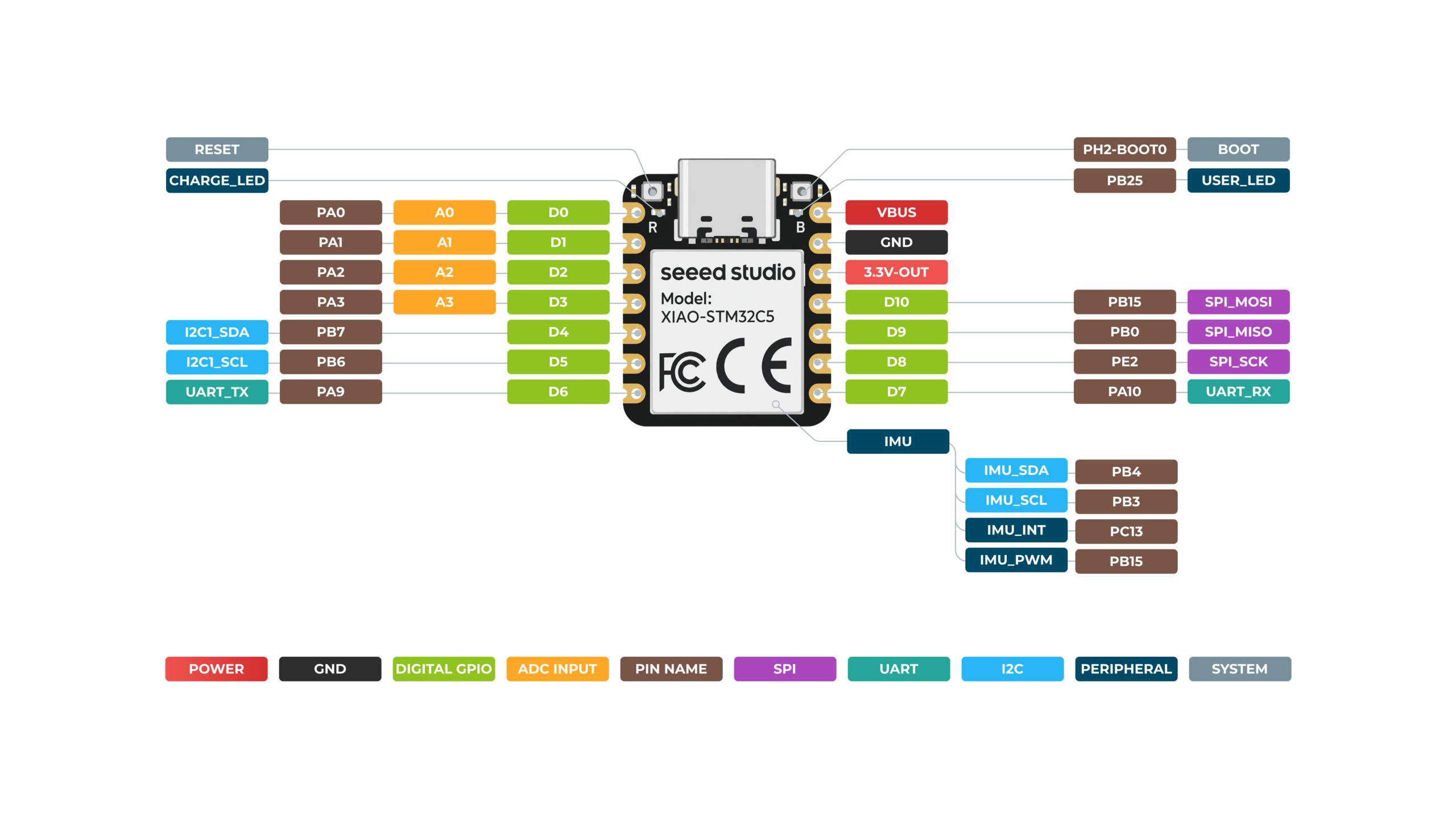
For the first time, an STMicroelectronics MCU is at the heart of a XIAO board. Built around the STM32C5A3CG, XIAO STM32C5 development board combines native CAN FD (FDCAN), a 6-axis IMU with programmable heating, 16MB of external Flash, high-speed external crystal, and the STM32 ecosystem in the compact XIAO form factor.

CAN FD opens the door to connected robotics and industrial control, and the heated IMU gives developers a way to actively manage the sensor’s operating temperature. Together with STM32C5’s processing capabilities, they make XIAO STM32C5 a very different kind of XIAO, built for applications where communication, sensing, and real-time control need to work together.

Built on STM32C5A3CG, with Native CAN FD

At the heart of XIAO STM32C5 is the STM32C5A3CG, featuring a 144MHz Arm Cortex-M33 processor with floating-point support and DSP instructions. More importantly, for connected control systems, the MCU provides two native CAN FD controllers.
 
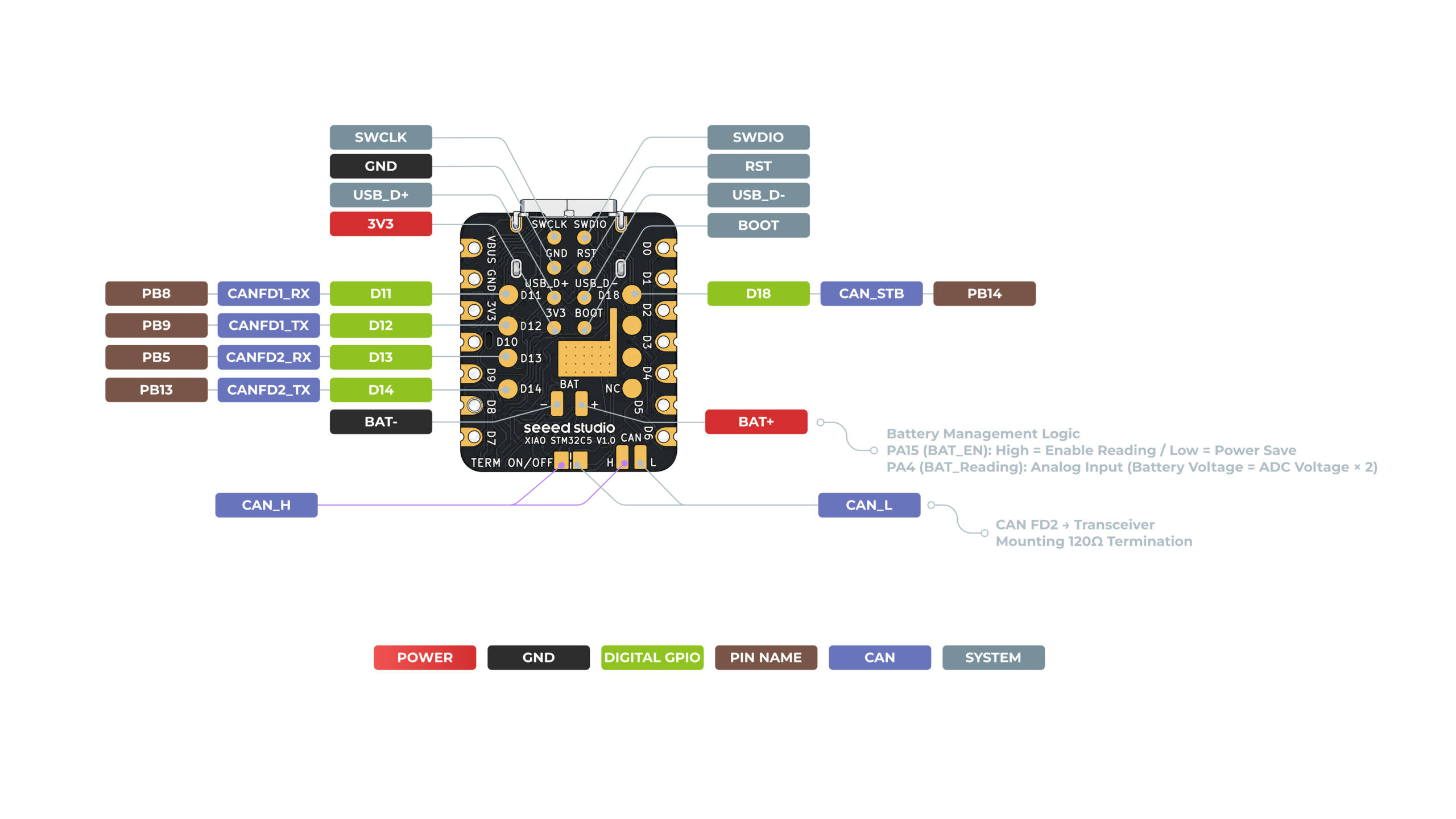
One CAN FD channel is connected to an onboard TI TCAN3403-Q1 transceiver, with CANH and CANL exposed on the board; The second CAN FD controller is available through digital TX/RX signals, allowing an external transceiver to be added when a project needs a second physical CAN bus. This makes XIAO STM32C5 a compact option for systems where the controller needs to communicate directly with other devices on a CAN FD network.
(And we’re not stopping here. We’re also working on a XIAO STM32C5 CAN FD Analyzer, coming soon to make CAN FD development and debugging even easier. Get notified when it launches.)

Programmable Heating Keeps the Onboard IMU Accurate

Temperature changes can affect MEMS IMU measurements. As an IMU warms up or cools down, its readings can shift even when the sensor itself isn’t moving. This is a known source of error in robotics and motion-sensing applications operating across varying conditions.
 
XIAO STM32C5 addresses this directly on the board. The onboard LSM6DS3TR-C 6-axis accelerometer and gyroscope is paired with dedicated heating resistors controlled through GPIO. Firmware can warm the IMU before measurement begins, helping bring it to a more consistent operating temperature. With temperature feedback, the heating can also be controlled around a defined setpoint. Instead of simply accepting whatever temperature the sensor happens to reach, developers can actively manage the IMU’s thermal conditions as part of the application.

Left: IMU temperature rising to a ~40°C setpoint. Right: Euler angles from accel + gyro. XIAO STM32C5 held still, then moved.

Plenty of Room for Data and Control

XIAO STM32C5 combines 1MB of internal program Flash, 256KB of SRAM, and 16MB of external Flash. The additional storage provides room for local CAN traffic logs, IMU data, configuration files, and other application data. An onboard 48MHz HSE crystal with ±10ppm accuracy provides a stable clock reference for CAN FD, USB, and sensor sampling. USB-C handles development and data transfer, while onboard lithium battery charging and BAT pads make battery-powered applications possible as well.
 
The result is a small controller that can handle communication, sensing, data logging, and control without needing to offload every task to another board.

Demo: Two-Axis Gimbal over CAN FD

XIAO STM32C5 is suitable for applications such as USB-to-CAN FD adapters, CAN sensor nodes, compact industrial controllers, and other robotics and motion-control prototypes. To demonstrate the board in a real motion-control application, our engineer Zeller builds a two-axis camera gimbal using two XIAO boards. The system separates perception from control:
  • XIAO ESP32S3 Sense handles the camera, face detection, and video streaming over Wi-Fi;
  • XIAO STM32C5 handles the motion-control side, receiving tracking data over UART and driving two brushless motors over CAN FD.
It supports face tracking, manual control from a web UI, and auto-calibration. Check out the GitHub repo here.

Get Your XIAO STM32C5 Now

XIAO STM32C5 is now available in un-soldered and pre-soldered versions, priced at USD $9.90 and USD $10.90 per unit respectively. You can develop with STM32CubeIDE, PlatformIO with Zephyr, or MicroPython. The XIAO STM32C5 Wiki has [Getting Started], [CAN FD usage], [pin multiplexing] and [application examples].
 
With native CAN FD, a programmable-heated 6-axis IMU, and the STM32 ecosystem in a compact XIAO form factor, it brings a new option to developers building connected robotics, industrial, and motion-control systems.

About Author

Leave a Reply

Your email address will not be published. Required fields are marked *

Calendar

November 2026
M T W T F S S
 1
2345678
9101112131415
16171819202122
23242526272829
30