Open Source Robotic Arm Recommendation for Developers, Researchers, Educators, and Startups in 2026
By Liyan Gong 1 hour agoChoosing an open-source desktop robotic arm is about more than price and basic specs. The ideal robotic arm platform should deliver high repeatability, sufficient payload capacity, and a practical working reach, all within a reasonable budget. It should also be easy to assemble, program, and deploy. Equally important are a mature software ecosystem, comprehensive documentation, active community support, true open-source accessibility, and the scalability needed for future development.
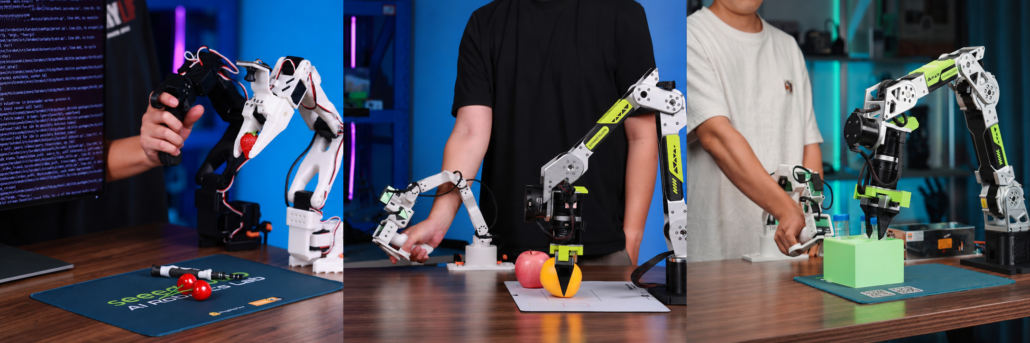
In this guide, we’ll highlight three open-source robotic arms: the SO-ARM101 Pro Assembled Kit, reBot Arm B601-DM, and reBot Arm B601-RS for Physical AI and robot learning researchers, universities and research labs, robotics startups, automation developers, and makers.
From entry-level kits costing a few hundred dollars to professional platforms priced under $2,000, they provide accessible hardware for robotics education, Physical AI research, imitation learning, VLA research, teleoperation, lightweight manipulation tasks, and end-to-end robotics development.
What is Open Source Robot Arm?
An open-source robotic arm is a programmable robotics platform with open access to its hardware designs, documentation, and source code, enabling users to study, modify, manufacture, and build on the platform under open-source licenses.
API access and source code availability should not be confused with full-stack openness. Some robotic arms expose SDKs, ROS packages, and simulation models while withholding core hardware assets, including CAD files, schematics, BOMs, and firmware. Others restrict commercial use through their licensing terms. So when choosing a robotic arm, pay attention to whether it offers open software, partially open hardware, or fully open-source.
The reBot RS and reBot DM featured in this guide are fully open-source robotic arm. Licensed under CERN-OHL-W 2.0 and certified by OSHWA. It’s not just open-sourcing the code, but everything, with nothing held back.
- All design files for two robotic arm models— B601-DM (Damiao) and B601-RS (Robstride), which have identical appearances.
- Hardware blueprints— Source files for sheet metal parts and 3D printed parts.
- BOM list— Detailed specifications and purchase links for every single screw.
- Software and algorithms— Python SDK, ROS1/2, Isaac Sim, LeRobot, etc.
A Quick Comparison of the Best Open-source Robot Arms
Below is a quick overview of the three recommended robotic arms and what they’re best for. We’ll dive into each in more detail later.
Parameter | |||
Payload | 0.5 kg | 1.5 kg | 2.5 kg |
Max Reach | – | 767 mm | 754 mm |
Weight | – | ≈ 4.5 kg | ≈ 6.7 kg |
Repeatability | – | < ±0.2 mm | < ±0.1 mm |
Degrees of Freedom | 5 DOF + 1 Gripper | 6 DOF + 1 Gripper | 6 DOF + 1 Gripper |
Supported Ecosystems | LeRobot, GR00T, SenseCraft Robotics | ROS1, ROS2, MoveIt, LeRobot, Pinocchio, Isaac Sim, Python SDK, SenseCraft Robotics | ROS1, ROS2, MoveIt, LeRobot, Pinocchio, Isaac Sim, Python SDK, SenseCraft Robotics |
Supply Voltage | Leader Arm DC 5V Follower Arm DC 12V | DC 24V | DC 48V |
License | Apache License 2.0 | CERN-OHL-W 2.0 | CERN-OHL-W 2.0 |
Price | $299 | $1,499 | $1,699 |
Best for | Robotics enthusiasts, beginners, educators, and robot learning researchers who want a fast, low-cost entry point into teleoperation, imitation learning, AI training, and education. | Budget-conscious developers, educators, and research teams seeking a fully open-source platform for robotics education, robot learning, and Physical AI development. | Researchers and robotics developers seeking a fully open-source platform with industrial-level performance for sim-to-real learning, teleoperation, and advanced Physical AI development. |
Note: Prices shown are from the Seeed Bazaar CN Warehouse, which typically offers the lowest prices.
Open Source Robotic Arms to Consider in 2026
Alright, let’s get into the details. Each of these robotic arm platforms is designed for a different set of use cases, so the best choice depends on your project requirements and budget.
1. SO ARM101 Pro Assembled Kit
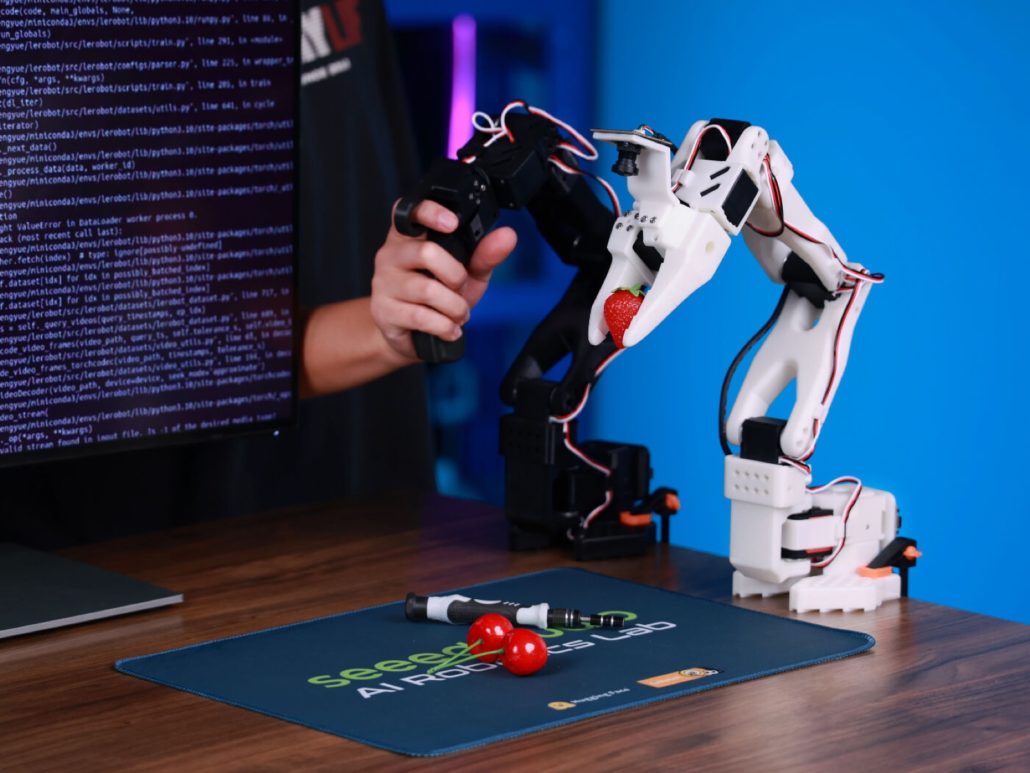
SO-ARM101 is an open-source, 6-degree-of-freedom robotic arm originally designed by The RobotStudio in collaboration with Hugging Face. It is a low-cost, DIY-friendly platform designed for teleoperation, imitation learning, and physical AI research, and integrates natively with the LeRobot framework.
To get a SO-ARM101, you can either build it yourself or purchase a pre-assembled kit from a vendor. Here we recommend the Seeed Studio SO-ARM101 Pro Assembled Kit, a pre-assembled, open-source 6-DoF robotic arm kit designed for robotics enthusiasts, educators, and imitation learning researchers. It addresses the challenge of getting started with AI-driven imitation learning quickly without the high cost and complexity of assembly and setup, combining a factory-assembled design, out-of-the-box compatibility with the Hugging Face LeRobot framework, and the ability to start teleoperation data collection and policy training within 30 minutes.
Why it’s great
- 6-DoF and high-torque: six STS3215 magnetic-encoder bus servos deliver 30 kg·cm torque per joint with 12-bit absolute position feedback for smooth, quiet, and repeatable motion
- Fully pre-assembled leader and follower arms, ready to use out of the box
- Seamlessly integrates with Hugging Face LeRobot for teleoperation, data collection, and imitation learning
- No-Code AI Development: powered by SenseCraft Robotics for guided calibration, data collection, model training, and inference.
- Affordable & Flexible kit options: select the $299 fully assembled kit, or choose servo‑only pack or unassembled parts to match your budget and project needs.
Application
If your project requires higher precision, better software support, and greater system integration capabilities, the Seeed reBot Dev Arm is the more suitable choice, especially for research, education, robotics R&D, and light industrial automation.
2. reBot Arm B601-DM
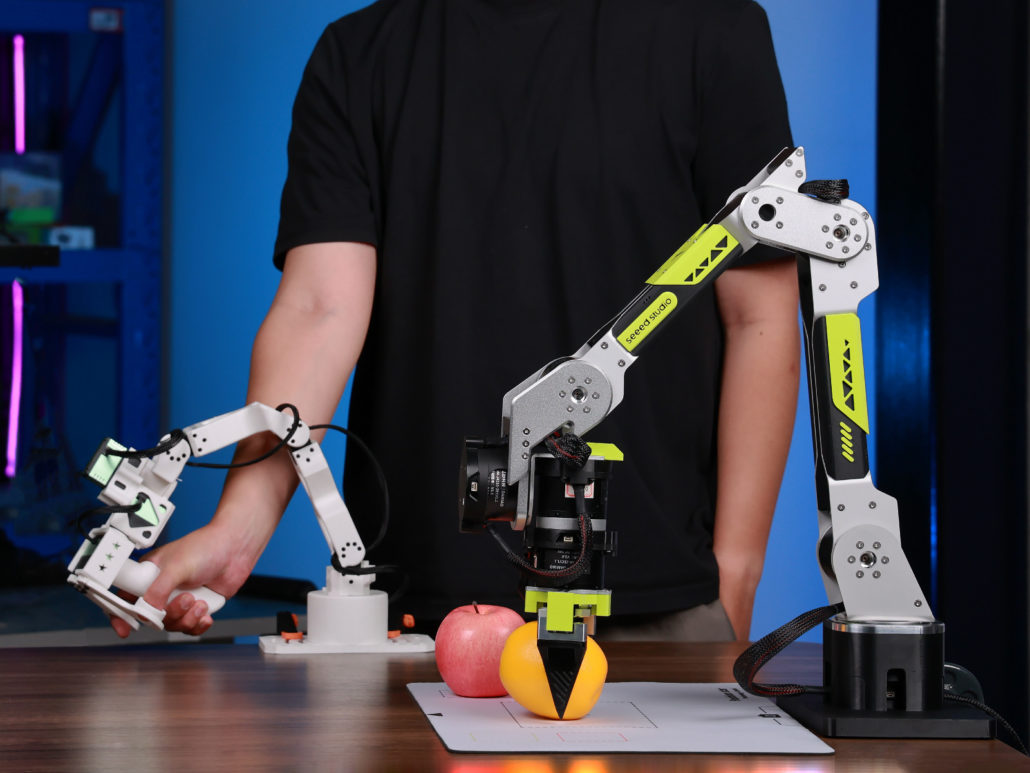
The reBot Arm B601-DM is an open-source 6+1-DoF multifunctional robotic arm designed for robotics enthusiasts, university labs, and budget-conscious development teams. It addresses the challenge of getting started with robotics development at a low cost without sacrificing access to a complete open ecosystem, combining a 1.5 kg payload, ±0.2 mm repeatability, and a fully open-source ecosystem spanning hardware, software, CAD files, BOMs, SDKs, and tutorials, all at a more accessible price point.
Why it’s great
- High performance: features a 1.5 kg rated payload, ±0.2 mm repeatability, a 767 mm maximum reach, and operates on 24V DC power.
- Fully Open Source: open access to the complete hardware and software stack, including designs, BOMs, firmware, software, and algorithms.
- Powerful software ecosystem compatibility: natively supports ROS1, ROS2 (Humble), Hugging Face LeRobot, Pinocchio, NVIDIA Isaac Sim, Python SDK, and SenseCraft Robotics.
- Constant content updates: The Seeed AI Robotics team will constantly update the latest algorithms and launch a series of completely free courses on GitHub, the wiki, and Seeed Studio x NVIDIA Sim-to-Real course.
- Cost-effective: Assembled kit priced at $1,499, offering exceptional value for entry-to-mid-tier robotics development. You can choose bundled options with a power supply, leader arm, and camera, or opt for body motor kit, with Jetson Thor bundle and more based on your budget and project requirements.
Application
The reBot B601-DM offers a strong balance of performance, affordability, and open-source flexibility. If your applications demand higher precision, greater payload capacity, and more industrial-level development capabilities, the reBot RS is the ideal step up.
3. reBot Arm B601-RS
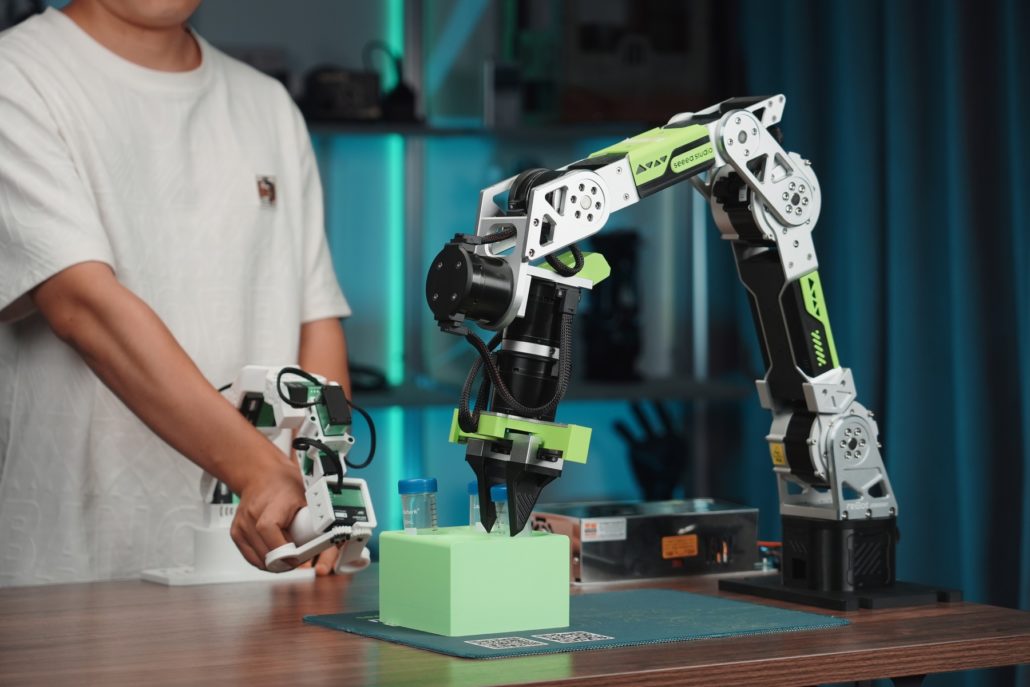
The reBot Arm B601-RS is a high-performance, open-source 6+1-DoF robotic arm designed for research teams and robotics developers. It addresses the challenges of insufficient performance and unreliable precision in sim-to-real learning, teleoperation, and real-world robotics development, combining a 2.5 kg rated payload, ±0.1 mm repeatability, and a fully open hardware and software ecosystem with comprehensive tutorials and documentation.
The RS and DM share the same mechanical architecture, open-source foundation, software stack, and visual grasping workflows. The key difference is the actuator system: the DM uses Damiao (DM) motors, while the RS uses RobStride (RS) motors. Thanks to its higher-power actuators and increased gear ratio, the RS delivers higher payload, greater precision, and improved overall performance for more demanding robotics workloads.
Why it’s great
- High performance: features a 2.5 kg rated payload, ±0.1 mm repeatability, a 754 mm maximum reach, and operates on 48V DC power.
- More Thorough Open-Source: not just the arm, but also the enclosure design and BOM for the 48V power supply.
- Smart operating system: The core software is upgraded to MotorBridge. This is not just a simple host computer; it’s a comprehensive solution supporting multiple motor brands (DAMIAO, Robstride Dynamics, High Torque, MyActuator, etc.). It offers drag-and-drop graphical control, one-click zero-point calibration, built-in model visualization, and even a Beta AI Agent for assisted initialization, significantly lowering the debugging barrier.
- Powerful Core: Moving beyond 24V to embrace 48V Robstride Dynamics motors. Higher voltage enables stronger instantaneous torque and dynamic response potential, laying the foundation for experiments requiring fast, precise movements.
- Powerful software ecosystem compatibility: natively support ROS1, ROS2 (Humble), Hugging Face LeRobot, Pinocchio, NVIDIA Isaac Sim, Python SDK, and the SenseCraft Robotics.
- Constant content updates: Seeed AI Robotic team will constantly update the latest algorithms and launch a series of completely free courses on GitHub, the wiki, and Seeed Studio x NVIDIA Sim-to-Real course.
- Cost-effective: Assembled kit priced at $1,699,delivering industrial-level performance at a fraction of the cost of traditional industrial robots. You can choose bundled options with a power supply, leader arm, and camera, or opt for body motor kit, unassembled bundle, and more based on your budget and project requirements.
Application
How to Choose the Open-Source Robotic Arm?
Choosing between the Seeed Studio SO ARM101 Pro Assembled Kit, reBot RS, and reBot DM depends on your specific needs regarding payload, budget, desired robustness, and whether you prefer to build from scratch or buy a more complete kit.
Seeed SO ARM101 Pro Assembled Kit: Entry-level, the Low Cost option
The assembled kit is best for those who want to skip the build and focus on AI, and it is often available as a DIY kit or for 3D printing, making it a popular choice for students and those new to robotics. It’s ideal for learning the fundamentals of robotics, programming with LeRobot, and rapid prototyping due to its open-source nature.
reBot Arm B601-DM: The Balanced, Mid-Range Option
The Rebot DM offers a higher payload capacity, repeatability, and smoother movements than the SO-101, making it suitable for more demanding educational or prototyping tasks. It integrates well with ROS 2, MoveIt, LeRobot, Pinocchio, NVIDIA Isaac Sim, and the Python SDK, offering a robust software development environment. It serves as a good middle ground for users who need more capability than the SO-101 but don’t require the industrial-grade performance or higher cost of the RS model.
reBot Arm B601-RS: The Robust, Higher-Payload Option
Choose the reBot RS instead of the reBot DM when your application requires a higher payload capacity, increased robustness, or a more industrial-like build for demanding tasks. The reBot RS offers a higher payload capacity and repeatability, and a 48V power supply. Its Robstride Dynamics quasi-direct-drive motors offer higher torque and stronger burst force. This platform provides greater extensibility and future-proof experimental capabilities, especially suited for developers comfortable with advanced motor tuning and control algorithms like MIT control.
About Author
Liyan Gong
10 years in the IoT hardware industry. I’m here to share practical guides on Home Assistant, NVIDIA Jetson, Meshtastic/Meshcore, Raspberry Pi, LoRa, PCB/PCB Assembly and more to help bring your creative ideas to life.