Why Choose Fanless Cooling for Industrial Edge Deployment?
In edge AI deployment, the choice of cooling solution is often simplified into a single question: “Do we need a fan?” But when we shift our perspective from “desktop office equipment” to “industrial field edge nodes,” the nature of the question changes—what industrial edge deployment must answer is not “quiet or efficient,” but “in long-term, unattended, harsh environments, can the device run stably for 3 years, 5 years, or even 10 years?” Starting from the real constraints of industrial scenarios, this article breaks down why fanless devices and passive cooling are the first choice in most industrial edge deployments.
The Challenge of Industrial Edge Deployment Environment
The physical environment where industrial edge nodes operate is completely different from conventional IT equipment in office buildings, data centers, and retail stores. Understanding these differences is the prerequisite for choosing a cooling solution. For the requirements of industrial edge deployment devices, we can extract them from some real usage environments, such as:
| Application Scenario | Core Environmental Conditions |
| Factory workshop | Metal dust, cotton lint, and oil mist continuously suspended; stamping machines, injection molding machines, and robots cause continuous vibration and occasional shock |
| Outdoor cabinets / roadside equipment | Day-night temperature difference can reach 30–50°C; long-term corrosion from rain, condensation, and salt spray; enclosed cabinet temperatures are higher under direct summer sunlight |
| AGV / AMR / vehicle-mounted terminals | Long-term low-frequency vibration, start-stop shock, power fluctuations |
| Coal mines, ports, construction sites | High dust, high humidity, strong electromagnetic interference, almost unattended |
| Distribution cabinets, weak-current wells, elevator shafts | Enclosed spaces with poor heat dissipation; maintenance requires shutdown or working at height |
Translating these physical constraints into equipment engineering language reveals five common requirements:
- 24/7 long-term stable operation, with no random downtime allowed.
- Resistance to dust, humidity, salt spray, and condensation; protection rating of at least IP40, with IP65+ required for harsh environments.
- Vibration and shock resistance, meeting industrial-grade IEC 60068 testing.
- Wide-temperature operation, covering the -20 to 70°C range, stable in both summer heat and winter cold.
- Minimal or even maintenance-free, with essentially no on-site personnel intervention after deployment.
These five requirements are the yardstick for determining “which cooling method is more suitable” later in this article.
Principles of the Two Existing Cooling Methods
There are only two common cooling methods for industrial edge devices: forced-air “active cooling” and purely static “fanless passive cooling.” Their heat exchange principles, key components, and necessary prerequisites are completely different.
| Route | Key Components | Heat Exchange Method and Prerequisites |
| Fan Cooling (Active Cooling) | Fan + fins + intake/exhaust air ducts | Forced convection heat exchange; must have air inlet/outlet vents, and the chassis cannot be fully sealed. |
| Industrial Fanless Cooling (Passive Cooling) | Metal enclosure + fins + heat pipes/vapor chamber + thermal interface materials | Natural convection + conduction; supports a fully sealed enclosure and does not rely on airflow. |
In theory, fan cooling systems generally offer greater heat dissipation capacity than fanless designs, as forced airflow accelerates heat transfer and allows more heat to be removed within the same space. However, in industrial scenarios, the biggest shortcoming of fan cooling in industrial edge deployment is not insufficient cooling capacity, but that it inevitably introduces mechanical moving parts, which are precisely among the most unpredictable and difficult-to-maintain sources of failure in industrial environments. Their lack of a fully sealed design and susceptibility to wear make them inherently less suited to complex industrial conditions.
Why Fanless Cooling Is More Suitable for Industrial Edge Deployment, and What Are Its Advantages?
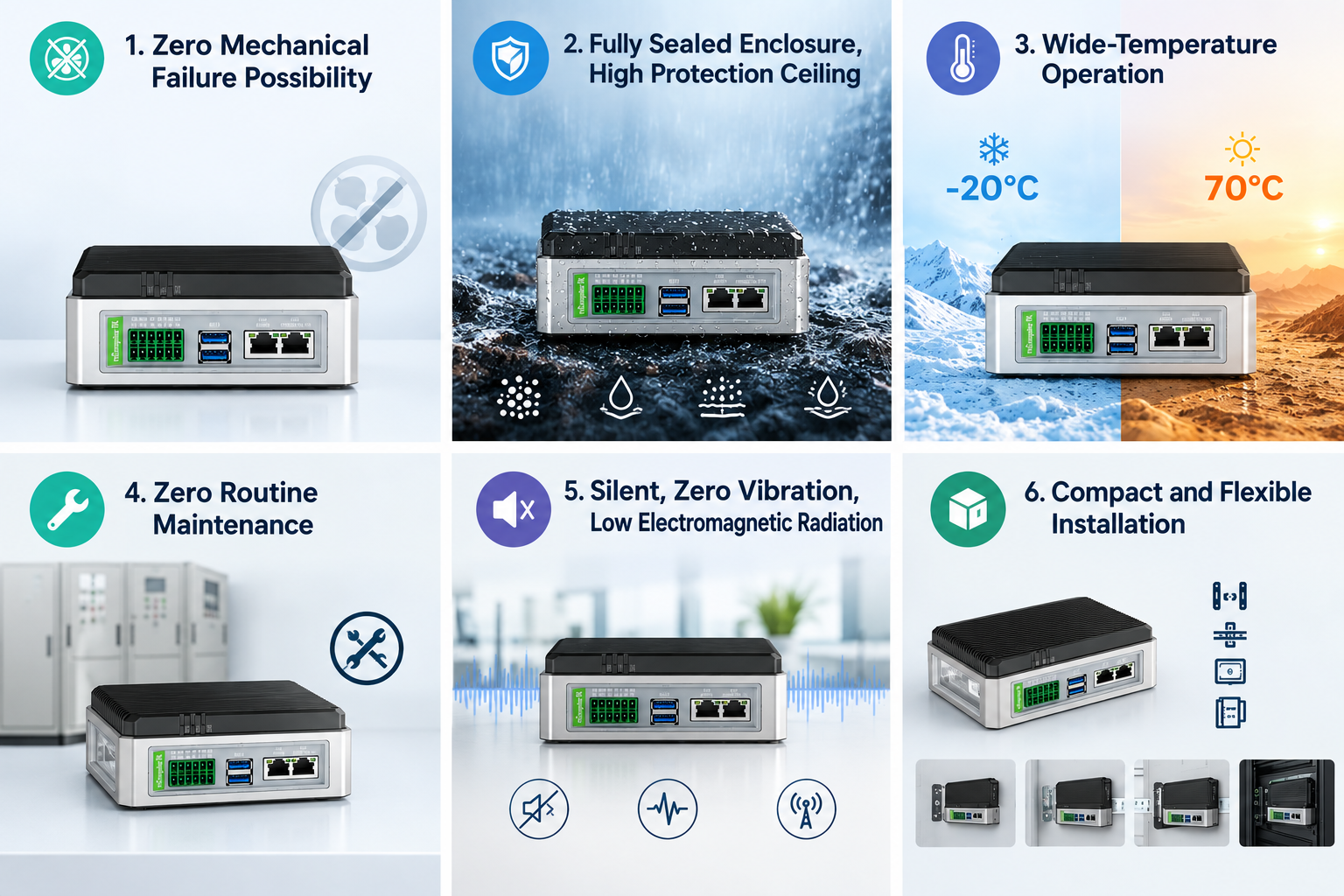
Zero Mechanical Failure Possibility (The Most Fundamental Advantage)
Completely fanless, motorless, and bearingless, the mechanical wear and fan-related failure rate is naturally zero. One fewer moving part means one fewer failure path—this is the fundamental reason fanless industrial computers have long been regarded as the preferred architecture for mission-critical applications. The other five advantages are essentially built on this one.
Fully Sealed Enclosure, High Protection Ceiling
No ventilation openings, naturally dust-proof, moisture-proof, salt-spray-proof, and splash-proof, meeting the hard sealing requirements of coal mines, outdoor cabinets, high-dust workshops, and similar environments. Active cooling must have intake and exhaust openings to ensure airflow, so its protection rating is naturally limited.
Wide-Temperature Operation
Common industrial-grade fanless solutions can cover -20 to 70°C operating temperature, with no fear of high-temperature summer equipment rooms or winter cold storage. This metric is especially critical for outdoor equipment, cold chain, and northern unattended sites.
Zero Routine Maintenance
After deployment, there is no need to clean fans, filters, or air ducts, enabling long-term unattended operation. For scenarios such as distribution cabinets, weak-current wells, and remote sites where “once the equipment is sent in, no one goes back,” this item directly determines total cost of ownership.
Silent, Zero Vibration, Low Electromagnetic Radiation
No rotating parts, zero noise, zero airflow noise, and no obvious vibration, suitable for laboratories, hospitals, office areas, precision monitoring, and other deployment locations sensitive to acoustics and vibration.
Compact and Flexible Installation
Fanless structures are easy to make small and thin, and various installation methods such as wall mounting, DIN rail, embedded, and cabinet mounting are easier to implement; the passive cooling metal enclosure itself often also serves as a structural component for fixing.
But passive cooling also has its disadvantages: the limit of passive cooling = the amount of heat that can be removed per unit volume. When suppressing sustained high power consumption (≥20W level) in an extremely compact chassis, concessions must be made in size/weight, or certain limits must be placed on SoC performance.
For the vast majority of industrial edge scenarios, passive cooling is sufficient. But in some special scenarios, passive cooling devices will face greater limitations:
① requiring an extremely small chassis;
② requiring long-term 100% occupancy of AI compute;
③ chassis dimensions strictly limited by DIN rail or rack space, unable to increase enclosure size to gain cooling capacity;
④ the working environment is not harsh, but requires 24/7 full load in a conventional data center, with extremely high compute density requirements per device.
When pursuing the smallest possible device size, the device’s compute capability cannot reach its maximum (it will cause overheating and trigger throttling); when pursuing full compute performance, the device size must be increased to meet the cooling capacity required for operation without throttling.
Recommended Fanless Cooling Devices for Industrial Edge Deployment
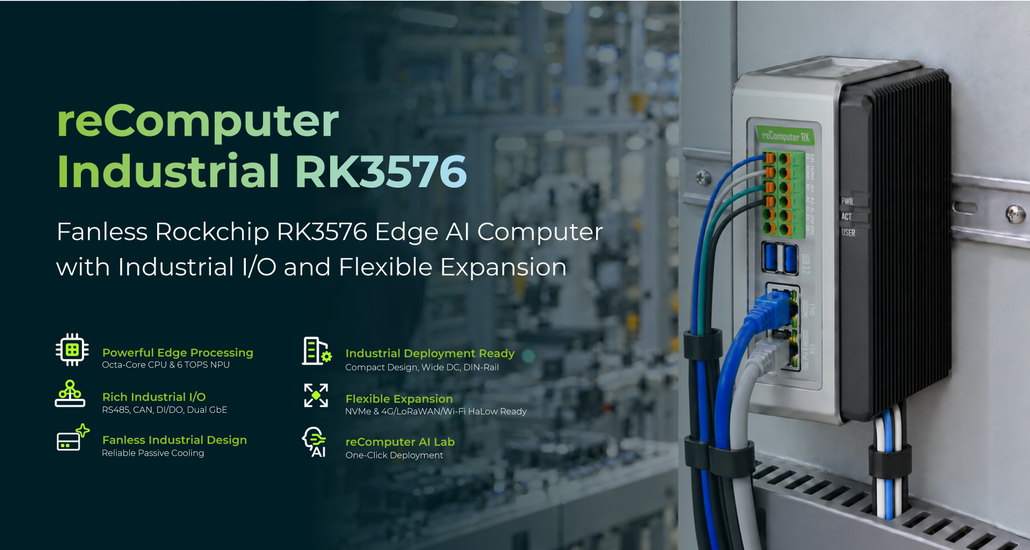
To address the above contradictions of industrial AI Boxes, Seeed Studio has launched the reComputer Industrial RK3576.
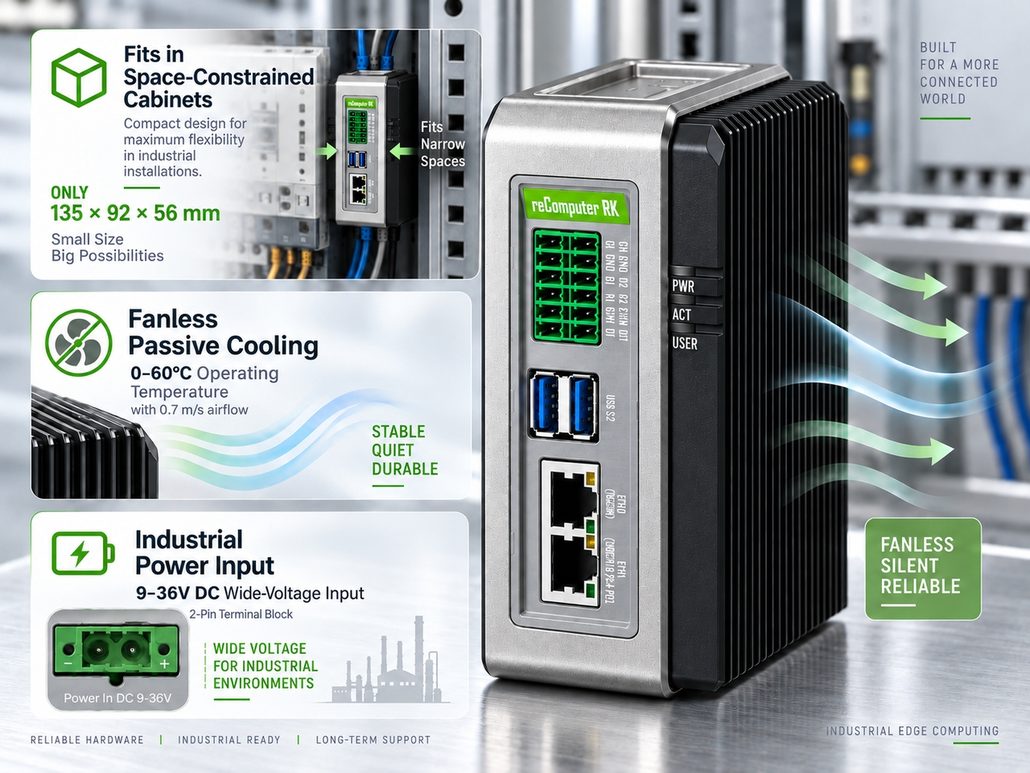
We integrated the Rockchip RK3576 computing platform into a compact and deployable industrial computer. The system includes an 8-core CPU architecture and 6 TOPS NPU compute. While reducing the overall device size to 135 × 92 × 56 mm, it can operate stably without throttling from 0–60°C (with 0.7m/s airflow) when an SSD is installed and the system runs at full load.
Thermal Performance Testing of the Fanless Design reComputer Industrial RK3576
In actual testing, the device simulated real edge AI full-load conditions throughout, covering normal temperature, high temperature, low temperature, and thermal cycling scenarios. Experimental parameters were designed with reference to actual application requirements. One set of 96-hour temperature test data is as follows:
| Test Stage | Duration | Environmental Condition | Ambient Temp | SoC Steady-State Temp | Big-Core Status | Little-Core Status | NPU Status | Test Conclusion | Corresponding Business Scenario |
| P1 Normal-Temp Warm-Up + Initial 55°C Test | 3.1 h | Normal temperature rising to high temperature | Normal → 55°C | Rose to 73°C, then switched to low-temperature stage | Full-frequency operation, 0% throttling | Full-frequency operation, 0% throttling | 93%–97% full load, constant frequency | Normal-temperature startup and heating process normal; verification passed | Indoor equipment rooms, normal-temperature control cabinet startup scenarios |
| P2 Low-Temp Cold-Start Stage | 48.0 h | Low-temp constant-temperature full load | 1–3°C | 1–3°C | Full-frequency operation, 0% throttling | Full-frequency operation, 0% throttling | 93%–97% full load, constant frequency | Stable long-term operation in low-temperature environments; high/low-temperature test passed | Northern outdoor sites, areas around cold storage, winter outdoor stations |
| P3 55°C Retest Stage | 23.5 h | High-temp constant-temperature full load (after thermal cycling) | 55°C | 75–76°C | Full-frequency operation, 0% throttling | Full-frequency operation, 0% throttling | 93%–97% full load, constant frequency | No performance degradation after thermal cycling; no throttling throughout at 55°C | Standard industrial control cabinets, factory production-line quality inspection, conventional roadside gateways |
| P4 60°C High-Limit Stage | 15.9 h | Extreme high-temp full load | 60°C | 82–83°C | Full-frequency operation, 0% throttling | Occasional brief throttling (7,402 times total, average 1.34 s per occurrence, total proportion ≈17%) | 93%–97% full load, constant frequency | Under extreme high temperature, core compute is unaffected; only the little cores undergo brief thermal throttling | Extreme summer outdoor heat, sealed unventilated cabinets (extreme conditions) |
This continuous high/low-temperature full-load test shows that the device can operate at full load with zero throttling throughout mainstream industrial conditions at 55°C and below, with no loss in CPU or NPU compute, and stably output full compute 24/7. Under the extreme high temperature of 60°C, the NPU responsible for AI inference and the CPU big cores can maintain full frequency, with only the background scheduling little cores experiencing brief occasional throttling, not affecting core business operation. After thermal cycling, the device’s cooling and performance show no aging degradation. Low temperature allows direct cold start and rapid NPU full load. The device is fully capable of adapting to changes across temperature ranges.
Click here to learn more about reComputer Industrial RK3576: reComputer Industrial RK3576 Edge AI Computer | Seeed Studio
Common Deployment Scenarios reComputer RK3576 Supports
Based on the above scenario analysis and simulation testing of actual industrial equipment, for the following scenarios, devices with [fanless passive cooling] are recommended, which are also application scenarios supported by the reComputer Industrial RK3576:
- Continuous dust environments such as industrial production lines, assembly workshops, metal processing, woodworking, and textiles.
- Outdoor cabinets, roadside equipment, seaside/salt-spray areas, coal mines, ports, and construction sites.
- AGV, AMR, forklifts, vehicle-mounted terminals, and other scenarios with long-term vibration + start-stop impact.
- Unattended locations such as distribution cabinets, weak-current wells, elevator shafts, and remote sites.
- Noise- and vibration-sensitive environments such as laboratories, hospitals, office areas, and precision monitoring rooms.
- Loads mainly consisting of data acquisition, protocol passthrough, edge gateways, and lightweight inference, without the need for long-term full-power AI compute.
Final Thoughts on Choosing Fanless Devices for Industrial Edge Deployment
The essential constraint of industrial edge deployment is “long-term, unattended, harsh,” which determines that fanless passive cooling is the default form and the standard answer for industrial scenarios; fan cooling is an engineering compromise when compute demand breaks through the physical limits of passive cooling. Which solution to choose is not a matter of preference, but an engineering conclusion after putting the physical conditions of the deployment environment, compute requirements, and O&M capabilities into the formula together.
Seeed offers two edge computing solutions based on the Rockchip RK3576 platform: the reComputer RK3576 and the reComputer Industrial RK3576. The former features active cooling and a cost-effective design for general commercial applications, while the latter adopts a compact, fanless passive-cooling design tailored to demanding industrial environments.
Further Information about Seeed’s reComputer RK Series
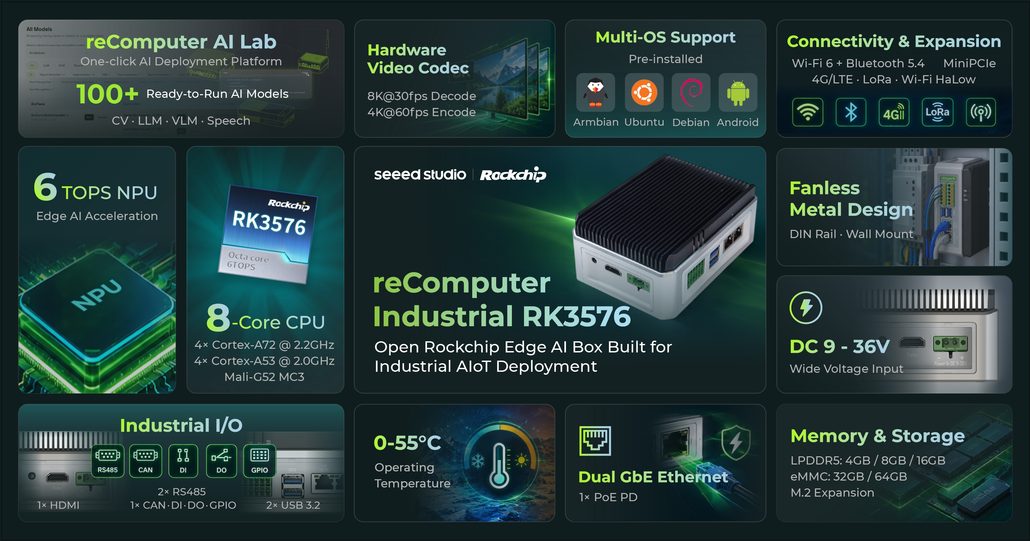
Want to learn about Seeed’s device customization standards? Click the link to jump and learn about Seeed’s complete process for Rockchip products, from customization to production –> Click here to quickly jump and learn more detailed product information <–
About Author
