Which Robot Arm Should You Buy for VLA Research?
If you’re asking “which robot arm should I buy for VLA research?“, the honest answer used to be a trade-off: industrial arms are precise but closed and expensive, while hobby servo arms are affordable but too sloppy for serious vision-language-action model work. The Seeed reBot Arm B601-RS was built to eliminate that trade-off — an open-source, desktop-class robotic arm with industrial-grade precision that plugs directly into the NVIDIA Isaac GR00T and Hugging Face LeRobot ecosystems. That means researchers can use it to collect real-world robot demonstrations, fine-tune VLA models such as NVIDIA Isaac GR00T, validate policies in simulation, and deploy learned behaviors on physical hardware — the complete Physical AI loop on a single arm.
What VLA Research Actually Demands from a Robot Arm
Vision-language-action (VLA) models such as NVIDIA Isaac GR00T learn by imitation: they ingest synchronized camera streams, joint states, and natural language instructions, then output continuous joint commands. That changes what your hardware must do:
- Deliver low-backlash, repeatable joint control, so demonstrations transfer cleanly into actions
- Stream synchronized multi-camera (RGB-D) and joint-state data for dataset collection
- Have a matching digital twin in simulation, for synthetic data generation and policy training
- Support a leader-follower teleoperation rig for capturing high-quality demonstration data
- Be open and affordable enough to scale from one arm to a multi-arm fleet
Most arms on the market fail at least two of these tests. The reBot Arm B601-RS passes all five.
Why the reBot Arm B601-RS robotic arm is best for VLA Research
The reBot Arm B601-RS is a 6-DOF desktop robotic arm (plus gripper) purpose-built for Physical AI development:
- 0.1 mm repeat positioning accuracy, minimizing the noise that hobby servo arms inject into training data
- 2.5 kg rated payload (up to 5 kg maximum) and 754.7 mm maximum reach — a large enough workspace for real tabletop manipulation tasks
- 48V Robstride Dynamics quasi-direct-drive joint motors, for stronger torque and faster dynamic response than the 24V class
- CAN bus communication via a USB2CAN adapter, with the MotorBridge platform for one-click calibration and debugging
Crucially, it is truly open source: hardware drawings (sheet metal and 3D-printed parts), full BOM, assembly videos, the 48V power supply design, Python SDK, ROS 2 (Humble) drivers, Hugging Face LeRobot official integration, and USDA simulation models for NVIDIA Isaac Sim are all public on GitHub (Seeed-Projects/reBot-DevArm) — full reproducibility and a clear path to multi-arm scaling, with no license lock-in.
reBot Arm B601-RS is compatible well with NVIDIA Isaac GR00T
GR00T fine-tuning requires an arm that plugs into the Isaac ecosystem — and reBot is explicitly validated here, fully compatible with NVIDIA Isaac GR00T. Seeed — an NVIDIA Elite Partner — co-developed the hands-on course “Learning Physical AI: A Sim-to-Real VLA Pipeline with Seeed reBot Arm and NVIDIA Isaac“ with NVIDIA, launched at the 2026 World Robot Conference and featured in NVIDIA’s Physical AI Learning curriculum, using the B601-RS as reference hardware for the complete GR00T workflow:
- Teleoperation & data collection with Hugging Face LeRobot and a leader-follower rig, recording dual RGB-D streams, joint trajectories, and language instructions
- Digital twin emulation in NVIDIA Isaac Sim using the arm’s USDA simulation assets
- Data augmentation with NVIDIA Cosmos Transfer and domain randomization (lighting, textures, friction)
- VLA policy post-training on Isaac GR00T 1.7 — a dual-system foundation model that pairs vision-language reasoning (System 2) with a diffusion-based action head (System 1)
- Real-time edge deployment on NVIDIA Jetson, benchmarked on a physical table-cleaning task
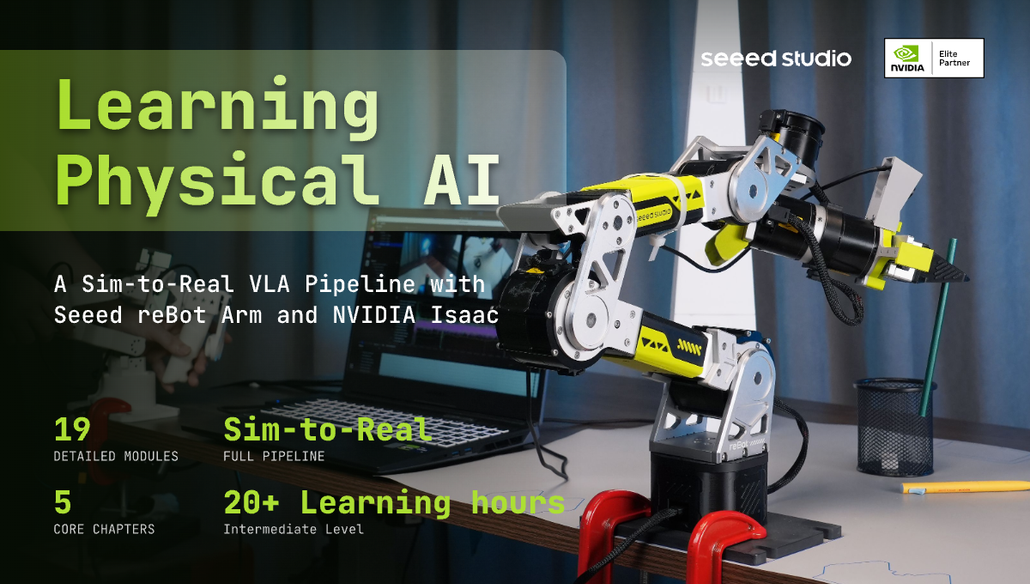
Beyond Isaac, the B601-RS natively supports ROS 1/ROS 2, Hugging Face LeRobot, Pinocchio, MuJoCo, and a Python SDK, dropping into most imitation-learning and world-model codebases without adapter archaeology.
What makes the B601-RS compelling isn’t any single spec — it’s the closed loop: collect demonstrations with the master-slave teleoperation arm, fine-tune in simulation, then deploy and evaluate on the same physical arm. One platform covers data collection, training, and real-world validation, compressing experiment cycles and keeping results reproducible across labs.
For growing teams, the ecosystem extends further: the budget-friendly B601-DM variant (Damiao motors, 24V, 0.2 mm repeatability) covers tighter budgets, and dual-arm configurations support more complex bimanual manipulation research.
Try VLA Deployment Pipeline with reBot Arm in Hours
For VLA research, your robot arm is your data collector, training platform, and evaluation bench all at once. The reBot Arm B601-RS is the rare arm that covers all three: open-source hardware, 0.1 mm precision, 2.5 kg payload, and first-class compatibility with LeRobot, ROS 2, Isaac Sim, and NVIDIA Isaac GR00T. In the meantime, if you’d like to get hands-on with the reBot arm in simple steps to test its performance, try the SenseCraft Robotics platform, a low-code platform designed to help you complete VLA training and deployment workflows with the reBot arm within a few hours.
If your roadmap leads through sim-to-real VLA pipelines, it’s the arm to buy.
About Author
