Building AI Goggles — What its “Brain” Should Look Like
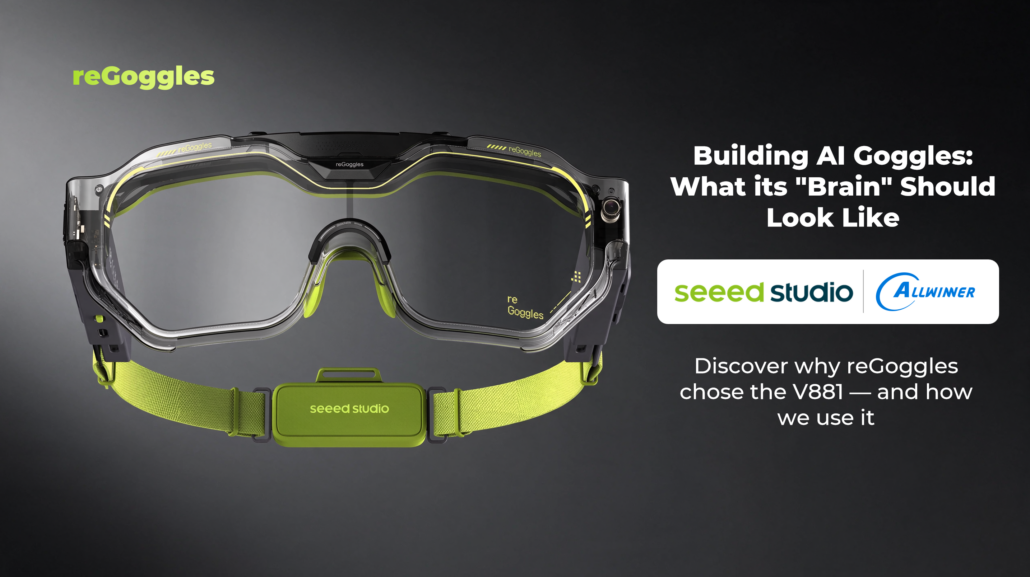
For a pair of open smart glasses like reGoggles, everything starts with one choice: the main SoC.
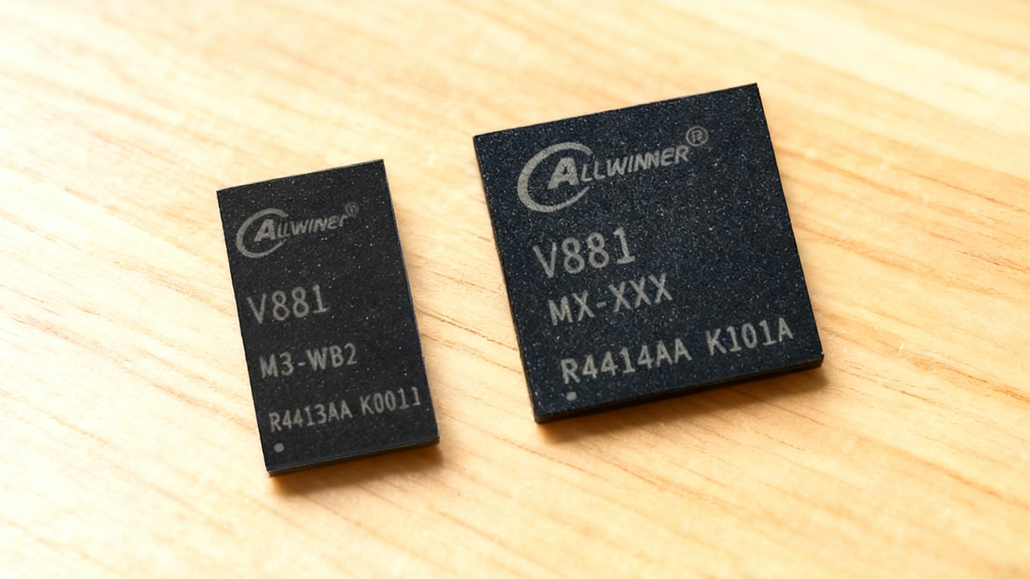
We went with Allwinner’s newly released V881 family, which the company positions as a “4K30 HD AI Vision Processor.” Inside that family, the V881M3-WB2 landed almost exactly on our size, video, and cost targets. This post looks at what the chip can do — and how we actually put it to work on reGoggles.
Allwinner V881: Purpose – Built for Smart Glasses
1.1 Multi-path video input
Smart glasses can’t achieve multimodal perception with a single RGB camera. The V881M3-WB2 offers three MIPI CSI-2 interfaces (DPHY V1.1, 1.5 Gbit/s per lane) and splits its four physical data lanes three ways: 1×4, 2×2, or 3×1.
In practice, the main camera can take 2 lanes, leaving the other 2 for a ToF sensor or a second camera — enough to run “RGB + depth” or stereo in one device. If a later design needs one high-bandwidth sensor, the four lanes can merge back into a single 1×4 link.
1.2 Pre-encode preprocessing
Shake, backlight, and low light cause most of the quality loss in head-worn imaging. NPU post-processing cannot fix them perfectly. The V881 integrates Allwinner’s AI-ISP 2.0. It applies 2F-WDR, 2D/3D noise reduction, and hardware EIS in the RAW domain. These corrections land before the frame reaches the encoder. No external ISP sits between the sensor and the encoder. So the board needs less area, images come out cleaner, and encoding costs less.
1.3 Strong encoding, minimal decoding
Capture matters more than playback on smart glasses. The V881 puts its silicon into the encode path to meet the demands of industrial AI applications. It supports H.265 and H.264 encoding up to 4K, plus baseline JPEG up to 1080p. Together they cover primary recording, compatibility playback, and still capture. The decode side keeps only one JPEG path at 1080p, enough for thumbnails and capture previews.
1.4 Heterogeneous cores, jitter-free pipelines
The V881 uses a three-core heterogeneous architecture, with each core taking a different kind of work. Its main core is a dual-core C907 at 1.4 GHz, with a 128-bit RVV1.0 vector unit. This core runs the main Linux pipeline. A separate E907 at 800 MHz handles audio and sensor input in real time. A 1 TOPS NPU then covers lightweight vision inference. Because each core owns one class of task, real-time work never preempts the main core. So video and inference both run without jitter.
1.5 All-in-one SiP packaging
The V881M3-WB2 uses SiP packaging. The package stacks 128 MB of DDR3 on top of the main die. It also adds a dual-band Wi-Fi 6 radio at 1T1R and Bluetooth 5.4. All of this fits in an 11.9 × 6.9 mm body. Compared with a discrete design, it eliminates external DRAM, the wireless module, and their PCB traces. That cuts board area and power significantly.
How reGoggles Actually Uses the V881
2.1 Two-SoC architecture: V881 for vision, WQ7036AX for always-on
reGoggles uses a host-and-companion two-chip design: the V881 serves as the application processor for visual capture, AI inference, and Wi-Fi; the WQ7036AX is a low-power companion responsible for Bluetooth audio, key detection, and power-domain management.
When idle, the V881 enters super-standby, where the AON domain draws about 10 µA with the rail off and 600 µA in standby. BLE advertising, button interrupts, and voice wake-up are all handled by the WQ7036AX; when any one of them fires, it wakes the V881 through a hardware interrupt. Heavy loads power up on demand, light loads stay on watch — and that split is what brings average system power into a workable range.
2.2 Modular expansion ports
reGoggles breaks out two MIPI ports from the V881. The first is a dedicated 2-lane link to the main camera, so baseline capture works without configuration. The second is a 2-lane link shared by both expansion ports. It carries either a secondary camera or a 1-lane ToF sensor. Only one module can attach to it at a time.
2.3 A mainboard that fits the temple
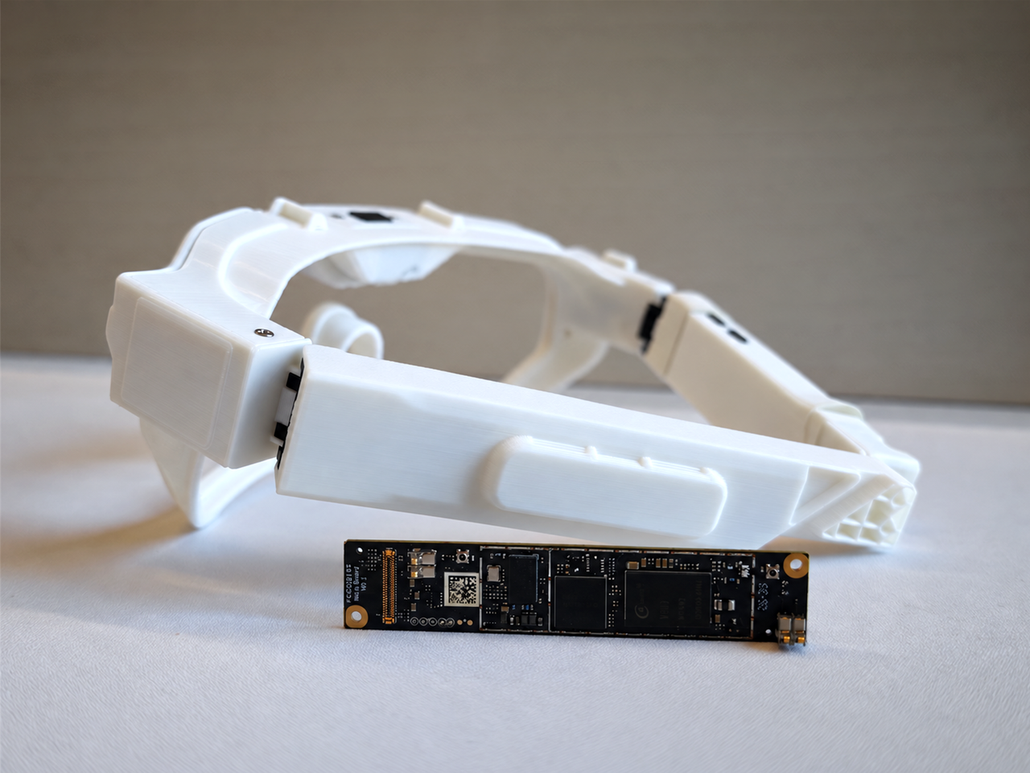
The mainboard measures 13 × 67 mm, a size the SiP integration of the V881M3-WB2 makes possible: one 11.9 × 6.9 mm package carries the compute core, NPU, 128 MB DDR3, and the Wi-Fi/BT 5.4 radio, so the board needs no external DRAM or wireless components. The WQ7036AX companion measures 3.8 × 6.5 mm. Runtime memory sits inside the SiP, while eMMC remains on-board for non-volatile storage. Both BGA SoCs and the eMMC fan out within the 13 mm width, on a 12-layer stackup built with two-stage HDI.
2.4 HD streaming, 4K still capture
The V881M3-WB2 encodes H.265 at 4K@30 and H.264 at 4K@25, but reGoggles doesn’t stream 4K continuously: 1T1R single-stream Wi-Fi can’t sustain the bitrate, and the sealed temple’s short thermal path would force throttling under sustained high-bitrate encoding. Testing shows long-running streams hold 1080p, where latency and stability for on-device inference and remote views are more predictable. 4K is reserved for still captures — key-moment records and high-resolution vision-model input.
Open Source, So You Actually Own It
Smart glasses on the market today are almost universally closed-source, and an open hardware platform for developers has been absent for far too long. reGoggles is a joint project of open smart glasses by Seeed and Allwinner. It is designed as a hardware base you can modify freely: interfaces are open, firmware is editable, and developers can bring their own algorithms, backend, and sensors without waiting on a vendor roadmap.
The firmware is built on the V881 BSP and runs Linux 6.6 (OpenWrt), split into seven independently replaceable services: capture, audio, sensing, input, system, OTA, and Bluetooth. The SDK and firmware documentation are in preparation and will be published on GitHub shortly.
Join Now
- Early Builder Program and full story: https://www.seeedstudio.com/blog/2026/11/06/introducing-regoggles-building-open-smart-goggles-together/
- Join our Discord community and connect with developers worldwide: https://discord.gg/jb5qdrnAVU
- Subscribe to email updates on the landing page to be the first to receive development news and Early Builder application notices: www.seeedstudio.com/regoggles
- Industrial customers or potential partners can reach us directly at: https://www.seeedstudio.com/contacts, or fill out our enterprise application form: https://docs.google.com/forms/d/e/1FAIpQLSdeWjPPHA_orgoDbsES4A_fsP4bHeOsbbtGSKGhObkvSF_pjg/viewform?usp=header
About Author
