New Release: reSpeaker XMOS XVF3800 – AI-Powered 4-Microphone Array for Clear Voice Even in Noise
At Seeed, we’re diving into the exciting world of voice AI with our Microphone Arrays Series — reSpeaker, focusing on enhancing the quality of voice as the foundation for more complex audio applications. Whether it’s isolating a specific voice in a crowded room or detecting subtle audio cues, it all begins with the ability to capture and process high-quality sound. In this article, we’ll explore how Seeed is advancing voice AI and the technologies that make it possible.
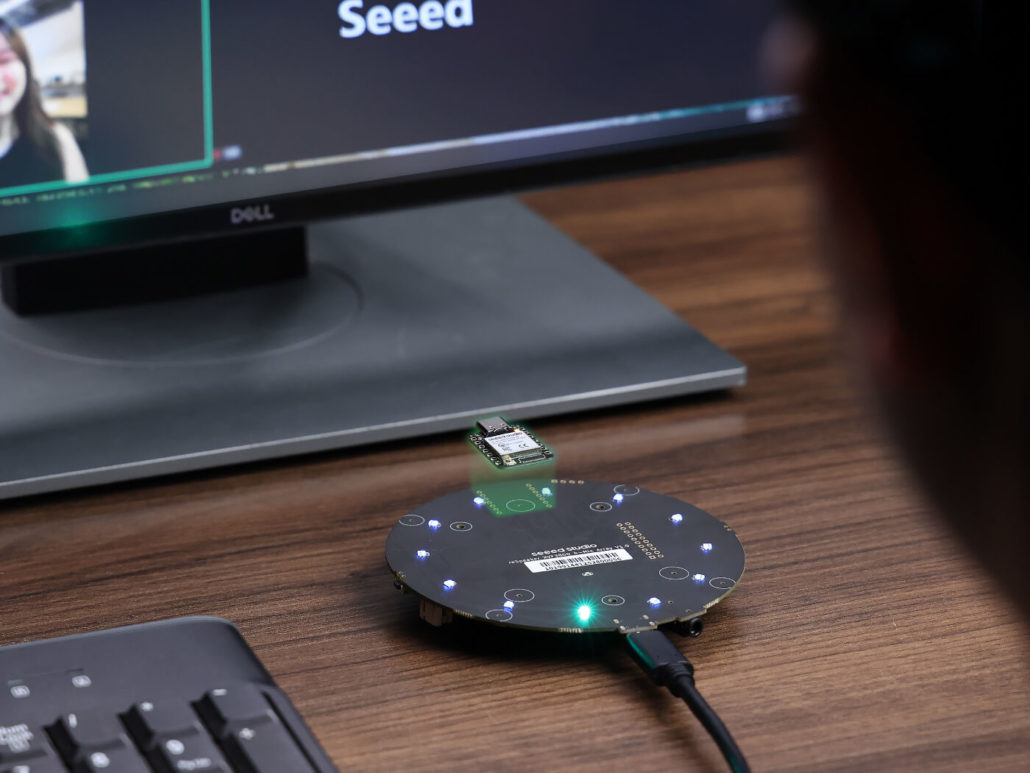
Microphone Arrays and Voice Processing Algorithms: The Key to Capturing Clear Audio in Complex Environments
When it comes to capturing high-quality voice, the microphone is the starting point. There are two main types: a single microphone and a microphone array. While a single microphone works well for simple, close-range voice interactions, a microphone array is designed to tackle more complex environments. With multiple microphones working together, a microphone array is ideal for spaces like meeting rooms or open areas where multiple people are speaking from different directions and distances.
But what makes microphone arrays so effective in handling such complex audio environments? The answer lies in their ability to utilize various voice processing algorithms. These advanced algorithms enable microphone arrays to handle challenges like background noise, multiple speakers, and varying voice volumes—ensuring that the audio captured is both clear and accurate.
1. Automatic Gain Control (AGC)
AGC automatically adjusts volume levels to create a balanced audio output. It makes quiet voices louder and loud voices softer, ensuring that everyone’s voice is heard at the same level. This results in a more natural, balanced audio experience without the need for manual volume adjustments.
2. Acoustic Echo Cancellation (AEC)
AEC removes any echo that may occur during two-way communication, particularly in speakerphone or conference call scenarios. It stops the microphone from picking up voices from the speaker, preventing annoying audio loops and improving the clarity of the conversation.
3. Noise Suppression
Noise Suppression identifies and removes unwanted noise from the voice signal, such as the hum of a fan or the click of a keyboard. By filtering out these distractions, it ensures that only the clean voice signal remains, providing clear communication even in noisy environments.
4. Direction of Arrival (DoA)
DoA calculates the direction from which the voice is coming. This algorithm enables the microphone array to identify the location of a speaker, ensuring that the system focuses on the right voice source, even in environments with multiple sounds or speakers.
5. BF (Beamforming)
Beamforming focuses on voice coming from a specific direction while reducing noise from other directions. This is especially useful in meetings where multiple people speak from different positions. It can be adaptive, automatically detecting and following the speaker, or it can be pre-set to a fixed direction, such as a 45° angle, to only enhance voice from that direction.
By leveraging these advanced voice processing algorithms, microphone arrays can effectively handle a variety of challenges in real-world applications like conferences, smart home devices, and AI-powered communication systems.
Seeed’s Voice AI Solutions: reSpeaker Microphone Array Series Tailored for Your Applications
Seeed’s reSpeaker product line offers a range of microphone arrays, from simple voice interactions to complex far-field applications. These arrays support various voice processing algorithms that improve voice quality.
reSpeaker Lite 2-Mic Array – Embedded AI for Better Sound Quality
The reSpeaker Lite is a compact 2-mic array based on the XMOS XU316 chip. This compact, powerful microphone array is optimized for a variety of use cases, offering exceptional voice processing capabilities with embedded algorithms like Interference Cancellation (IC), AGC, NS, and AEC.
The reSpeaker Lite offers great flexibility for development and deployment, available in three variants: a standalone USB board for platforms that support USB audio and I2S, a version with a soldered XIAO ESP32S3 for seamless integration with Home Assistant via ESPHome, and a complete kit with a mono speaker and acrylic enclosure, providing an all-in-one voice interaction solution. This versatility makes it highly customizable and ideal for various projects.
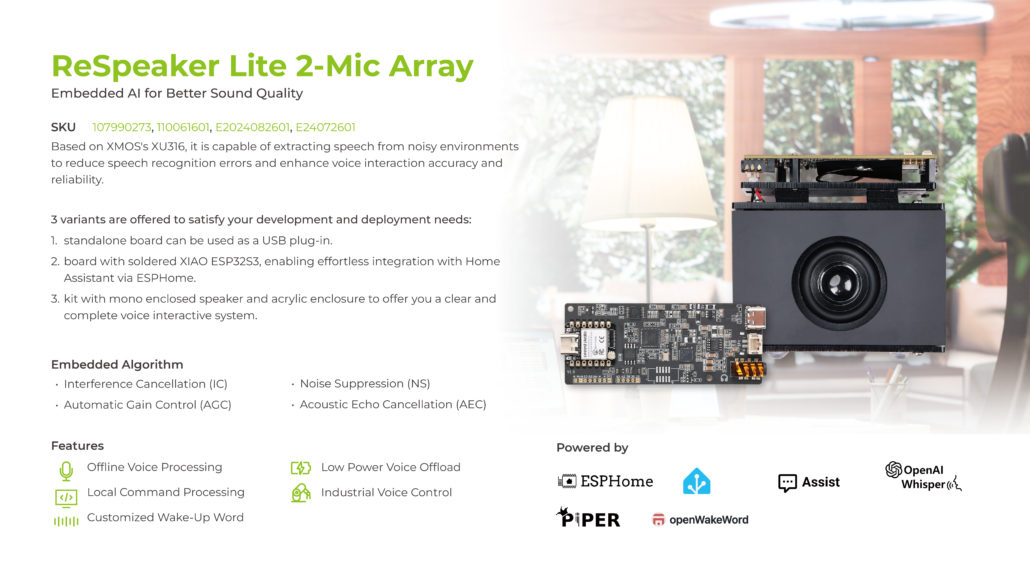
reSpeaker XMOS XVF3800 4-Mic Array – AI-powered Microphone Array for Clear Voice Even in Noise
Introducing Seeed Studio’s newest reSpeaker XVF3800, an AI-powered 4-mic array for clear voice even in noise, with the more powerful XMOS XVF3800 chip. The reSpeaker XVF3800 provides clear voice capture in noisy environments with features like 360° far-field voice pickup (up to 5 meters), AEC, AGC, DoA, beamforming, and noise suppression. The combination of the XMOS XVF3800 chip and the 4-mic array enables the reSpeaker to handle complex audio scenarios, making it ideal for applications like smart devices, AI assistants, or conference systems that require precise voice recognition and isolation.
4 versions to meet different needs:
- reSpeaker XMOS XVF3800
- reSpeaker XMOS XVF3800 with Case
- reSpeaker XMOS XVF3800 with XIAO ESP32S3
- reSpeaker XMOS XVF3800 with XIAO ESP32S3 (Case Version)
Additionally, the reSpeaker XVF3800 also integrates XIAO ESP32S3 for use with Home Assistant, allowing users to easily integrate it into smart home setups for automated voice control and other advanced AI functions.
Deep Dive into Seeed Studio’s Latest Launch: reSpeaker XMOS XVF3800
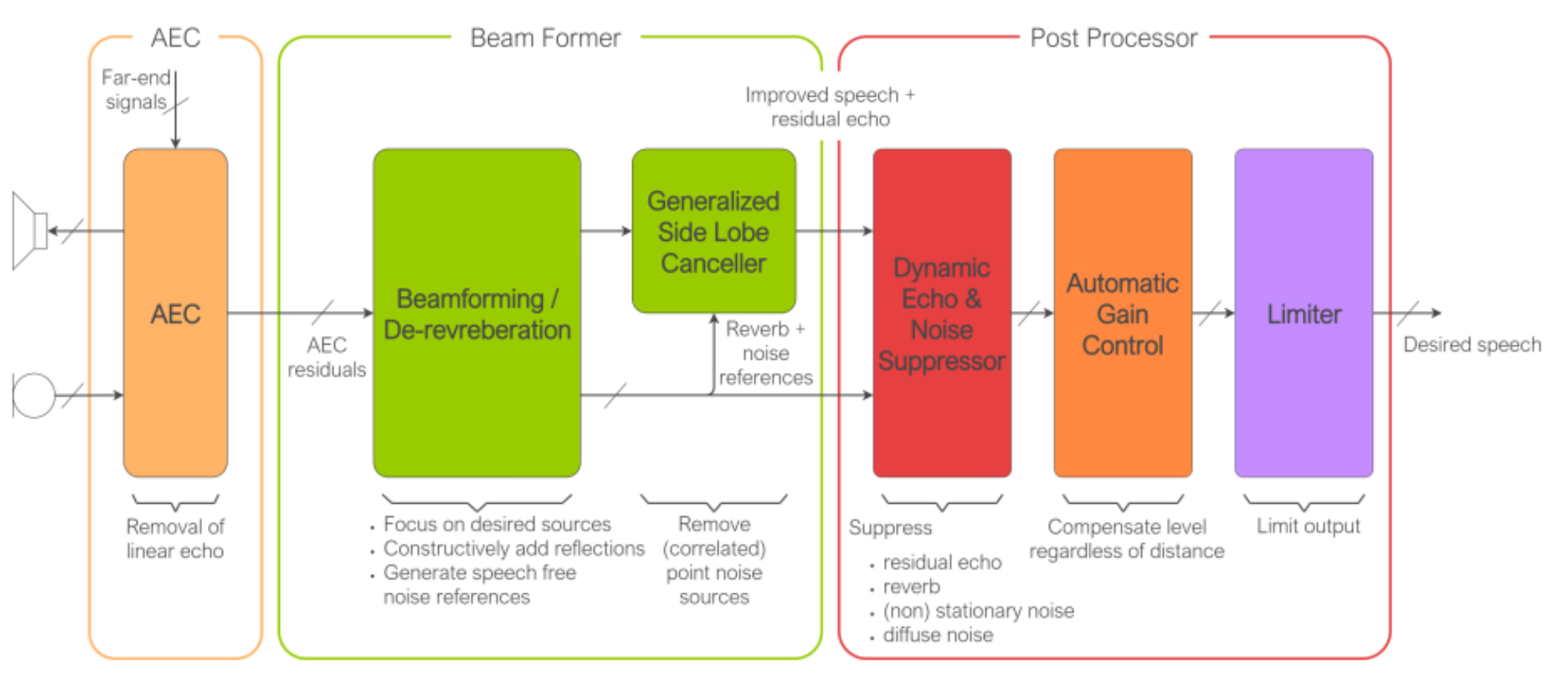
The reSpeaker algorithm pipeline generally follows a sequence where the voice is first cleaned up, then volume adjustments are made. The exact order may vary depending on the chip or company, but typically, it starts with noise reduction, followed by beamforming and dereverberation, and ends with automatic gain control (AGC) to optimize the audio. Now, let’s dive deeper into how each of these algorithms works with some live demos.
1. reSpeaker XMOS XVF3800 integrated with Home Assistant
Home Assistant is an open-source platform for automating and controlling smart devices in your home. It allows you to integrate various smart products, manage them from a single dashboard, and create custom automations for tasks like lighting, security, and climate control.
Using the power of Voice AI and IoT, you can easily manage your devices—like turning a lamp on and off—simply by speaking. The process is smooth and intuitive, offering an excellent example of how voice control can be incorporated into everyday smart home applications. With reSpeaker acting as the bridge for voice commands, this setup enhances convenience and demonstrates the practical capabilities of sound-driven IoT interactions.
2. reSpeaker XMOS XVF3800 + Whisper for Seamless STT(Speech-to-Text) Conversion
STT (Speech-to-Text) is a technology that converts spoken language into written text, enabling devices to transcribe speech in real time. It plays a key role in many sound-related applications by allowing hands-free interaction and faster data processing.
Whisper is an open-source speech recognition system developed by OpenAI. It can transcribe spoken language into text in multiple languages, offering high accuracy and robustness across various audio conditions.
Featuring Whisper STT for seamless voice-to-text conversion, combined with the reComputer AI Industrial R, powered by the Raspberry Pi CM5 and the Hailo-8 AI accelerator, we demonstrate how this powerful combination captures speech and converts it into accurate text output. This combination can be used in applications such as real-time voice assistants, smart home systems, and automated customer service. The high accuracy and speed of STT conversion enable seamless voice interactions, where users can control devices, query information, or issue commands effortlessly.
3. reSpeaker XMOS XVF3800 Enabling Robots to Respond to Your Voice
By showcasing reSpeaker’s integration with a robot through AI Box, we highlight how the robot can detect and turn toward the direction of your voice in real-time. This simple yet powerful feature demonstrates reSpeaker’s ability to capture voice commands and translate them into actions, enhancing robot interactions. While this is just a basic example, it reveals the vast potential of reSpeaker in robotics. With its advanced voice recognition capabilities, reSpeaker enables robots to respond dynamically to their environment, paving the way for more intuitive, interactive, and personalized systems.
How to Choose your reSpeaker Microphone Array
| reSpeaker Lite | reSpeaker XVF3800 | reSpeaker XVF3000 | |
| Price | $28.99 | $59.99 | $64.00 |
| No. of Mics | 2 PDM MEMS Microphones | 4 PDM MEMS Microphones | 4 PDM MEMS Microphones |
| Microphone Array | Linear 2-Microphone Array | Circular 4-Microphone Array | Circular 4-Microphone Array |
| Core Chip | XMOS XU316 | XMOS XVF3800 | XMOS XVF3000 |
| Pickup Range | up to 3 meters | up to 5 meters | up to 5 meters |
| AI Algorithms | Interference Cancellation (IC) Acoustic Echo Cancellation (AEC) Noise Suppression (NS)Voice-to-Noise Ratio (VNR)Automatic Gain Control (AGC) | Acoustic Echo Cancellation (AEC) Noise Suppression (NS)Voice-to-Noise Ratio (VNR)Automatic Gain Control (AGC) Direction of Arrival(DoA)De-ReverberationMulti-beamforming | Acoustic Echo Cancellation (AEC) Noise Suppression (NS)Voice-to-Noise Ratio (VNR)Automatic Gain Control (AGC) Direction of Arrival(DoA)De-ReverberationBeamforming |
| Connectivity | USB、I2S | USB、I2S | USB |
| Compatibility | XIAO ESP32S3, Raspberry PiJetsonPC, any platform supports I2S and USB Audio | XIAO ESP32S3, Raspberry PiJetsonPC,any platform supports I2S and USB Audio | Raspberry Pi, JetsonPC, any platform supports USB Audio |
| Application | Wireless voice assistants, Home Assistant integration, DIY projects, prototyping, basic smart home devices, education | Wireless voice assistants, Home Assistant integration, Conference systems, smart robots, professional voice assistants, noisy environments, voice localization | Conference systems, smart robots, professional voice assistants, noisy environments, voice localization |
When selecting a reSpeaker microphone array, several key factors should guide your decision:
- Number of Microphones: The number of microphones directly impacts the array’s ability to capture voice accurately. A 2-mic array is ideal for simpler applications, while a 4-mic array provides enhanced performance in more complex environments, delivering clearer voice capture.
- Pickup Range: The range at which the microphone array can effectively capture voice is crucial for determining the size of the area it can cover. Seeed reSpeaker can capture voice from 3 to 5 meters, this range is suitable for a wide variety of applications.
- Built-in Algorithms: The quality and type of embedded algorithms determine how well the array handles environmental challenges like noise or echo. You should carefully consider these factors to ensure the array best suits your application. The XVF3800 series features more advanced algorithms than the Lite model. These algorithms can be adjusted to meet specific needs.
- Connectivity and Platform Support: Compatibility with various platforms and connectivity options (such as I2S and USB Audio) is essential for ensuring the microphone array integrates seamlessly with your existing hardware. This versatility allows users to connect the array to a broad range of devices, from SBCs to PCs running different operating systems.
By considering these factors, you can easily choose the right reSpeaker microphone array to fit your specific needs. Currently, Seeed offers circular 4-mic arrays, ideal for central placement in a room. We’re also planning to release linear 4-mic arrays, perfect for TVs or applications requiring 180-degree front coverage.
Unlock the Power of Voice AI with reSpeaker: Advanced Microphone Arrays for Smart Solutions
As we’ve explored in this blog, reSpeaker microphone arrays bring powerful, precise voice AI capabilities to a wide range of applications, from smart homes to industrial voice control systems. With built-in advanced algorithms, seamless integration with various platforms, and multiple configuration options, reSpeaker offers both versatility and exceptional performance.
Whether you’re looking to enhance voice interaction for IoT or improve voice clarity in challenging environments, reSpeaker has a solution tailored to your needs.
About Author
