Improving Reachy Mini Assembly Quality with Seeed Studio reCamera PoE: Edge AI Vision Inspection for Smart Factory
Project Summary
During the mass production of Reachy Mini, the manufacturing team identified a repetitive inspection challenge in the servo installation process. Technicians had to manually verify whether each servo motor was installed in the correct orientation and whether the nameplate matched the model number. To reduce human error and improve inspection efficiency, the team introduced reCamera as an automated visual inspection system. By combining a lightweight optical algorithm and on-device OCR, reCamera can automatically detect reversed servo installation and verify servo model labels directly on the assembly line. This edge AI vision solution transforms a previously manual inspection task into a fast, consistent, and scalable process, helping streamline production while improving quality control.
Project Background
Together with Pollen Robotics and Seeed Studio, Reachy Mini is the first open-source desktop robot introduced by Hugging Face, built to make experimenting with robotics and AI more accessible. Designed to be expressive, programmable, and easy to interact with, it allows users to explore human–robot interaction and intelligent behavior right from their desk.
More than just a robot product, Reachy Mini functions as a development platform that encourages hands-on exploration and community collaboration. It provides an approachable way for people to prototype ideas, learn about robotics, and build interactive AI experiences.
As the production of Reachy Mini scaled up to over 3,000 pcs, one key step in the assembly process required operators to visually confirm:
- Whether the servo motor orientation was correct
(The circular component on the lower layer has two vertical lines on one side and a single vertical line on the other. In the correct assembly orientation, the side with two vertical lines should face outward, while the side with the single vertical line should face inward.)
- Whether the nameplate matched the model number
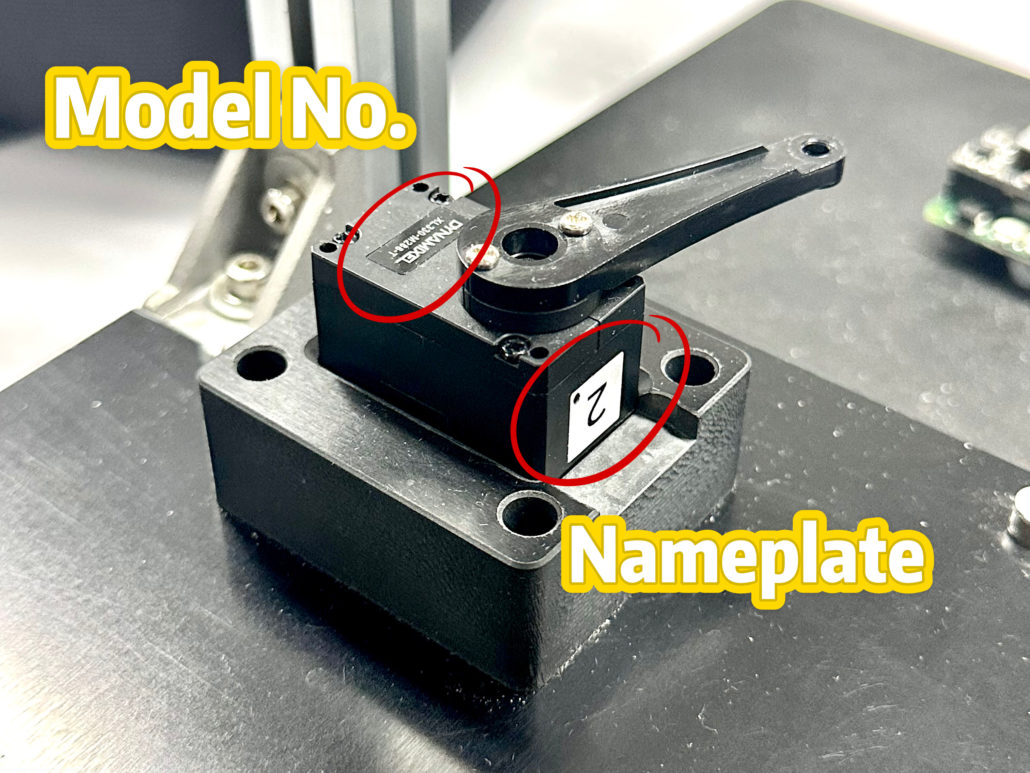
This verification step occurs during the assembly inspection stage, where each unit must be checked before proceeding to final assembly.
Because this process relied entirely on human inspection, it introduced several operational risks:
- Human visual inspection can occasionally miss errors
- The step requires dedicated manual labor time
- Inconsistent inspection quality can lead to downstream rework
To address this, the engineering team began exploring whether an edge AI vision system could automate this inspection step.
The Challenge
Manual Visual Inspection
Originally, this inspection step relied entirely on a human operator who visually checked every servo during the assembly process.
This process required one dedicated operator and still carried the risk of occasional misjudgment due to fatigue or visual oversight.
Error Risks in High-Volume Assembly
Servo installation errors are particularly problematic because:
- Orientation errors can affect mechanical movement
- Incorrect models may cause compatibility issues
- Model number mismatches can lead to traceability and even more serious problems
Even small error rates can create rework costs and production delays when discovered later in the assembly process.
The Idea: Bringing Edge AI Vision to the Production Line
The solution emerged through collaboration between Eric Pan, CEO of Seeed Studio, and the reCamera team
Instead of relying solely on human inspection, the team proposed deploying a compact AI camera directly at the inspection station.
The goal was simple:
- Automatically detect servo orientation
- Automatically verify servo model numbers
- Run the entire process locally at the edge
This approach would maintain production speed while improving inspection reliability.
The Solution
reCamera is a fully open-source, modular AI camera. It runs Linux on an embedded AI SoC, delivers 1-3 TOPS computing power, and comes with built-in YOLO models and Node-RED. The PoE version(which used in this case) is equipped with a 1/2.9” CMOS sensor, replaceable M12 lenses (90° FOV by default), PoE and GPIO. It is a network-ready smart eye for any system and also the go-to AI camera for YOLO at the edge.
The final system uses 3 reCamera PoE as an edge AI visual inspector, combining two complementary detection methods. This 3-reCamera multi-view inspection system is deployed to monitor the top, front, and right faces of the servo simultaneously, or can say the reCameras are positioned along the X, Y, and Z viewing axes to capture three orthogonal faces of the servo.
1. Servo Orientation Detection (Optical Feature Extraction)
To determine whether a servo component is installed in reverse, the reCamera team developed a custom optical binary algorithm.
The process works as follows:
- The reCamera captures an image of the installed servo.
- A binary image processing pipeline extracts key structural features.
- Characteristic feature points on the servo housing are detected.
- The system compares these features against a predefined orientation pattern.
If the detected features do not match the expected configuration (2 lines), the system flags the servo as potentially reversed and highlights the corresponding detection area in red.
This method is lightweight and highly efficient, allowing the detection to run directly on the edge device.
2. Servo Specification Verification (OCR Recognition)
In addition to orientation detection, the system must verify that the servo model number and nameplate match the required specification.
This is achieved by deploying an open-source OCR model directly on reCamera.
The workflow:
- The reCamera captures the servo nameplate and model number.
- The embedded OCR engine extracts the text information.
- The extracted text is compared against the expected servo model database.
- If the values match, the part passes inspection; otherwise, it is flagged in red.
Because the OCR model runs entirely on-device, the system operates without cloud connectivity and delivers immediate results. Also guarantees data privacy for business consideration.
The two images above show the three views captured by the three reCameras when the system starts, all focused on a single servo. The three detection panels below display clear, real-time inspection results. The time from placing a servo at the inspection position to obtaining the detection result is typically around 1–2 seconds.
Deployment Architecture
The inspection system is designed for simple industrial deployment.
The solution includes:
- A dedicated mechanical fixture (jig) to position the component (servo) consistently
- Pre-configured reCamera hardware
- A packaged inspection program running locally on the device
From the factory’s perspective, deployment is straightforward:
- Mount the fixture at the inspection station
- Connect the reCamera device
- Power on the system
The inspection pipeline runs automatically once the device is powered on. This design enables truly plug-and-play deployment without complex configuration.
Scalability for Production Lines
If the solution is rolled out across larger production lines, scaling is relatively simple.
The system can be delivered as a pre-packaged inspection kit, including:
- reCamera hardware
- Pre-trained detection algorithms
- OCR recognition software
- Mechanical fixture
This allows factory teams to install the system quickly without requiring deep AI expertise.
Current Status
The inspection system is currently in the final testing phase before full deployment to the factory production line.
Once the system is fully integrated into the manufacturing workflow, it is expected to:
- Reduce manual inspection workload
- Improve consistency in servo installation checks
- Prevent assembly errors earlier in the production process
Why reCamera?
Using reCamera PoE for industrial inspection provides several advantages:
- Edge AI processing with low latency
- Compact hardware suitable for factory deployment
- Flexible support for custom vision algorithms
- Stable thermal performance, 2–3W low power consumption, and PoE power supply enable reliable 24/7 operation in factory environments.
- All inspection data—including component appearance and model number—is processed locally on the device, protecting enterprise data privacy.
For applications like component verification, label inspection, and assembly validation, edge
AI vision systems like reCamera can significantly improve production efficiency.
Looking Ahead
As robotics manufacturing scales, automated inspection will become increasingly critical for maintaining quality and efficiency.
With compact edge AI devices like reCamera, production lines can deploy fast, reliable visual inspection systems without the complexity of traditional machine vision infrastructure.
Solutions like this demonstrate how edge AI vision can bring practical intelligence directly into manufacturing workflows, helping teams build the next generation of intelligent hardware faster and more reliably.
About Author
