openUC2 qBOX: Quantum Physics Experiments for Every Classroom, Powered by XIAO ESP32-C3
By Kezang Loday Last Updated on: May 6, 2026They say that anyone who claims to understand quantum physics is lying. The openUC2 team doesn’t claim to have solved that problem — but they have built something remarkable: a portable, open-source experiment kit that lets high school students, university classes, and curious makers perform real quantum physics experiments right on their desks.
The qBOX (Quantum Box) is the latest creation from openUC2, the open-source “Raspberry Pi for optics” platform. Funded by the German Federal Ministry for Research, Technology, and Space (BMFTR), it packages more than ten experiments — from measuring the speed of light with a Michelson interferometer to detecting quantum spin states through Optically Detected Magnetic Resonance (ODMR) — into a set of snap-together modular cubes that need nothing more than a flat surface to operate.
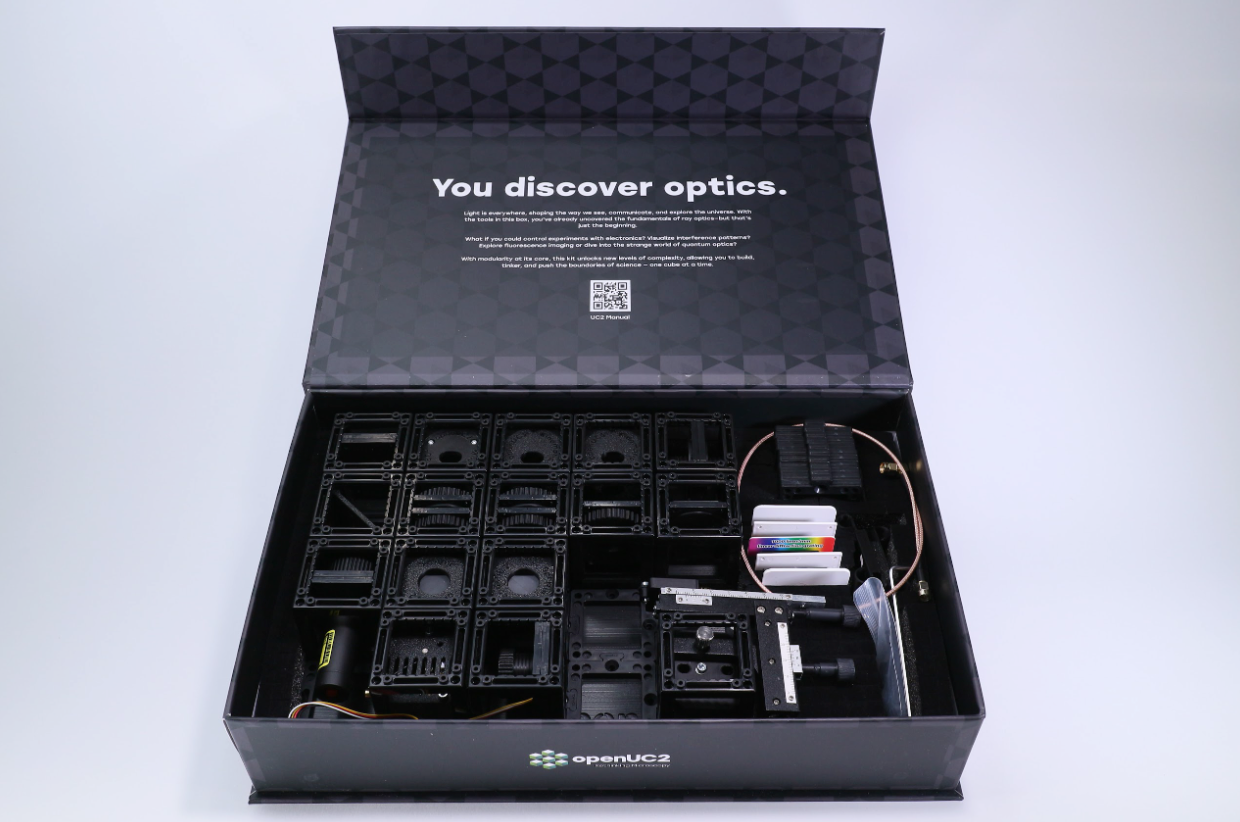
Quantum Box with all the parts in one package
At its core is a Seeed Studio XIAO ESP32-C3 paired with a custom microwave synthesizer board. The XIAO serves a sleek web app over Wi-Fi, turning any smartphone into a lab console: tap “Start” and watch as the controller sweeps microwave frequencies and plots the fluorescence of a nitrogen-vacancy diamond in real time. The result? A live demonstration of quantum spin flips and the Zeeman effect that previously required equipment costing thousands of euros.
Everything is open source — hardware, firmware, and documentation — and the project actively invites the community to design new experiment modules, contribute code, and push the boundaries of what’s possible in science education.
Hardwares
Despite its compact and classroom-friendly design, qBOX is built with a carefully selected set of components that make real quantum optics experiments possible:
- Seeed Studio XIAO ESP32-C3
- Green laser module
- Dichroic beam-splitter cube
- Focusing lens and mirrors
- Micro-diamond sample with nitrogen-vacancy (NV) defect centres
- Photodetector
- Polarisation filters
- Beam splitters for interferometry
- Custom PCB adapter board for microwave synthesis
- Permanent magnets
- openUC2 modular cube system
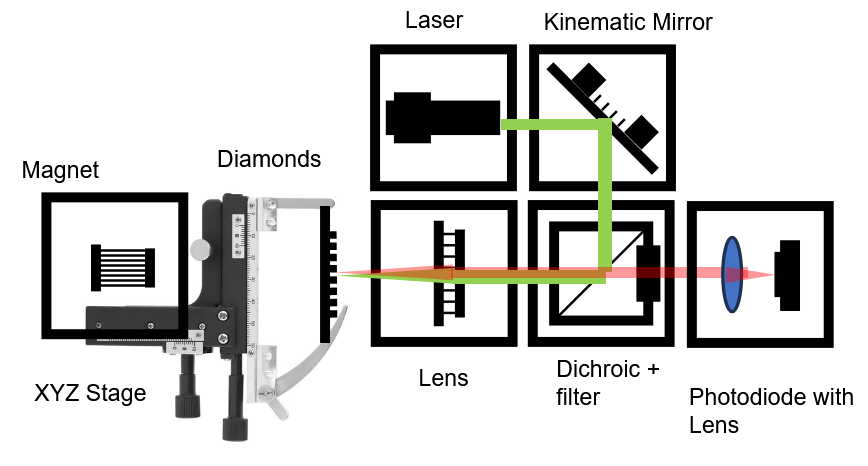
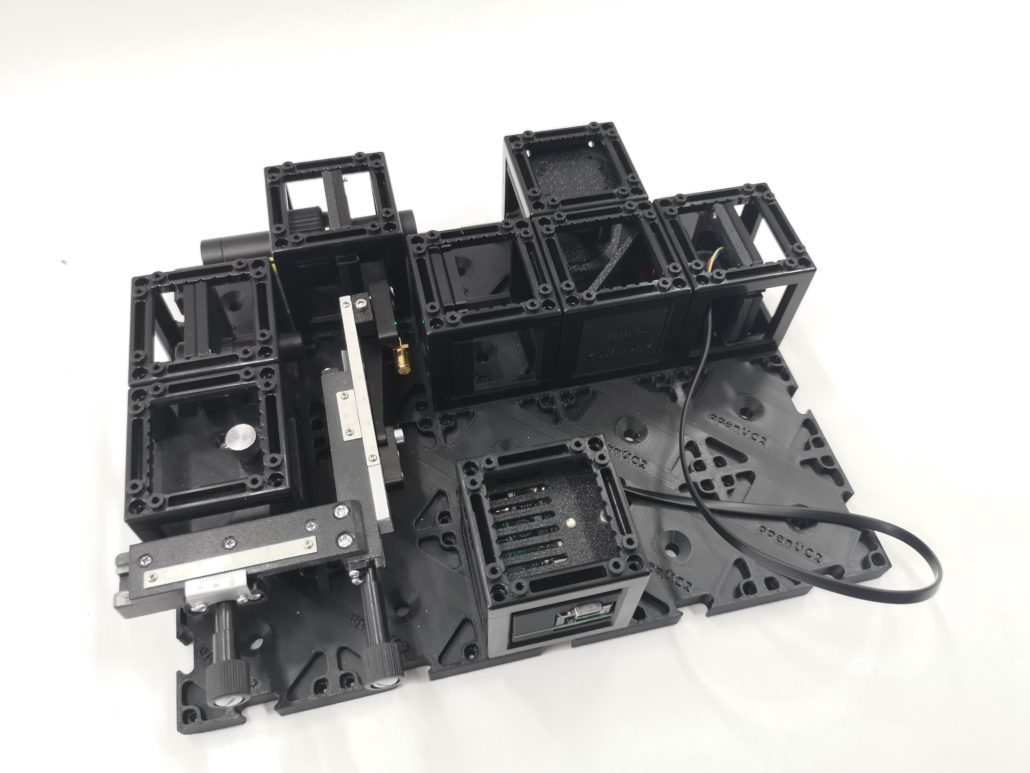
ODMR setup layout
How openUC2 qBOX Works
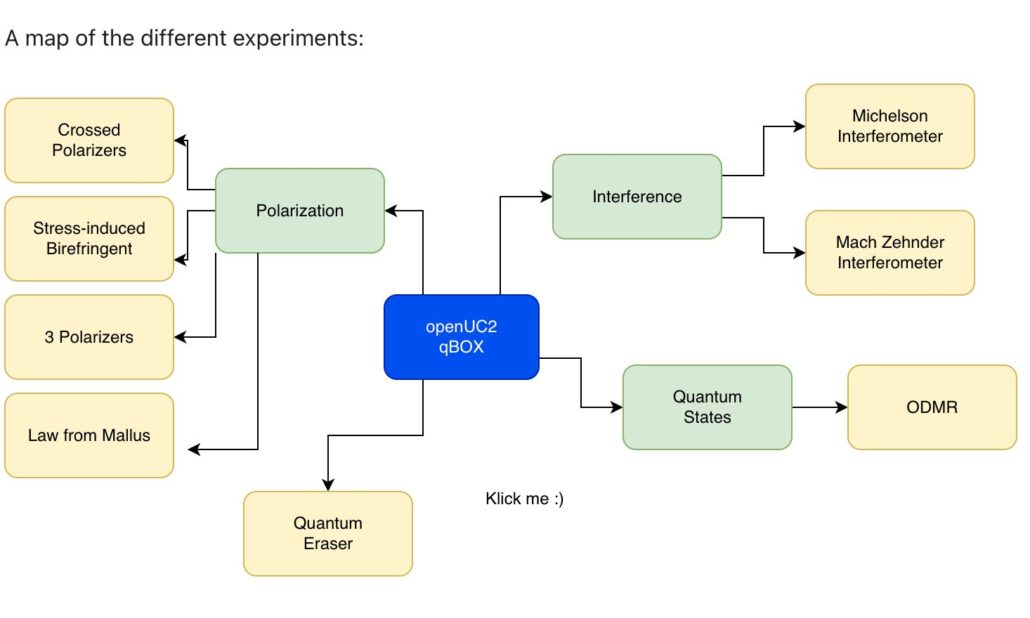
The qBOX ships with more than ten hands-on experiments grouped into three major learning areas: Polarisation, Interference, and Quantum States. Its flagship demonstration is ODMR (Optically Detected Magnetic Resonance), an experiment that allows users to explore magnetic-field sensing through quantum effects in diamond — something normally reserved for advanced research labs.
In the ODMR setup, a green laser is focused onto a tiny diamond containing engineered nitrogen-vacancy centres. When the laser excites these defects, the diamond emits red fluorescence. A dichroic beam-splitter cube separates the green excitation light from the red fluorescence, allowing a photodetector to measure how brightly the diamond is glowing.
This is where the XIAO ESP32-C3 comes in. Mounted with a custom microwave synthesizer board, the XIAO sweeps microwave frequencies across the diamond’s resonance range. At a specific frequency, some electrons transition through a “dark” state instead of fluorescing, causing a visible dip in the detected signal. That dip corresponds to a quantum spin transition.
When a permanent magnet is placed near the diamond, the resonance peak splits into two — a direct demonstration of the Zeeman effect. In other words, users are not just reading about quantum physics; they are assembling and operating a real optical magnetometer on a desk or classroom table. Through the XIAO-hosted web app, users can start measurement sweeps, monitor fluorescence intensity live, and view the resulting curve directly on a smartphone or laptop with no separate app installation required. Check out the short demo video showing the ODMR kit in action.
The XIAO ESP32-C3 handles two critical roles in this workflow. First, it drives the custom adapter board that generates tunable microwave signals for the ODMR experiment. Second, it reads the analog output from the photodetector to capture fluorescence intensity in real time. Its compact size, built-in Wi-Fi, and responsive control capabilities make it an ideal fit for turning qBOX into a portable browser-controlled lab platform.
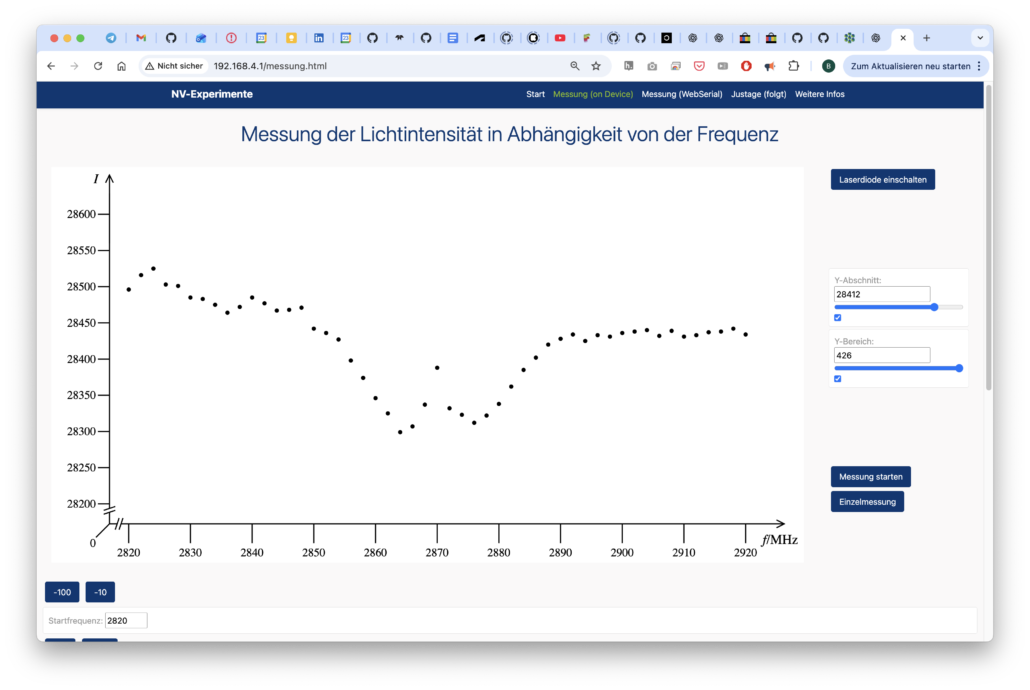
Live ODMR signal captured through the XIAO-hosted web interface.
More Than One Experiment Box
What makes qBOX especially exciting is that ODMR is only one part of the experience. The platform also supports a wide range of optics and photonics experiments, including crossed polarizers, the three-polarizer paradox, stress-induced birefringence, double-slit diffraction, single-slit and grating experiments, Michelson interferometry, Mach–Zehnder interferometry, measuring the speed of light, and even a quantum eraser setup.
Because all of these experiments use the same modular cube architecture, students and makers can learn by physically assembling optical paths, aligning lasers, swapping components, and collecting real data — much like they would in a professional photonics lab, but in a far more accessible and affordable format. Teachers gain a turnkey platform for hands-on STEM and quantum physics education, while researchers and advanced users get a rapid-prototyping system they can extend with new modules and configurations.
The firmware running on the XIAO ESP32-C3 is written in Arduino/C++ and combines Wi-Fi web serving, microwave synthesizer control through SPI, and ADC readout for the photodetector. The web interface is served directly from the XIAO’s flash memory, which keeps the entire user experience lightweight and self-contained. According to the project materials, one of the main technical challenges was synchronizing the microwave sweep with each fluorescence measurement precisely enough to generate a reliable dip curve in such a compact system.

Michelson Interferometer layout
Open Source, Modular, and Built for the Community
The qBOX is not just a finished product — it is part of the broader openUC2 ecosystem, an open-source optics platform developed in Jena, Germany. openUC2 provides 3D-printable, injection-moulded, and magnetic snap-together cube modules that can be combined like building blocks for optical science. The team’s long-term vision is to make hands-on optical and quantum science education more affordable and more widely available.
All firmware, hardware designs, build instructions, and experiment documentation are released as open source or planned for open release. The team is also expanding the library of experiments and inviting physics labs, educators, and makers worldwide to contribute new modules, educational content, and code. That means qBOX is not just something to buy and use — it is something the community can actively build upon.
Bring openUC2 qBOX to Life
The openUC2 qBOX shows what can happen when modular optics meets compact embedded control. By combining open hardware, real experimental science, and the wireless convenience of the Seeed Studio XIAO ESP32-C3, the project makes quantum physics more tangible, interactive, and approachable for the next generation of learners and builders.
Whether you are an educator looking for a more engaging way to teach optics, a student curious about quantum phenomena, or a maker eager to experiment beyond the breadboard, qBOX opens the door to real science in a remarkably compact format.
Reference
For more background on the science and educational approach behind low-cost ODMR experiments with nitrogen-vacancy diamonds, check out:
End Note
Hey community, we’re curating a monthly newsletter centering around the beloved Seeed Studio XIAO. If you want to stay up-to-date with:
🤖️ Cool Projects from the Community to get inspiration and tutorials
📰 Product Updates: firmware update, new product spoiler
📖 Wiki Updates: new wikis + wiki contribution
📣 News: events, contests, and other community stuff
Please click the image below👇 to subscribe now!

