From Cup-and-Vane to Ultrasonic: How We Measure Wind with Precision
We understand there are strong needs of technology and industry know-how in environmental and weather monitoring. As a technology provider and professional weather sensor desigtner and manufacturer, we are happy to share the tech knowhow with you. So we are starting this Sensor Know-How series where we share different technologies in environmental and weather monitoring. From this, you can get practical information and guidance on wind, solar radiation, and other industrial weather sensors. In this way, you will be able to select the most suitable products for your IoT solutions.
We will focus on wind speed and wind direction monitoring in this first episode!
Why Do We Need to Measure Wind Speed and Direction?
Accurate wind data is essential in meteorology, agricultural microclimate monitoring, wind power generation, port management and many other fields. But how do we turn the invisible movement of air into precise numbers: meters per second and degrees of direction?
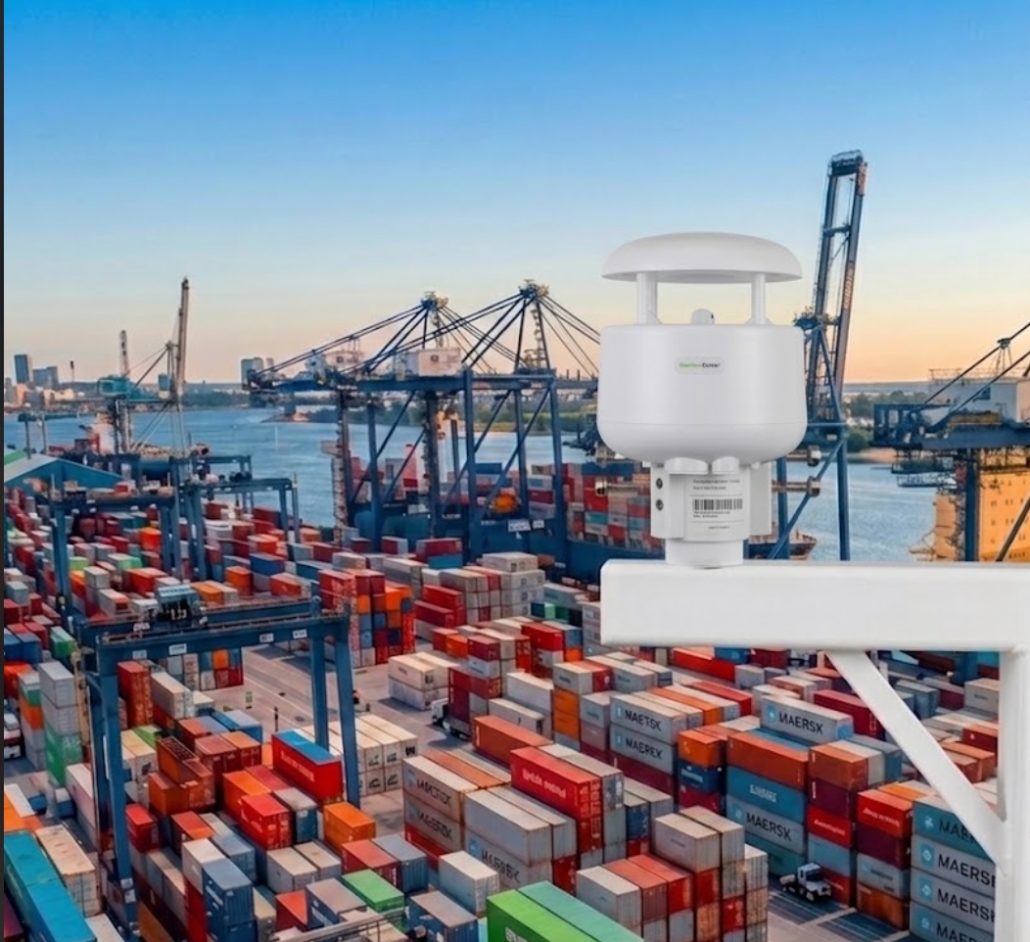
(wind speed and wind direction monitoring by SenseCAP S200 Wind Speed & Wind Direction Sensor deployed at the port)
Two main technologies dominate wind measurement today: mechanical cup-and-vane sensors and ultrasonic anemometers. Understanding how they work, where they excel, and where they fall short helps you choose the right solution for your application.
This article compares the two technologies across three dimensions: underlying physics, core performance metrics, and environmental adaptability, to give you a clear side-by-side view.
Measurement Principles: Classical Mechanics vs. Acoustic Time-of-Flight
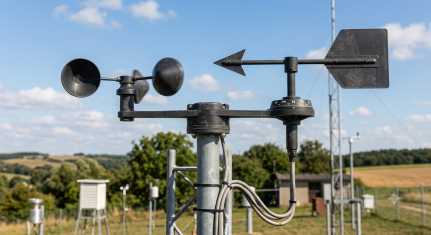
Mechanical (Cup-and-Vane) Sensors rely on direct physical interaction with the wind. A set of rotating cups catches the airflow and rotate around a vertical axis. The rotation speed is converted into electrical pulses by an optical encoder or Hall-effect sensor, which is then used to calculate wind speed. A separate tail vane aligns itself with the wind direction, and its angular position is read by a potentiometer or coded disc.
This is classic Newtonian physics: the wind pushes, and mechanical parts move.
Ultrasonic Sensors work on a completely different principle — the time-of-flight difference of sound waves. Pairs of ultrasonic transducers (usually arranged in two orthogonal axes) alternately transmit and receive pulses.
- When sound travels with the wind, its effective speed increases and transit time shortens.
- When it travels against the wind, transit time lengthens.
By precisely measuring these time differences, the sensor calculates both wind speed and direction simultaneously — with no moving parts.

Key Differences at a Glance
| Aspect | Mechanical (Cup-and-Vane) | Ultrasonic |
|---|---|---|
| Mechanical wear & lifespan | Bearings wear over time; shorter operational life | No moving parts; significantly longer lifespan |
| Starting threshold | Higher (typically ≥ 0.3 m/s) due to friction | Near-zero; can detect very light breezes |
| Response time | Slower due to mechanical inertia | Fast, near real-time response |
| Harsh environment tolerance | Vulnerable to icing, frost, or dust jamming | More robust; optional heating for anti-icing |
| Maintenance | Requires periodic bearing replacement & lubrication | Virtually maintenance-free |
| Integration | Often separate wind speed and direction units | Highly integrated (ideal for compact weather stations) |
- Mechanical sensors are mature and cost less upfront. However, their higher starting threshold means they can miss light winds, and they are more prone to failure in freezing or dusty conditions.
- Ultrasonic sensors offer wear-free operation, faster response, better low-speed sensitivity, and lower long-term maintenance costs. The main trade-off is a higher initial purchase price.
In short: mechanical sensors are reliable workhorses that need regular care. Ultrasonic sensors deliver higher precision and peace of mind — provided the transducers stay clean and unobstructed.
The Shift Toward Integrated, Maintenance-Free Monitoring
With the growth of the Industrial Internet of Things (IIoT) and smart meteorology, weather stations are moving toward higher integration, unattended operation, and long-term reliability. Compact all-in-one weather sensors that combine ultrasonic wind measurement with temperature, humidity, barometric pressure, light intensity, and rainfall are becoming the preferred choice for remote and distributed deployments.
These integrated solutions greatly reduce installation complexity and ongoing maintenance, making them ideal for smart agriculture, power utilities, water management, and emerging applications such as the low-altitude economy. To overcome the mechanical wear and lag inherent in traditional anemometers, compact solutions like the SenseCAP S200 Wind Speed and Direction Sensor utilize solid-state ultrasonic transducers to deliver high-precision, low-maintenance wind measurements. Similar to S200, our collection of Seeed Studio SenseCAP Compact Weather Sensors all adopt ultrasonic wind measurement along with other parameters including temperature, humidity, barometric pressure, light intensity, and rainfall, etc., depending different models.
How to Choose Wind Sensors: Matching Technology to Your Scenarios?
There is no universally “best” wind sensor — only the right fit for your needs:
1. Budget-constrained projects & routine observations
If the environment is moderate and regular on-site maintenance is feasible, traditional mechanical sensors remain a cost-effective and proven option.
2. High-precision or fast-dynamic applications
For wind power control, airport meteorology, ports, or research that demands excellent low-speed sensitivity and rapid response, ultrasonic sensors have clear advantages.
3. Remote, polar, alpine, or unattended sites
Where maintenance visits are expensive or difficult, ultrasonic sensors with optional heating and anti-icing features are usually the better choice.
4. Large-scale multi-parameter networks
In smart cities, environmental monitoring, and precision agriculture, integrated ultrasonic weather stations offer the high reliability and simple deployment that distributed networks require.
Conclusion
Mechanical cup-and-vane sensors continue to serve many applications thanks to their simplicity and lower cost. Ultrasonic sensors represent the modern direction of wind measurement — higher precision, faster response, and virtually maintenance-free operation.
We hope this article has helped you understand the fundamental differences between mechanical and ultrasonic wind sensors—and which might fit your project.
For specific recommendations tailored to your environment and technical requirements, reach out to us at [email protected] or leave a comment below. We’d be glad to discuss your specific environment and technical needs in more detail.
About Author
