Build, Audit, and Ship on Jetson with NVIDIA Skills + JetPack 7.2: BSP and Device Skills, Signing, and Trustworthy Jetson Production
Embedded projects have two very different risk zones: before flashing and after booting. NVIDIA separates Jetson expertise into BSP-side skills and device-side skills, and then wraps both in a trust pipeline.
Pre-flash: jetson-bsp-skills

BSP customization is where carriers get bricked. Same Orin NX SoM, three customers, three problems:
- Carrier A exposes PCIe x4, Carrier B only x1, Carrier C routes USB3 to a different PHY.
- One pinmux SFIO/GPIO direction error can prevent boot.
- Memory carveout for display/camera/firmware can compete with AI memory; JetPack 7.2 memory-optimization workflows can help reclaim or rebalance reserved regions when the workload doesn’t need them.
- ODMDATA and DTB fields are tightly coupled; one wrong value can produce an unbootable image.
jetson-bsp-skills structures these expert checklists into skills such as init/set target, customize pinmux/PCIe/USB/UPHY/clocks/fan/power, optimize memory, build source, promote image, flash, and validate. The value is not “more scripts” — it is [OK]/[STOP] semantics: high-risk flashing and DTB changes stop for human confirmation; repetitive setup steps become repeatable.
On 8GB-class devices, this can be decisive. Recovering hundreds of megabytes of reserved DRAM may determine whether a 4B-class LLM or a large vision model loads at all.
Post-flash: jetson-device-skills
After the device boots, the work becomes fleet operations:
jetson-diagnostic— read-only snapshot: model, JetPack/L4T, memory, storage, thermal, power mode, services, top processes.jetson-memory-audit— measure pressure from tegrastats//proc/meminfo/process consumers before changing anything.jetson-headless-mode— disable desktop/UI safely when the workload is headless inference.jetson-llm-serve/jetson-llm-benchmark— run and benchmark edge LLMs with Jetson-appropriate recipes.jetson-package— recommend Jetson-compatible wheels/containers instead of generic PyPI defaults.- video/DeepStream skills — codec capability, NVDEC/NVENC, GStreamer/DeepStream pipeline validation.
The discipline matters more than any single command. jetson-memory-audit says “measure, then optimize.” On AGX Orin 32GB, removing the desktop may be nice-to-have; on Orin NX 8GB, the same change can be the difference between OOM and a shippable prototype.
Trust pipeline: signing, scanning, governance
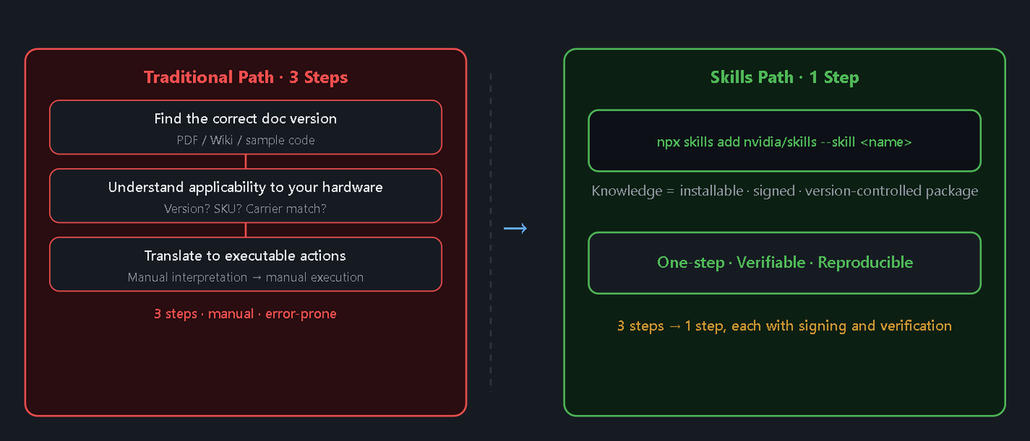
Markdown alone would just be another wiki. NVIDIA’s skill governance adds three layers:
OMS signing. OpenSSF Model Signing can sign the whole skill directory tree. Verify before use:
pip install model-signing
model_signing verify certificate SKILL_DIR
  --signature SKILL_DIR/skill.oms.sig
  --certificate_chain nv-agent-root-cert.pem
  --ignore_unsigned_files
For BSP skills, this proves the flash scripts, DTB paths, and ODMDATA templates come from the trusted publisher and were not modified in transit.
SkillSpector. Static/semantic scanner for prompt injection, data exfiltration, over-privileged commands, destructive shell patterns (dd to eMMC, wrong flash.sh board name, unsafe carveout edits). It moves “senior engineer review” into CI.
Skill Card / BENCHMARK.md. Machine-readable governance: author, version, license, supported JetPack/L4T, known limitations, evaluation notes. For a memory-optimization skill, the card should state validated scenarios — for example headless, no-camera, specific swiotlb/carveout configurations — so product teams know the boundary.
This is especially important for Seeed reComputer deployments: if you standardize on a carrier board, you can pin signed BSP skills per board revision and signed device skills per JetPack version. CI verifies signatures, SkillSpector passes, and Skill Card compatibility before any agent pushes changes to devices.
Why this is a paradigm shift
Traditional hardware knowledge lives in PDFs, wikis, and tribal experience. Skills make knowledge installable:
dependencies:
  - nvidia/skills/[email protected]
  - nvidia/skills/[email protected]
  - nvidia/skills/jetson-bsp-skills/[email protected]
  - seeed/skills/[email protected]
For robotics, that means repeatable bring-up across same-model arms or AMRs. For industrial edge, that means 1,000 devices configured identically, with every change traced to a signed skill version. Knowledge becomes a software-supply-chain artifact, not a Slack message.
In Part 3, we make this concrete with the vehicle-speed workflow: diagnostic → environment → minimal prototype → validation → web demo → production migration to TensorRT/DeepStream.
Useful links
- NVIDIA verified agent skills blog: https://developer.nvidia.com/blog/nvidia-verified-agent-skills-provide-capability-governance-for-ai-agents/
- JetPack 7.2 memory efficiency: https://developer.nvidia.com/blog/deploy-agentic-ready-ai-at-the-edge-with-memory-efficiency-in-nvidia-jetpack-7-2
- Seeed JetPack 7.2 resource hub: https://wiki.seeedstudio.com/jetpack_7_2_resource_hub/
- Seeed Jetson Develop Tool: https://github.com/Seeed-Projects/Seeed-Jetson-DevelopTool
About Author
