Meshtastic Hardware Buyer’s Guide: Solar Node vs Mesh Tracker — Which One Do You Need?
Introduction
Newcomers often get confused when choosing hardware, as many enthusiasts cannot distinguish between trackers and repeater nodes. This article aims to compare their positioning, use cases and power consumption side by side to help readers make purchasing decisions.
1.What are Solar Node & Mesh Tracker?
1.1 Solar Node
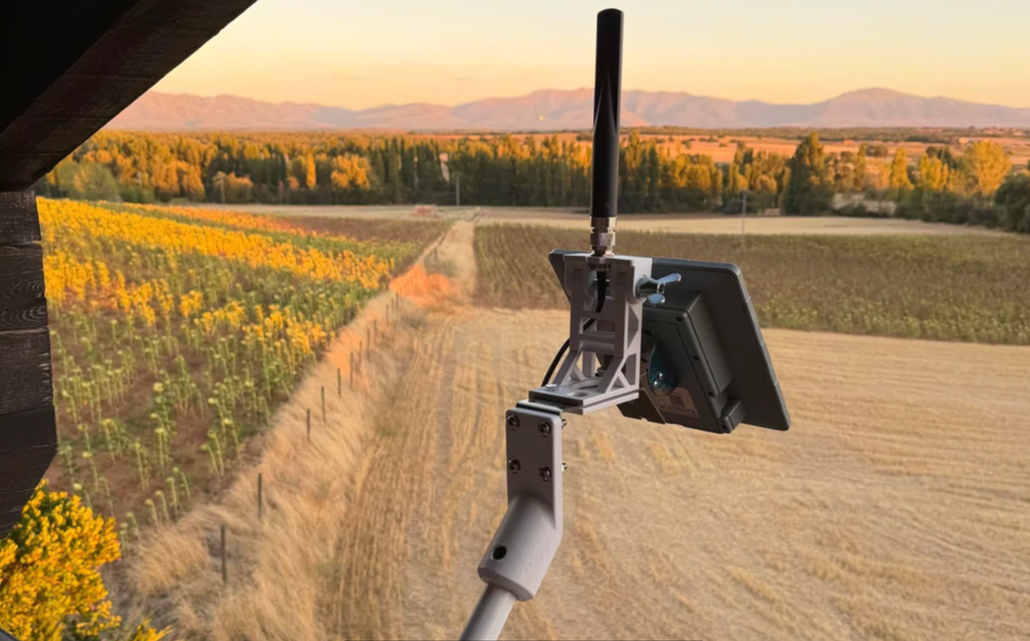
· Core positioning: Fixed repeaters for long-term outdoor deployment, powered continuously by solar energy.
· Core function: Amplify Mesh signals to build large-scale Mesh networks and expand coverage for the whole community.
· Form factor: Enclosed outdoor casing with solar panels, usually mounted on elevated locations such as rooftops or poles.
1.2 Mesh Tracker
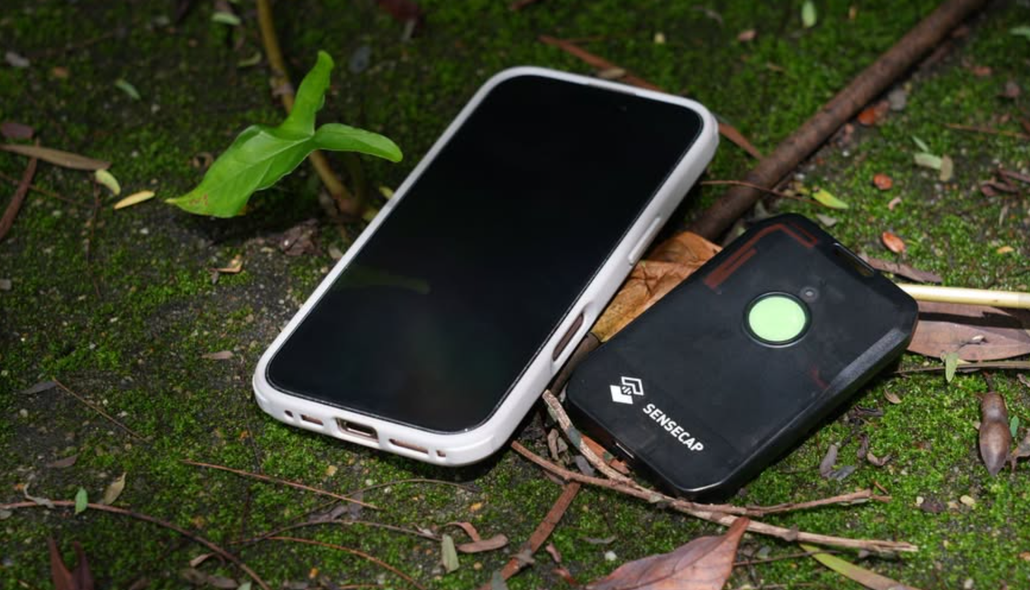
· Core positioning: Portable end-user device for carrying on your person.
· Core function: GPS tracking for people or assets, Mesh message send & receive; most models support Bluetooth connection to mobile phones.
· Form factor: Compact and lightweight, battery-powered, ideal for hiking, vehicle convoys and outdoor field activities.
2.Side-by-Side Comparison: Solar Nodes vs Mesh Trackers
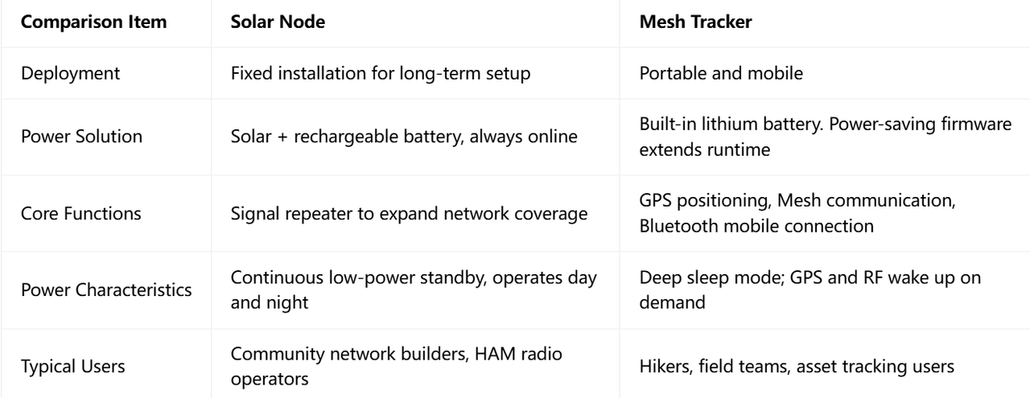
3.Suitable Use Cases
3.1 When to Choose Solar Nodes
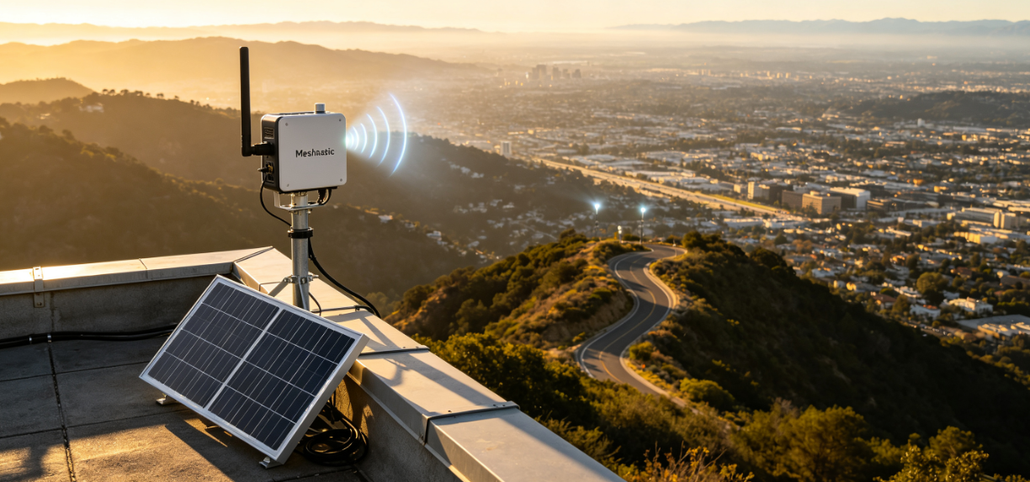
· Build the backbone network of the local Meshtastic community and fill signal dead zones.
· Permanently deployed on hilltops or rooftops for long-term relay forwarding.
· Goal: Expand coverage of the entire Mesh community and serve hobbyists across the area.
Example: SenseCAP Solar Node P1‑Pro, built for long‑term outdoor deployment, it acts as a fixed relay to strengthen local Meshtastic network coverage.
3.2 When to Choose Mesh Trackers
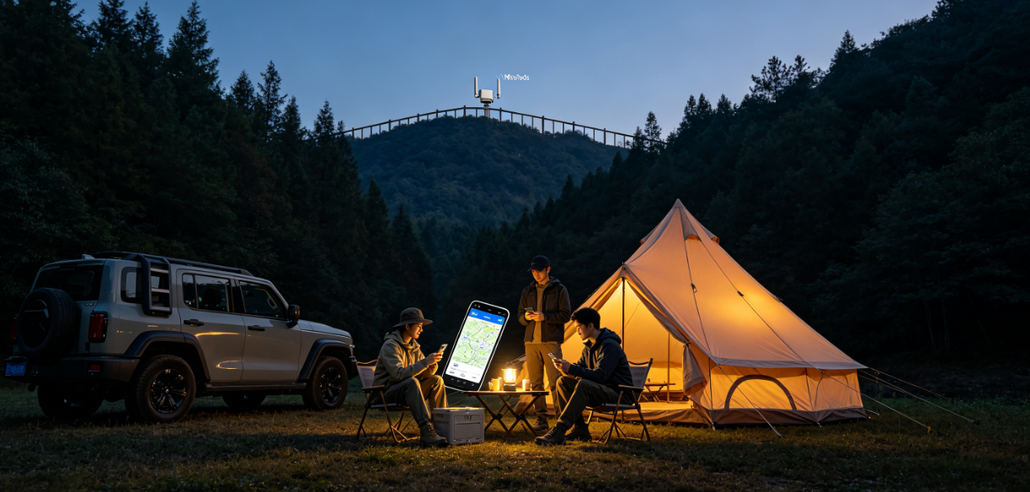
· Designed for outdoor hiking, camping, and off-road vehicle teams. Carry it with you for location sharing and offline messaging.
· Supports field asset and device positioning. It is also widely used for pet location tracking. Users can view real‑time location data by connecting the device to their phones via Bluetooth.
· No fixed‑relay functionality required, the unit itself can connect to the Mesh network for communication.
Example: SenseCAP Card Tracker T1000-E and SenseCAP MeshTracker X1. Compact, built-in GPS and Bluetooth, ideal for outdoor activities.
4.Common Pitfalls When Selecting Meshtastic Hardware
· Important distinction: Trackers are not designed to serve as permanent backbone relay nodes. Portable trackers are hardware‑optimized for low‑power mobile use and are unsuitable for continuous infrastructure‑grade relaying. Solar‑powered nodes are bulkier and not intended to be carried on‑person.
· Power tradeoffs: Portable trackers achieve long battery life via power optimization. GPS activation draws significant power. Solar nodes maintain continuous operation with energy harvested from sunlight.
· Firmware impact: MeshCore and Meshtastic firmware differ in power consumption and supported features. Verify firmware compatibility before purchase.
5.Quick Check: Which Device Fits Your Needs?
1.Looking for a portable device for field positioning and communication? → Mesh Tracker
2.Need a fixed installation to continuously extend Mesh coverage for your community? → Solar Node
6.Frequently Asked Questions
Q1:Can I use a Mesh Tracker as a Meshtastic repeater node?
A:Most portable Mesh Trackers are designed as end devices, not backbone repeaters. Their firmware and hardware are optimized for low power consumption and GPS positioning. Running them continuously as a repeater will drain the battery quickly and is not suitable for permanent community network infrastructure. Choose a Solar Node if you need a fixed relay.
Q2:Can I carry the Solar Node for hiking or outdoor trips?
A:The Solar Node is engineered for stationary outdoor installation on rooftops, poles or high ground. It has a larger enclosure and solar panel, it is bulky and not designed to be portable for hiking.
Q3:Do I need both a Solar Node and a Mesh Tracker for my Meshtastic network?
A:For a complete local Mesh community: Yes. Solar Nodes build up the backbone network to extend signal coverage. Mesh Trackers are user terminals that let people join the network, send offline messages and share GPS locations while moving.
Q4:Will the Mesh Tracker keep working without a nearby repeater?
A:Meshtastic is a mesh network. If your tracker is out of range of any node, direct communication fails. That’s exactly why communities deploy multiple solar‑powered repeater nodes to fill dead zones.
7.Wrap-up
One-sentence summary of their roles: Solar nodes act as the “base stations” of a Mesh network, while trackers are the handheld “end devices” for users within the Mesh network. To build a complete Mesh community, the two are often used together.
Feel free to share your Mesh projects in the comments. In addition, welcome to join our Mesh community to exchange Meshtastic deployment tips, share your field test results, and connect with Mesh builders worldwide.
Our discord offical website: https://discord.gg/BCBg547Qc
About Author
