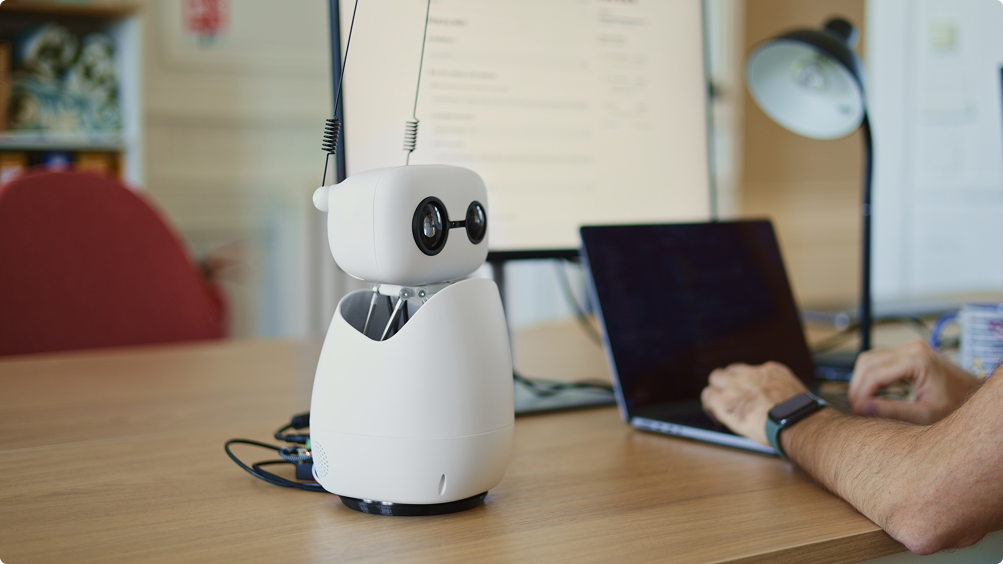
At CES 2026, Reachy Mini appeared on stage as a compelling example of how Voice AI is moving artificial intelligence beyond screens and into the physical world. Jensen Huang unveiled this open-source desktop robot during NVIDIA’s CES keynote. It demonstrated how large-scale AI models, open tooling, and real hardware can come together to form an interactive, collaborative agent.
Together with Hugging Face, Pollen Robotics, and Seeed Studio, the team shipped 3,000 units of Reachy Mini last month. Designed for learning, creativity, and human–robot interaction, Reachy Mini represents a meaningful step toward making robotics more open, accessible, and community-driven.
The Real Challenge Behind Voice Interaction in Reachy Mini
Reachy Mini is designed for direct speech interaction. Without a screen or keyboard, voice becomes the primary interface between humans and the robot. This design choice introduces a significant technical challenge: noise.
Inside Reachy Mini, multiple motors operate at the same time. These motors generate mechanical noise during movement, which can interfere with voice capture and audio processing. As a result, reliable interaction becomes more difficult.
Other challenges come from real-world environments. Multiple people may speak at once, and background sounds—such as TV audio, music, or dramas—are common where the robot is placed. All of these factors place high demands on its sound capture capabilities.
Sound pickup distance also plays a critical role in delivering a natural human–robot interaction experience. Clear speech recognition while the robot is moving requires more than basic microphones. It requires a carefully optimized acoustic system.
Solving this problem was a key part of turning Reachy Mini from a prototype into a real-world product.
Inside Reachy Mini’s Hearing System: reSpeaker × XMOS XVF3800
To address these challenges, Reachy Mini integrates a Seeed Studio reSpeaker linear 4-microphone array built on the XMOS XVF3800 audio platform. The system builds on Seeed Studio’s years of experience in voice AI within the reSpeaker product family. It uses mature, on-board acoustic algorithms to deliver strong voice pickup and effective noise reduction.
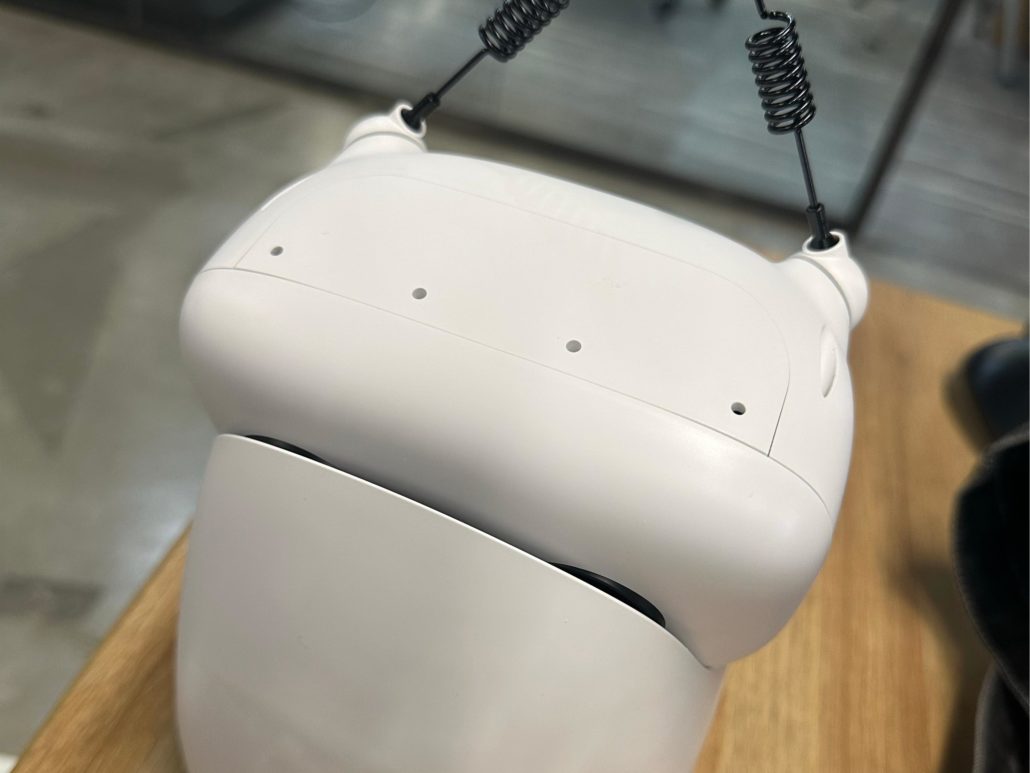
The reSpeaker and XMOS teams worked closely through repeated acoustic experiments and joint optimization. Hardware-level improvements included structural refinements such as positioning the microphone sound ports as close to the sound source as possible, minimizing interference introduced by surrounding electronic components. In parallel, algorithm-level tuning was performed directly on the audio chipset to further enhance noise suppression and signal clarity.
The image above shows the top structure of Reachy Mini. reSpeaker is custom-mounted to fit tightly against the robot’s head, positioned as close to the outer shell as possible. This placement helps bring the microphones closer to the sound source while minimizing signal degradation and structural interference as sound travels into the robot’s interior. Based on Reachy Mini’s specific form factor and interaction requirements, we introduced a series of targeted optimizations at both the hardware and algorithm levels.
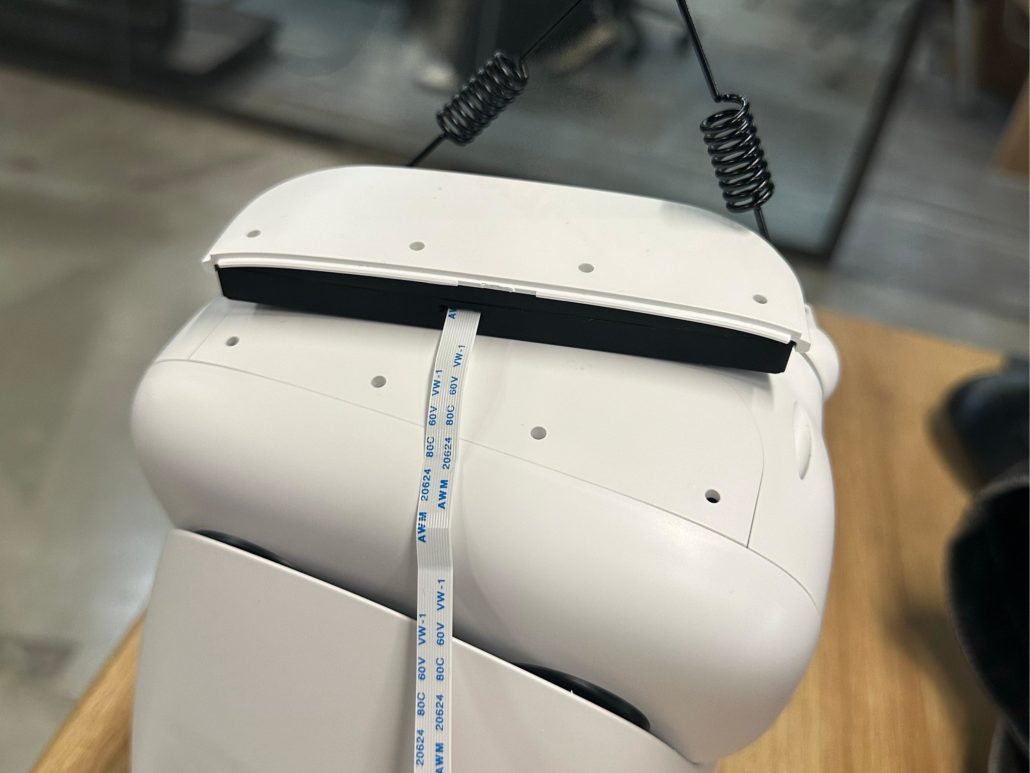
While standard reSpeaker products are best known for their 360° sound capture using a four-microphone circular array, Reachy Mini presents a very different set of challenges. In real interaction scenarios, the robot primarily needs high-quality, accurate audio capture within the 180° field in front of it. At the same time, as a compact desktop robot, Reachy Mini has extremely limited space in its head design, placing strict constraints on size and aesthetics. To address this, we found a balance between physical dimensions and algorithmic performance by developing a custom four-microphone linear array and tuning the algorithms accordingly, enabling stronger directional audio capture within the forward-facing area.
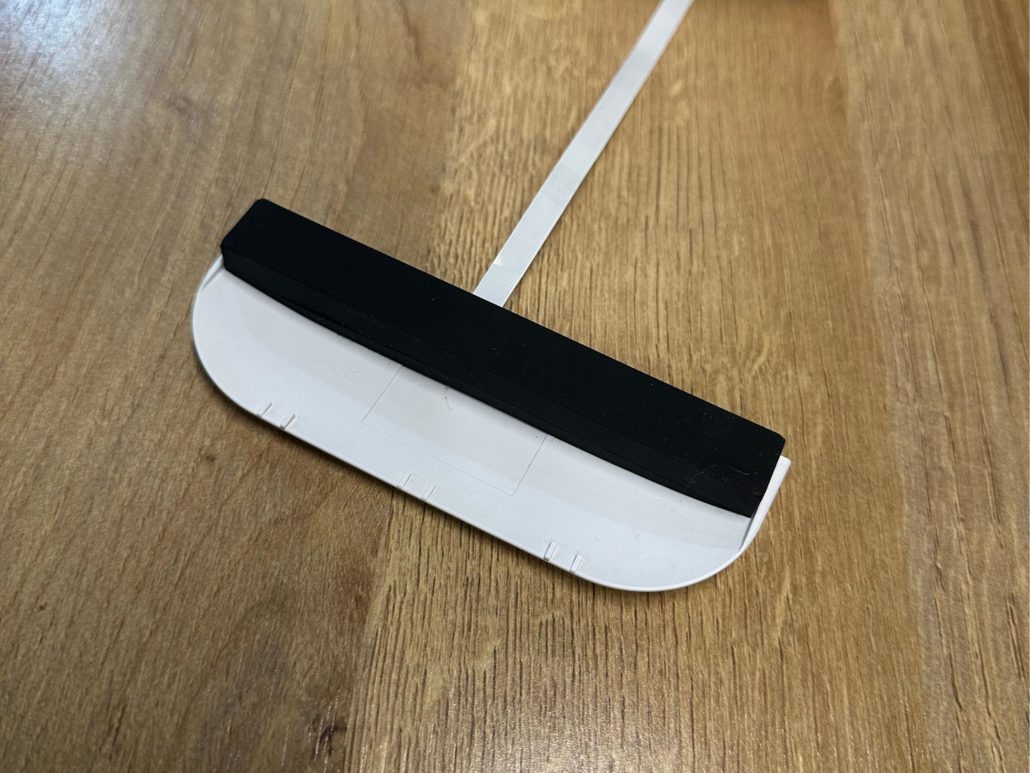
In addition, the microphone array is wrapped in a specially customized black silicone layer that provides acoustic isolation and vibration damping. This design effectively reduces mechanical noise generated by the robot’s internal motors, helping maintain stable and clean voice input.
On the algorithm side, we applied dedicated optimizations to Acoustic Echo Cancellation (AEC) and noise reduction to improve full-duplex interaction and performance in real-world environments. A common challenge for robots is handling situations where the user is speaking while the robot is also talking. In these moments, the system must suppress its own playback audio and focus on the user’s voice—this is exactly where AEC plays a critical role.
This end-to-end optimization—from physical design to embedded acoustic algorithms—resulted in a voice system that supports clear far-field voice capture and stable audio processing in a compact, motor-driven robot. It enables Reachy Mini to deliver natural voice interaction in real-world environments.
From Reachy Mini to a Broader Voice AI Platform: reSpeaker Microphone Arrays
The same audio technology that supports Reachy Mini is part of Seeed Studio’s broader reSpeaker product lineup, designed to make voice AI more accessible across different applications and platforms.
The same audio technology used in Reachy Mini also powers Seeed Studio’s broader reSpeaker product lineup. This portfolio is designed to make voice AI more accessible across a wide range of applications and platforms.
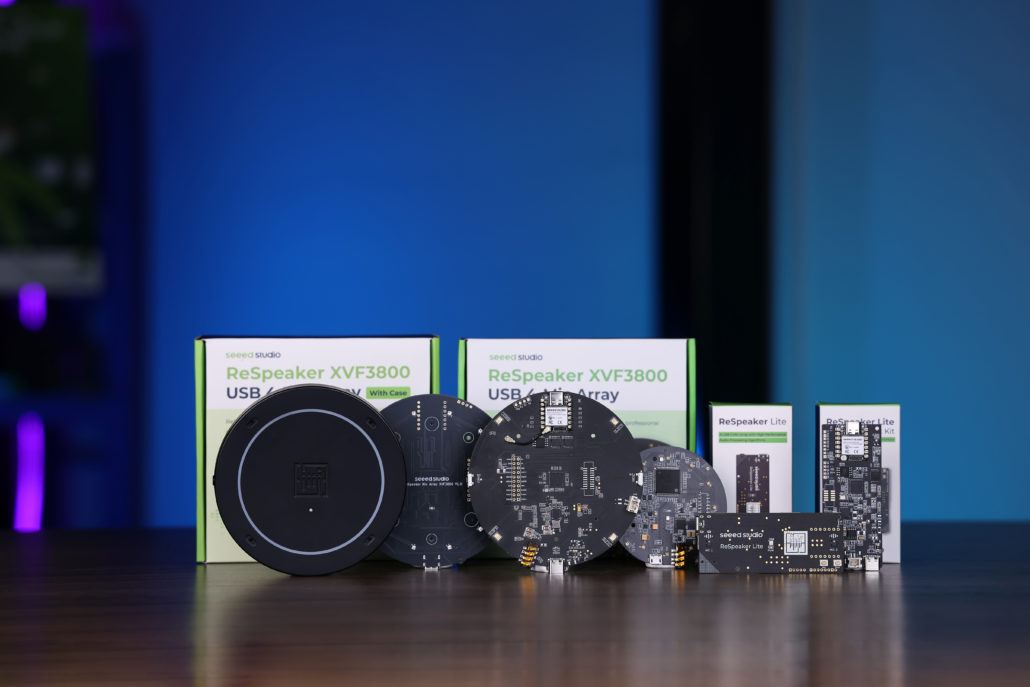
The reSpeaker standard product portfolio includes:
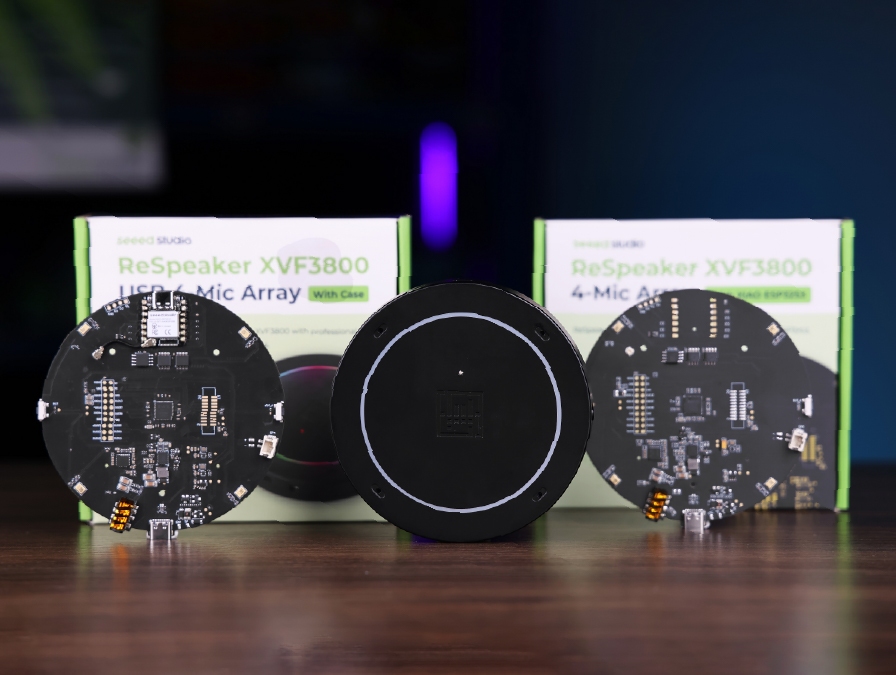
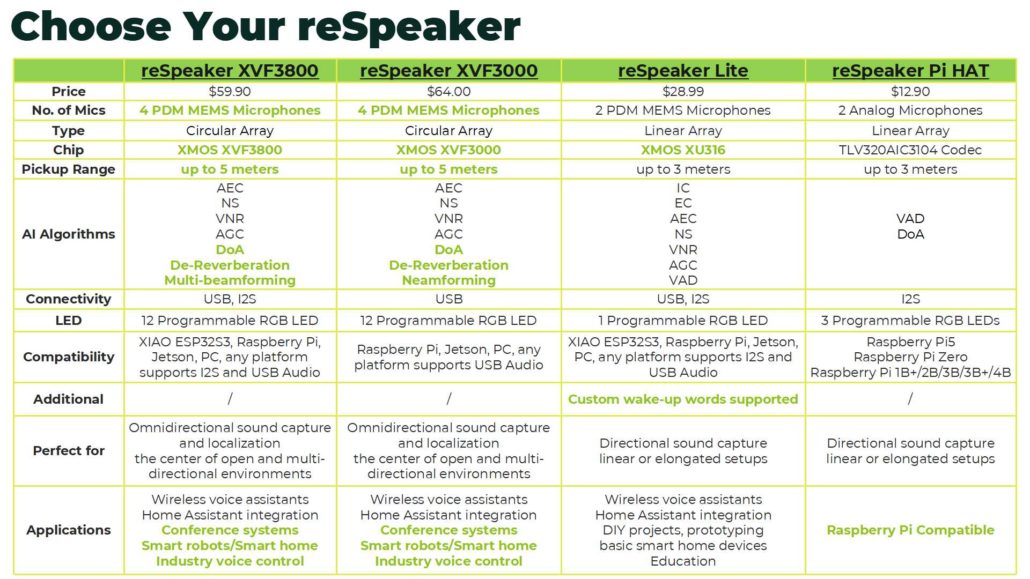
- reSpeaker XMOS XVF3800 – Circular 4-Microphone Array
A professional 4-mic circular array based on XMOS XVF3800, enabling clear target voice capture in noisy environments. Features dual modes, 360 far-field voice pickup (up to 5m), AEC, AGC, DoA, VAD, dereverberation, beamforming, and noise suppression. Easy setup with USB interface-compatible with XlAO ESP32S3, Raspberry Pi, NVIDIA Jetson, and PCs running Windows, Linux, or macOS. No complex setup needed. Bottom-firing microphones and a flat PCB for easy embedding into space-constrained devices without obstruction.
- reSpeaker Lite – Linear 2-Microphone Array
Based on XMOS’s XU316, it is capable of extracting speech from noisy environments to reduce speech recognition errors and enhance voice interaction accuracy and reliability. 3 variants are offered to satisfy users’ development and deployment needs: standalone board can be used as a USB plug-in/board with soldered XIAO ESP32S3/kit with mono enclosed speaker and acrylic enclosure to offer users a clear and complete voice interactive system.
Designed specifically for the Raspberry Pi ecosystem, enabling rapid prototyping and development. These standardized products help developers move more efficiently from proof-of-concept to real-world deployment.
Expanding the Voice AI Roadmap
Beyond the current product lineup, the reSpeaker ecosystem continues to evolve to address a broader range of market needs and application scenarios. Upcoming and planned expansions include:
- Sound event detection modules, designed for use in security, smart factories, and smart home environments. These modules can detect abnormal audio events such as baby crying, glass breaking, gunshots, smoke alarms, and CO alarms (T3/T4). Once an event is detected, the system can trigger real-time alerts in multiple forms—such as activating indicator lights, sounding alarms, or sending notifications to mobile phones and other connected devices—helping users respond quickly and effectively to potential risks.
- Smaller-size reSpeaker XMOS XVF3800 microphone arrays, offering options with 44 mm and 30 mm microphone spacing, to support more compact and embedded designs. These new variants are developed in direct response to community feedback and real-world use cases, giving developers greater flexibility in form factor selection while maintaining strong voice pickup and noise reduction performance across different project requirements.
- Split microphone arrays further extend the flexibility of the reSpeaker platform for space-constrained embedded applications such as robotics. By separating the microphone array from the core processing board, microphones can be positioned closer to the sound source while allowing greater freedom in mechanical and structural design. This approach broadens the applicability of reSpeaker in complex embedded systems where layout constraints are critical.
- Wearable microphone arrays are being developed for conversational and conferencing scenarios. Featuring an ultra-compact design and a small display to show device status, these wearable reSpeaker can be easily clipped onto clothing or worn as a necklace. With long-duration recording capabilities and support for AI-powered conversation capture, meeting transcription, and summarization, they are designed to be quickly deployed in real-world voice interaction use cases.
Together, these ongoing expansions aim to extend reSpeaker’s voice AI capabilities across robotics, smart environments, safety, and edge AI applications—enabling more natural, reliable, and scalable audio interaction in the physical world.
Voice AI: From Hearing Sound to Understanding the World
Voice interaction often serves as the most natural bridge between AI systems and the physical world. As Reachy Mini demonstrates, reliable audio capture and processing form the foundation for intuitive human–robot interaction.
By offering optimized hardware, integrated acoustic algorithms, a complete product portfolio, rich documentation, and scalable designs, reSpeaker lowers the engineering barrier to deploying voice AI in real devices. It acts as the smart ears for embodied AI.
Looking Ahead
Reachy Mini represents an important milestone. Built on open-source principles and shaped through collaboration across teams and communities, it shows what becomes possible when hardware, software, and AI are designed together.
With reSpeaker, Seeed Studio continues to support developers working at the intersection of voice, robotics, and embodied AI—helping turn ideas into products that can hear, respond, and interact in the real world.
Learn more about Reachy Mini: https://www.seeedstudio.com/blog/2026/01/06/reachy-mini-an-open-journey-built-together-with-hugging-face-pollen-robotics-seeed-studio/