FLRC: How the Wio-LR2021 will Reshape the Possibilities of IoT
The Long-Standing Dilemma: The Impossible Triangle of IoT
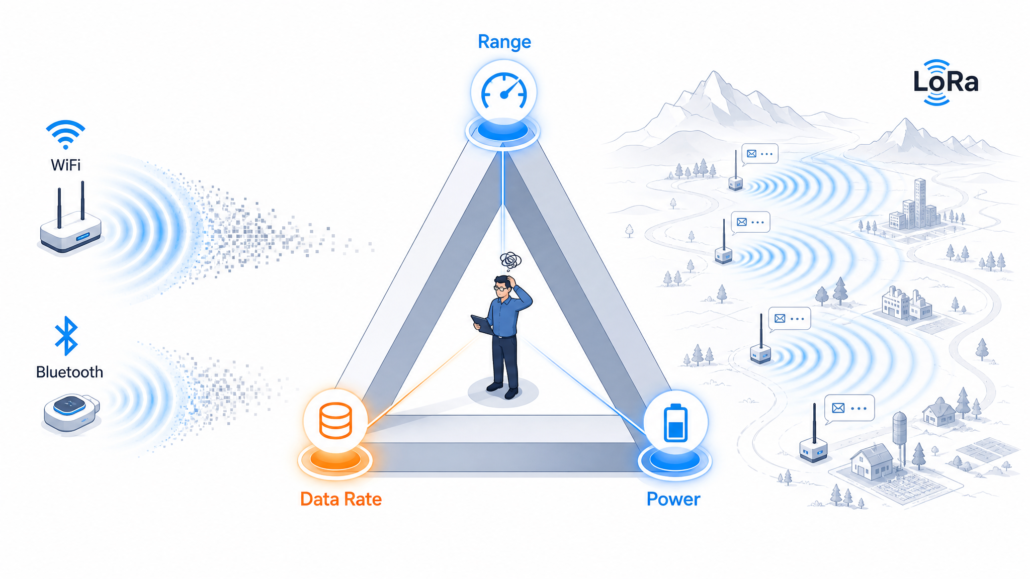
For many years, the IoT field has been struggling to balance long communication range, transmission data rate, and energy consumption—a challenge famously known as the impossible triangle for LPWAN devices. Traditional IoT devices built on WiFi or Bluetooth offer excellent communication speed, yet applications relying on these technologies often hit a wall when endpoints are deployed far from the access point or hidden behind complex structures. On the other hand, devices based on technologies like Sigfox, LoRa, and NB-IoT deliver impressive communication range and energy efficiency, but they are limited to uploading small data packages.
Why the Data Bottleneck Matters More Than Ever
This constraint has become increasingly restrictive as modern IoT applications demand higher data stream capacity. The rise of edge AI and TinyML has fundamentally transformed what we expect from endpoint devices. Cameras equipped with on-board inference engines no longer just capture images—they analyze them locally to detect crop diseases, monitor wildlife behavior, or identify manufacturing defects. Yet the results of these local inferences, along with the confidence scores and metadata-rich feature maps, often need to be transmitted back to the cloud or a central gateway for aggregation, retraining, or human review. A single compressed image or a short audio clip can easily exceed the payload limits of traditional LoRa networks, forcing developers to either sacrifice model complexity, reduce sampling frequency, or abandon the wireless edge entirely.
The challenge is compounded in multi-modal sensing scenarios, where a single node might simultaneously stream vibration spectra for predictive maintenance, thermal imaging for equipment monitoring, and acoustic signatures for anomaly detection. In a smart factory or a precision agriculture deployment, dozens of such nodes may operate in tandem, generating a collective data torrent that legacy LPWAN technologies simply cannot shoulder. Even the routine management of these intelligent edge devices—such as pushing over-the-air firmware updates or deploying refined neural network weights—has become a logistical bottleneck. A typical TinyML model can range from hundreds of kilobytes to several megabytes; at traditional LoRa speeds, updating a fleet of sensors becomes a multi-day operation fraught with energy drain and transmission failures… In this context, the “impossible triangle” is no longer just an engineering inconvenience. It is an active barrier to innovation. The industry needs a bridge: a technology that preserves the long-range, low-power DNA of LPWAN while delivering the throughput necessary to feed the data-hungry pipelines of modern edge intelligence.
A Turning Point: Introducing the Wio-LR2021 and FLRC
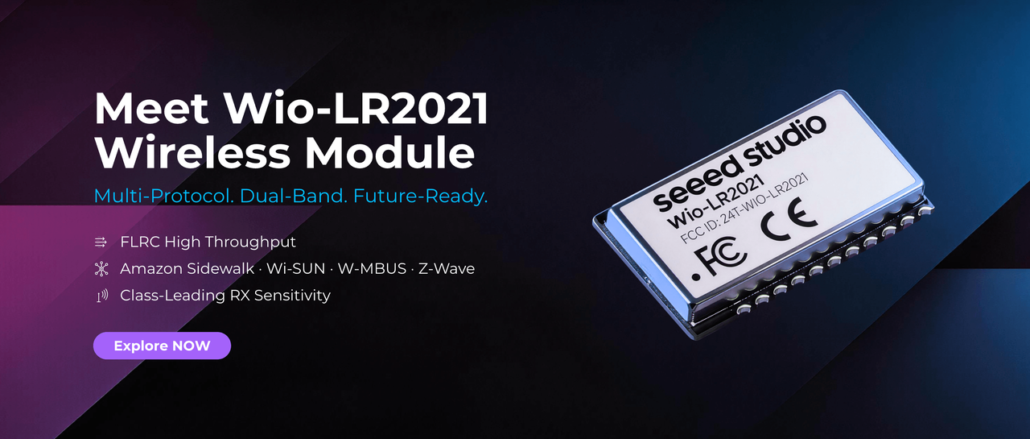
With the release of Seeed Studio’s new LoRa transceiver, the Wio-LR2021 module—powered by Semtech’s fourth-generation LoRa Plus chip, the LR2021—this long-standing dilemma has reached a turning point. Unlike any previous LoRa chip Semtech has released, the LR2021 introduces a new modulation scheme called Fast Long Range Communication (FLRC).
Looking for a specific LoRa module? Filter our complete inventory in seconds – start HERE.
Under the Hood: How FLRC Works
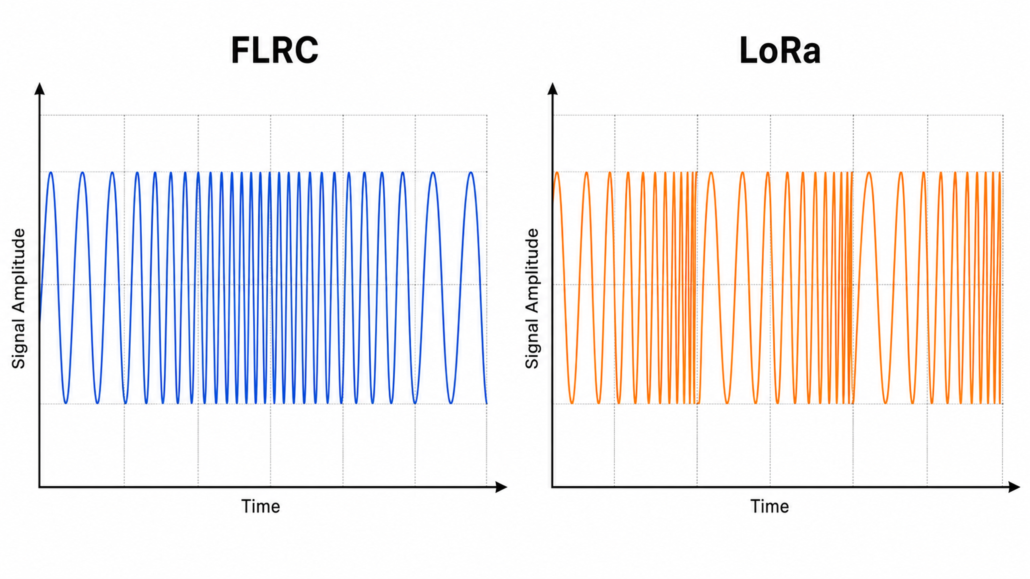
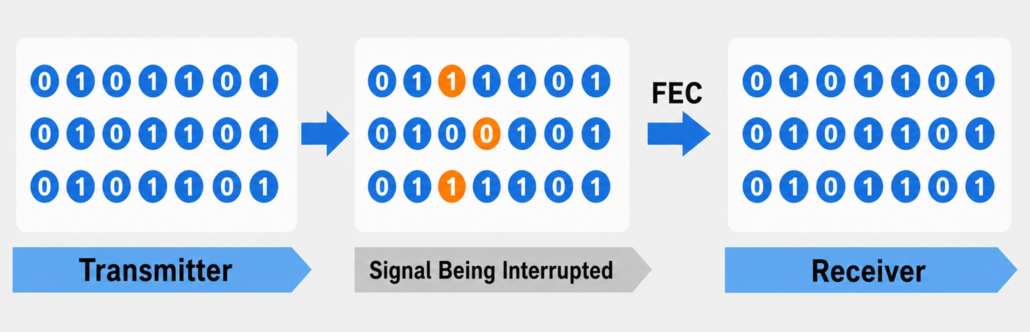
FLRC offers an enhanced link budget and significantly higher data throughput compared to traditional LPWAN technologies. By carefully integrating coherent Minimum-Shift Keying (MSK/GMSK) modulation, Forward Error Correction (FEC) and Interleaving Technique, FLRC achieves long-range transmission with notable spectral and energy efficiency. By adding redundant error‑correcting codes (FEC) at the transmitter and interleaving the data order, the receiver is able to effectively detect and correct transmission errors, especially those caused by bursty interference. Compared to traditional FSK modulation at the same data rate, FLRC offers an 8 to 10 dB improvement in link budget. Unlike conventional LoRa, FLRC does not employ spread spectrum methods; consequently, the raw bit rate is equivalent to the channel bandwidth prior to the application of FEC. This direct mapping enables FLRC to deliver higher throughput while maintaining the extended range that long-range applications require.
The result is a technology that occupies a unique position in the wireless landscape:
- Compared to WiFi and BLE: FLRC provides significantly greater transmission distance and superior penetration through obstacles, making it far more reliable in non-line-of-sight scenarios.
- Compared to traditional LoRa: With data rates reaching up to 2.6 Mbps, FLRC shatters the throughput ceiling that has long constrained LoRa-based applications.
This is not merely an incremental improvement—it is a paradigm shift that opens the door to entirely new classes of IoT applications.
Unlocking New Application Possibilities with Wio-LR2021
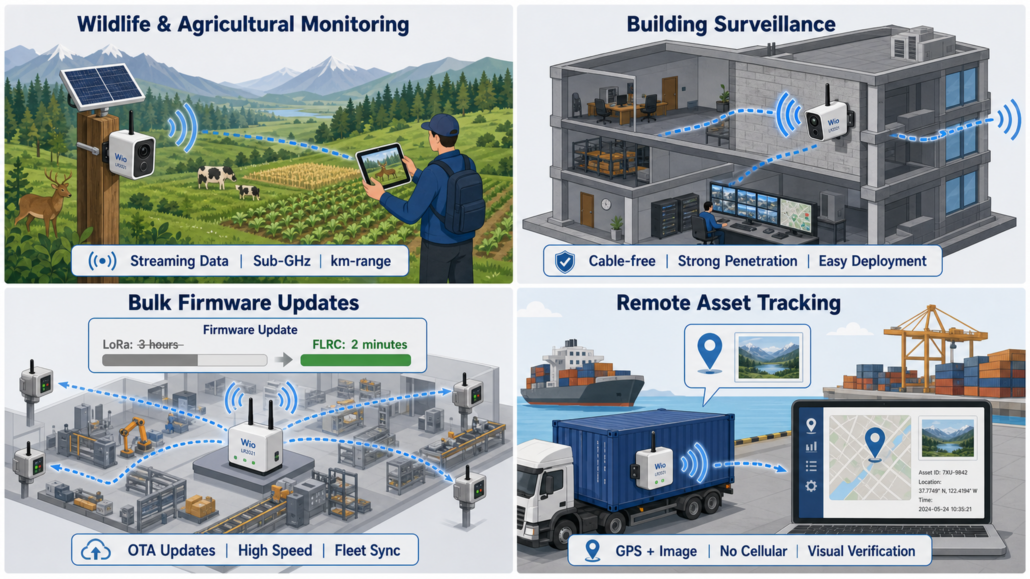
Thanks to its high data rate, FLRC brings the possibility of more complex applications such as image, audio, and even video transmission, as well as efficient over-the-air firmware updates. Here are some of the most promising scenarios where the Wio-LR2021 can make a real difference:
1. Long-Range Wireless Image Transmission for Wildlife and Agricultural Monitoring
Deploying cameras in remote wilderness areas to monitor wildlife, or across vast farmland to track crop health, has traditionally required either expensive cellular data plans or the painstaking deployment of wired infrastructure. With FLRC’s combination of high throughput and long range, the Wio-LR2021 enables wireless image transmission up to kilometers, which allows researchers and farmers to receive visual data from dispersed endpoints without worrying about cellular subscription costs or WiFi range limitations.
2. Building Surveillance with Enhanced Penetration and Easy Deployment
Urban environments are notoriously hostile to wireless signals. Concrete walls, metal structures, and multi-floor layouts severely degrade WiFi and BLE signals. FLRC’s robust modulation maintains strong connectivity even in these challenging environments, thanks to its excellent diffraction and penetration capabilities. For building surveillance—whether in commercial offices, residential complexes, or industrial facilities—the Wio-LR2021 allows for wireless video data transmission that is easier to deploy and more reliable than traditional WiFi-based camera systems, without the need for extensive cabling or mesh networking.
3. Bulk Firmware Updates for Industrial IoT Nodes
In large factories, campuses, or smart city deployments, managing hundreds or thousands of IoT sensor nodes is a logistical challenge. One of the most painful tasks is pushing firmware updates across the entire network. Traditional LoRa’s low data rate makes over-the-air (OTA) updates a slow, energy-intensive process that can take hours or even days. With FLRC’s 2.6 Mbps capability, the Wio-LR2021 can dramatically accelerate OTA updates, reducing downtime and maintenance costs while keeping the entire fleet synchronized with the latest features and security patches.
4. Emergency Response and Disaster Monitoring
In disaster scenarios—such as earthquakes, floods, or wildfires—existing communication infrastructure is often the first casualty. FLRC’s long-range, high-throughput capability makes the Wio-LR2021 an ideal candidate for rapidly deployable emergency networks. Rescue teams could set up temporary cameras and sensors in affected areas to stream visual situational awareness back to command centers, even when cellular towers and wired networks are down.
5. Remote Asset Tracking with Visual Verification
Logistics and supply chain operations often need more than just location pings from GPS trackers—they need visual confirmation of cargo condition. The Wio-LR2021 enables trackers to not only report their position but also transmit snapshot images of the goods, all over a long-range, low-power link. This adds a new layer of accountability without relying on cellular networks.
A Complementary Future, Not a Competitive One
It is important to emphasize that FLRC does not arrive to replace traditional LoRa—it arrives to complement it. The two modulation technologies serve different needs across the spectrum of distance and data requirements. Traditional LoRa remains the undisputed champion for ultra-long-range, ultra-low-power telemetry where small data packets are sufficient. FLRC, meanwhile, fills the critical gap for applications that need both range and bandwidth. The Wio-LR2021, by integrating both LoRa and FLRC, becomes a versatile platform that adapts to the task at hand. Whether a deployment calls for a trickle of sensor data across ten kilometers or a burst of image data across a sprawling campus, the module can switch modes to optimize for the scenario.
Looking Ahead
As IoT continues to evolve, the demand for richer data streams from images, audio, video, to large firmware payloads will only grow. The introduction of FLRC through the LR2021 chip, and its accessible implementation in the Wio-LR2021 module, represents a significant step toward a more capable, more flexible IoT ecosystem. By breaking the traditional constraints of the impossible triangle, Seeed Studio and Semtech are not just offering a faster radio; they are expanding the very boundaries of what IoT can achieve. The future of IoT is not about choosing between distance and speed. With the Wio-LR2021, you no longer have to.
About Author
