Multi-Protocol Fusion: How the Wio-LR2021 Becomes the Swiss Army Knife of IoT
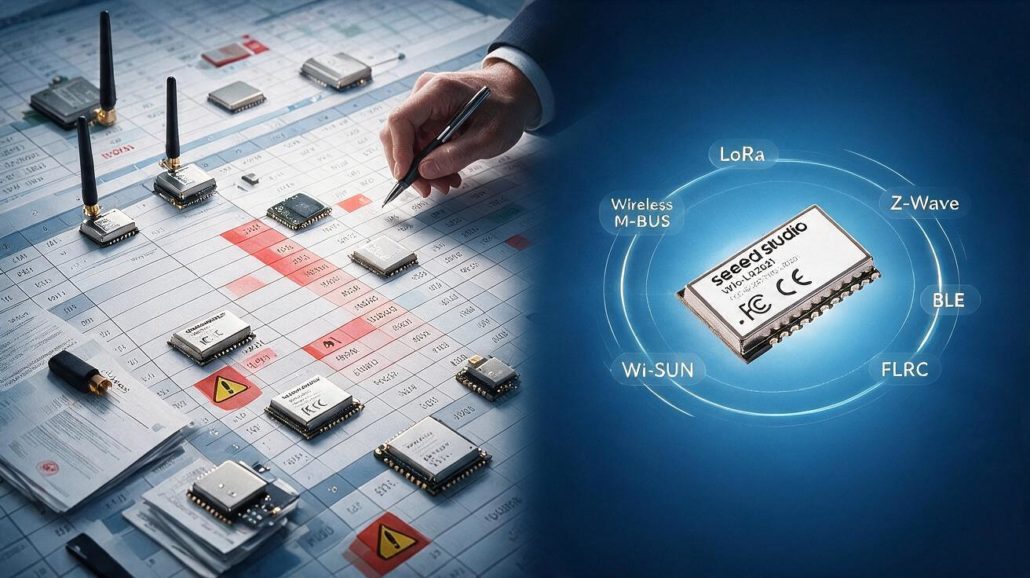
The Protocol Lock-In Trap : Why the LR2021 Is an Architecture Shift, Not an Upgrade
Every IoT product manager knows the moment. It happens early—too early—in the product lifecycle. Before a single line of application code is written, before the industrial design is finalized, you are forced to make a bet that will haunt your BOM for years: Which protocol do we marry?
LoRaWAN for long-range, low-power telemetry; Bluetooth LE for seamless smartphone onboarding; Z-Wave for the smart home channel; Wi-SUN for the utility grid; In the current hardware paradigm, this is not merely a technical decision. It is a capital commitment. Each protocol path locks you into a specific transceiver chip, a specific matching network, a specific antenna, a specific regulatory certification, and most painfully, a specific geographic SKU. When the European pilot requiring Wireless M-BUS turns into a North American deployment requiring Wi-SUN, or when the utility customer suddenly asks for Z-Wave instead of LoRa. You respin.
The cost is not merely engineering hours. It is inventory risk, supply chain fragmentation, and the quiet death of platform economics. For a solution vendor managing dozens of SKUs across regions, the “radio decision” becomes a cash-flow decision. What if the radio layer itself became software-defined? What if a single, pure RF module could be configured—to speak LoRa today, Wireless M-BUS tomorrow, and Z-Wave the next quarter?
That module is now a physical reality. The Wio-LR2021, built on Semtech’s fourth-generation LR2021 transceiver, is not another incremental LoRa module. It is a deliberate architectural bet that the future of IoT belongs not to protocols, but to protocol-agnostic platforms.
LR2021 Native Multi-Protocol: Fusion at the Die Level
Breaking that lock requires more than a software abstraction layer—it demands a fundamental redesign of the RF silicon itself. That is exactly what Semtech set out to do with the LR2021. To understand why the Wio-LR2021 matters, you must first understand what it is not. It is not a System-in-Package (SiP) that crams a BLE SoC next to a LoRa transceiver under epoxy, forcing you to manage two RF frontends, two SPI buses, two sleep currents, and two datasheets. It is not a “gateway-only” chip that promises multi-protocol support but only in receive-sniffer mode. It is a pure RF module—a connectivity engine that drops into your existing design and leaves your choice of host MCU entirely free.
The mechanism is elegantly simple: a single SPI command, SetPacketType (opcode 0x0207), re-orchestrates the digital front end, the packet handler, and the modulator/demodulator to adopt a new physical layer. LoRa, (G)FSK, FLRC, Bluetooth LE 5.0 PHY, O-QPSK (802.15.4 / Thread / Zigbee), Z-Wave, Wi-SUN FSK, Wireless M-BUS, OOK, LR-FHSS.
This matters for product strategy because it collapses the hardware boundary between physical layers. A Wio-LR2021 module can leave the factory uncommitted. The same PCB, the same shielding, and the same dual-band RF frontend can be flashed for LoRaWAN in Amsterdam, Z-Wave in San Jose, or FLRC-rich-media mode in the field. The hardware SKU remains one. Only the firmware—and the antenna selection for the target band—diverges.
A Typical LR2021 Sub-GHz Duality: Z-Wave or LoRa, Determined by Firmware
To see how this fusion works in practice, consider two protocols that have never before shared the same silicon: Z-Wave and LoRa. Z-Wave and LoRa share a physical home: the Sub-GHz spectrum. Yet historically, they have lived on separate silicon—Z-Wave on a dedicated transceiver, LoRa on another. The Wio-LR2021 collapses this boundary at the die level. Its LF frontend natively covers the Z-Wave bands, while its modem block handles both Z-Wave framing and LoRa modulation under the same RF-to-baseband pipeline.
For a Wio-LR2021-based device, this means the identical hardware—PCB, matching network, antenna, and shielding—can be provisioned for either ecosystem. For example, one can partition the host MCU’s Flash into independent banks: one image running Z-Wave for a smart-home SKU targeting mesh-centric markets, another running LoRa for a wide-area telemetry SKU. No respin, no antenna redesign. The protocol becomes a configurable setting choice, not a hardware variant.
This is not a concurrent operation. It is surgical hardware reuse: one certified radio platform, multiple protocol destinations. It is something more practical for supply chains: selected by the firmware image flashed at the factory, or even swapped in the field via an OTA bank switch. The Wio-LR2021 turns what used to be a hardware fork into a software branch.
LR2021 FLRC Mode: When Sub-GHz Devices Carry Voice and Image
Current LoRa field devices—whether GNSS trackers, mesh communicators, or industrial sensors—are architecturally capped to short text and telemetry. A traditional SX1262-based design offers no physical layer above typical LoRa bit rates, making voice or image transmission impossible.
The Wio-LR2021 removes this ceiling without adding a second radio. Its FLRC modem delivers up to 1.95 Mbps effective data rate in Sub-GHz bands with –100.5 dBm sensitivity, while retaining the same LF frontend and antenna infrastructure as its LoRa mode. A handheld field unit can spend its idle life in ultra-low-power LoRa, then burst a compressed voice clip or a low-resolution image to a peer node over FLRC in seconds. The same mesh that once carried 20-byte status packets can now carry situational awareness media—no cellular modem, no 2.4 GHz line-of-sight dependency, and no hardware respin.
The Swiss Army Knife was never defined by any single blade. Its value was the impossibility of predicting which tool you would need next. The Wio-LR2021 applies the same logic to RF: it does not guess which protocol will win. It makes the protocol a variable.
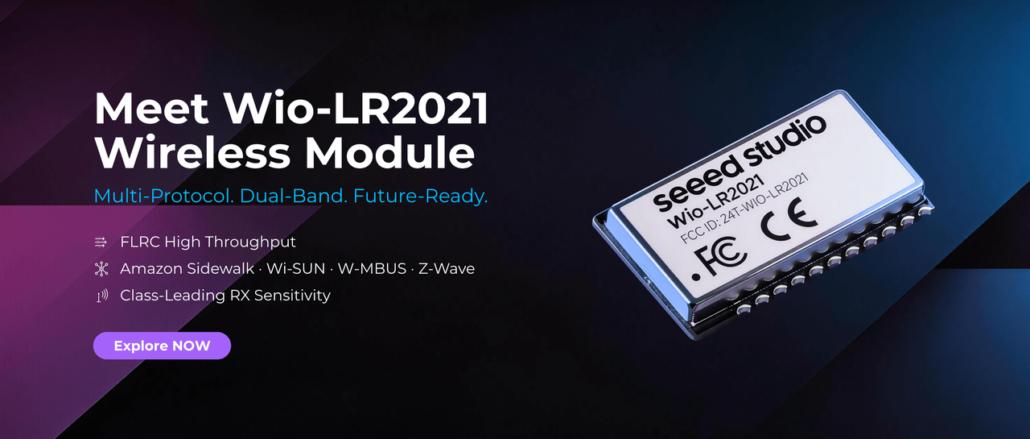
The Wio-LR2021—built on Semtech’s fourth-generation LR2021 is shipping now
About Author
