SO-101 vs. Traditional Robot Arms: Why Open-Source Robot Arms Are Changing Robotics
For decades, robotic arms have been associated with factories, high costs, and specialized engineering teams. Open-source robot arms are changing that model by making robotics more accessible to developers, researchers, educators, and makers.
The SO-101 is one example: a low-cost, open-source robot arm designed for robotics development, teleoperation, imitation learning, and AI experimentation.
Traditional Robot Arms: Built for Industrial Automation
Traditional robotic arms are optimized for repetitive, high-precision tasks such as:
- Assembly
- Welding
- Pick-and-place
- Packaging
- Machine tending
They offer reliability and repeatability, but often require significant investment in hardware, controllers, safety systems, integration, and proprietary software.
Their closed ecosystems can also limit access to mechanical designs, firmware, control systems, and data pipelines. As a result, they are well suited to production automation but less flexible for individual developers and researchers exploring new ideas.
What Makes Open-Source Robot Arms Different?
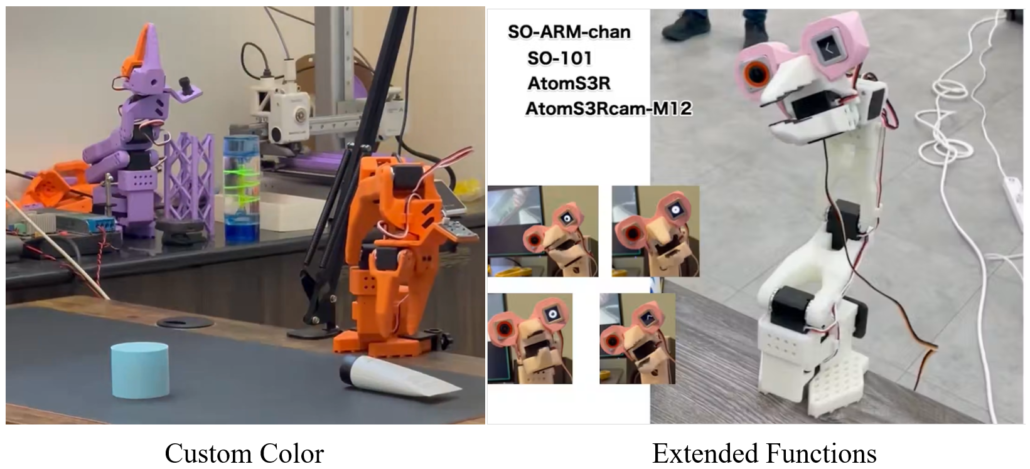
Open-source robot arms are designed as development platforms rather than finished industrial systems. Depending on the platform, developers may be able to access and modify:
- Mechanical designs
- Electronics
- Software and APIs
- Robot models
- Control interfaces
- Documentation
This makes it easier to customize the hardware, integrate new software, collect data, and experiment with robot-learning workflows.
SO-101: An Open-Source Platform for Learning
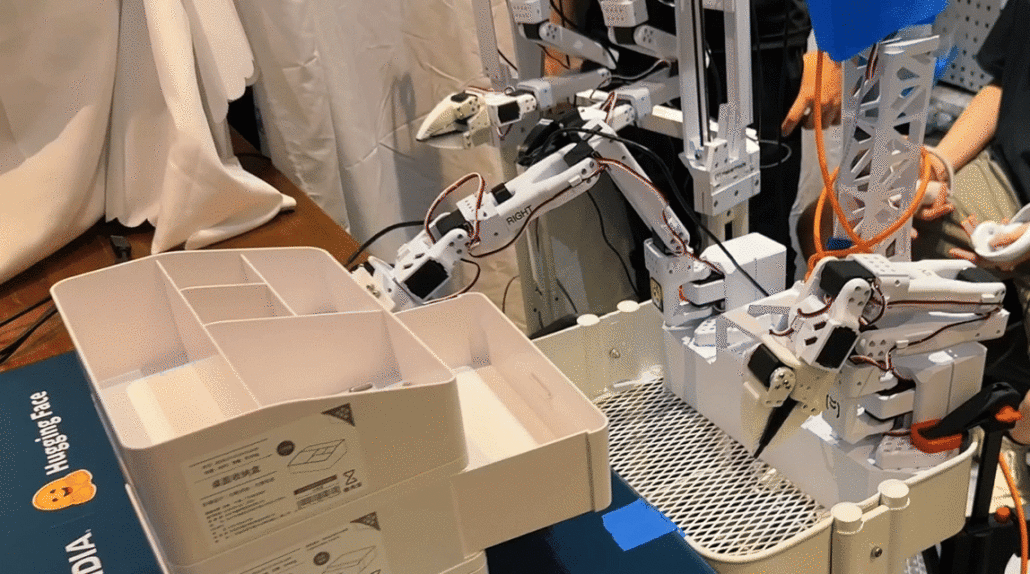
The SO-101 is built for hands-on experimentation. Its accessible design and open ecosystem allow developers to explore teleoperation, imitation learning, computer vision, and AI control without the cost of a traditional industrial robot.
Integrated with LeRobot, the SO-101 supports a practical development cycle:
Build → Teleoperate → Collect Data → Train → Deploy → Improve
Instead of manually programming every joint movement, developers can demonstrate tasks, record robot and camera data, train a policy, and evaluate the results.
| Feature | SO-101 | Traditional Industrial Robot |
| Price | Around $300 | Typically thousands to tens of thousands of dollars |
| Repeatability | ±1–2 mm | ±0.05 mm or better |
| Payload | 500 g | 3 kg to several hundred kilograms |
| Control | PC-based control via USB | Dedicated industrial controller |
| Programming | Python, LeRobot, and open APIs | Vendor-specific programming languages(e.g. RAPID) |
| Hardware & Software | Open and customizable | Usually proprietary |
| Data & Models | Open and shareable | Typically private or organization-managed |
| Customization | Highly customizable | Typically limited |
| Robot Learning | Designed for teleoperation and imitation learning | Usually requires additional integration |
| Best For | Learning, prototyping, research, and AI development | Production automation and industrial applications |
From Programming Robots to Teaching Robots
Traditional robotics typically follows this workflow:
Define the task → Program the motion → Run the robot
Traditional Robot Programming:
# Move to Position 1
move_to(x=0.3, y=0.2, z=0.15)

# Close the gripper
close_gripper()

# Move to Position 2
move_to(x=0.4, y=-0.1, z=0.15)
Therefore, all operations must be explicitly programmed.
Robot imitation learning introduces a different approach:
- A human operator guides the robot arm through the target task.
- The robot’s movements, joint angles, and camera observations are recorded during the demonstration.
- A neural network learns the relationship between visual input and the actions needed to perform the task.
- The trained model is then deployed to enable the robot to perform the task autonomously.
Want to experience robot imitation learning firsthand?Seeed Studio provides a step-by-step SO-ARM101 LeRobot tutorial covering everything from robot setup and teleoperation to dataset collection, policy training, and deployment.
Why LeRobot Matters
Hardware alone is not enough for robot learning. Developers also need software to control the robot, tools to collect and manage datasets, models for training, and interfaces for deploying learned policies.
LeRobot provides an open-source framework that brings these components together in a unified workflow. Instead of building separate tools for each stage, developers can use LeRobot to connect robot hardware with data collection, machine-learning training, and real-world deployment.
For SO-101 users, this means the same platform can support the entire development process—from controlling the robot and collecting demonstrations to training policies and testing them on the physical arm.
Robot Hardware → Data → Policy → Deployment
This integration is what makes LeRobot more than a robot-control library. It provides a practical foundation for experimenting with modern robot-learning methods on real hardware.
Lowering the Barrier to Robotics
Industrial robots remain essential for factories, but their cost and complexity can make them difficult to access for students, makers, and small research teams.
An open-source robot arm provides a more practical starting point. Developers can build and test physical AI systems in classrooms, labs, makerspaces, startups, or even on a desktop.
Open hardware also encourages collaboration. Developers can share designs, code, datasets, modifications, and training methods, allowing others to reproduce and improve their work.
Is SO-101 a Replacement for Industrial Robot Arms?
No. Industrial robots remain the better choice for applications that require high payload, speed, safety certification, reliability, and continuous operation.
The SO-101 serves a different role as a robotics development platform. It is designed for experimenting with:
- Robot learning
- Imitation learning
- Teleoperation
- Computer vision
- AI control
- LeRobot
- Robotics education
- Open-source hardware
Its value lies not only in its mechanical specifications, but also in what developers can build and learn with it.
From Robot Products to Robot Platforms
Traditional robots are usually purchased as finished products. Open-source robot arms can be treated as platforms that developers can modify, program, teach, and improve.
That shift is making robotics more collaborative and accessible, while connecting physical hardware with modern AI development.
The SO-101 represents this new approach: an open-source robot arm for developers who want to move beyond simply programming robots and start teaching them new skills.
Build it. Teleoperate it. Train it. Teach it something new.
About Author
