On August 26, a major flash flood swept through Nepal’s Rasuwa district, sending a fast-moving surge of water, sediment and boulders through the Bhote Koshi and Trishuli river systems. Scientists are still investigating the exact chain of events. Preliminary analysis by the International Centre for Integrated Mountain Development (ICIMOD) points to a possible high-altitude ice-rock avalanche, but the cause has not yet been conclusively established.
What is already clear is how quickly the hazard developed — and how difficult such events can be to monitor.
According to ICIMOD’s reporting on the flood, water levels at one point along the Trishuli rose by as much as nine metres within 30 minutes. Several water-monitoring stations were damaged or washed away as the flood travelled downstream.
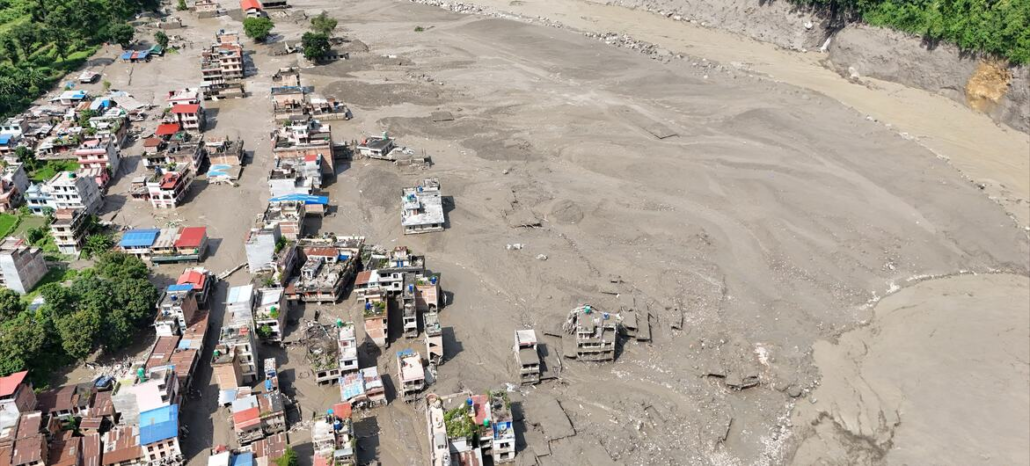
© UNICEF, a settlement in Rasuwa district in central-northern Nepal remains deep in mud following devastating flash floods.
Nepal is not starting from scratch on early warning. The country already has multi-hazard systems that combine automated weather stations, flood sensors, data-acquisition systems and community sirens across several watersheds. But the Rasuwa flood highlights a difficult engineering reality: the infrastructure designed to observe a hazard may itself sit inside the hazard zone.
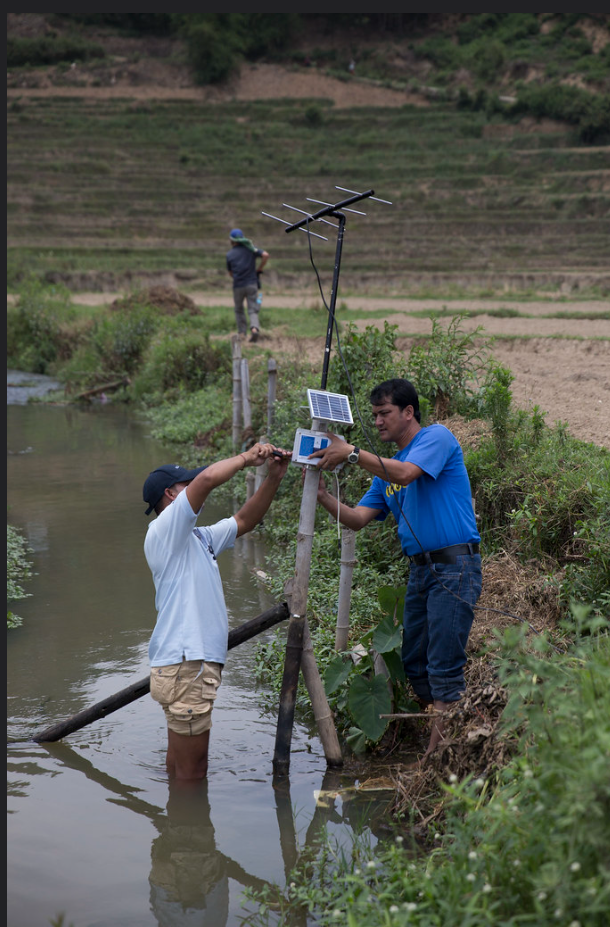
@Photo: ICIMOD Kathmandu / Flickr, ICIMOD staff conducting training for a community-based flood early warning system in Lalitpur, Nepal, June 2015.
In the aftermath, Nepal is preparing to rebuild parts of its warning infrastructure near the border using seismic sensors, cameras and VSAT satellite links — connections designed to keep monitoring posts online even when mobile networks fail.
The lesson is not simply that more sensors are needed. It raises a broader question relevant far beyond:
How do we build early-warning systems that can observe more of what is happening, continue operating under disruption, and adapt to very different hazards and landscapes?
Early warning is a system, not a sensor
A useful warning begins with sensing. But sensing alone does not produce a warning.
A river gauge can record water level. A weather station can measure rainfall, pressure and wind. A camera can observe changes in a landscape. Other instruments may detect movement, vibration or seismic signals.
The first challenge is deciding which observations matter for a particular hazard.
Then those observations have to be interpreted. That might mean comparing a measurement against a threshold, running an AI model locally, looking for an unusual pattern across several sensors, or combining historical data with what is happening in real time.
The information also has to travel.
In remote areas, LoRaWAN — a low-power, long-range wireless network designed for distributed sensors — can connect monitoring nodes over large areas. Mesh technologies such as Meshtastic, which allows LoRa radios to relay messages between devices without depending on cellular infrastructure, offer another option in places where conventional networks may be unreliable. Edge computers can process some information locally instead of assuming that every reading will reach the cloud.
For critical systems, resilience may also mean having more than one way for information to move. Nepal’s planned use of VSAT satellite connectivity, for example, is intended to keep monitoring stations connected if mobile networks go down.
But even that is not the end of the chain.
An observation ultimately has to become a warning that people can actually use. Depending on the place, that may mean an SMS, radio message, community loudspeaker, local alarm, visual alert or another trusted channel. The information has to reach both communities at risk and the people responsible for acting on it — in a language, format and channel they can understand and respond to.
That also means considering people who may be missed by a smartphone-first approach: older people, children, people with disabilities, people with limited literacy, or communities where language and connectivity cannot be taken for granted. International early-warning frameworks increasingly describe this as a people-centred, end-to-end system, where monitoring is only one part of a chain that also includes communication, preparedness and response.
In engineering terms, the chain might look simple:
Sense → Understand → Communicate → Warn
In practice, every arrow between those words contains its own design problem.
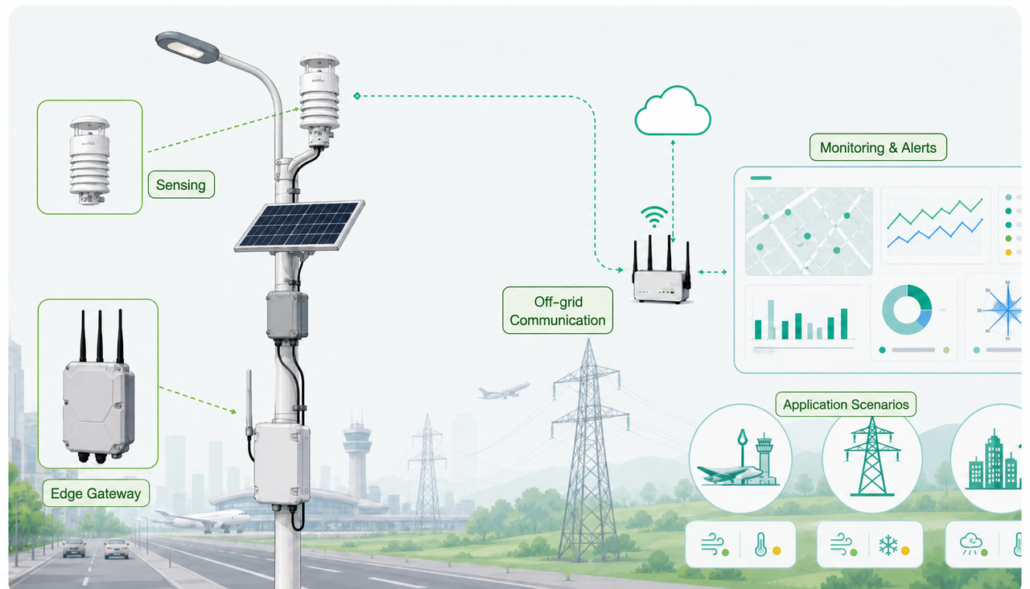
@Seeed Studio, a simplified hardware architecture for early warning.
Open hardware is already providing the building blocks
Open and modular hardware can make early-warning experimentation more accessible: components are easier to adapt, systems can be expanded as requirements change, and local technical teams do not always have to begin with an entirely closed architecture.
We have already seen different pieces of an early-warning system explored through Seeed hardware in very different settings.
A community-built flash-flood warning prototype, for example, used a SenseCAP K1100 kit and Grove Vision AI to explore how environmental sensing and visual detection could be connected to a remote warning workflow. The project remained a prototype, but it showed how relatively accessible hardware could lower the barrier to experimenting with an early-warning architecture.
Communication presents a different problem. In the Philippines, grassroots NGO Light of Hope PH tested SenseCAP T1000-E devices running Meshtastic as part of a disaster-preparedness communication network. Mainland, mountaintop relay and boat nodes were able to maintain a one-hop connection over more than 30 kilometres without relying on cellular or Wi-Fi infrastructure. The project was not predicting a hazard; it was testing one of the conditions that makes a warning useful when ordinary infrastructure becomes unavailable.
Another project, developed for industrial fire monitoring in Texas, connected thermal sensing with user-defined thresholds, local alarms, SMS notifications and automated outputs through Seeed’s reTerminal DM. It demonstrates another piece of the same architecture: turning a physical measurement into a predefined trigger and then into an action.
At a much larger scale, more than 500 SenseCAP sensors and data-transmission units have been deployed across hundreds of sites in Cagliari, Italy. The network feeds environmental measurements including temperature, humidity, wind and rainfall into a shared platform for real-time visualization, anomaly detection and data-limit alerts. It is not an early-warning project in the disaster-management sense, but it demonstrates what distributed field sensing looks like once it moves beyond a single prototype.
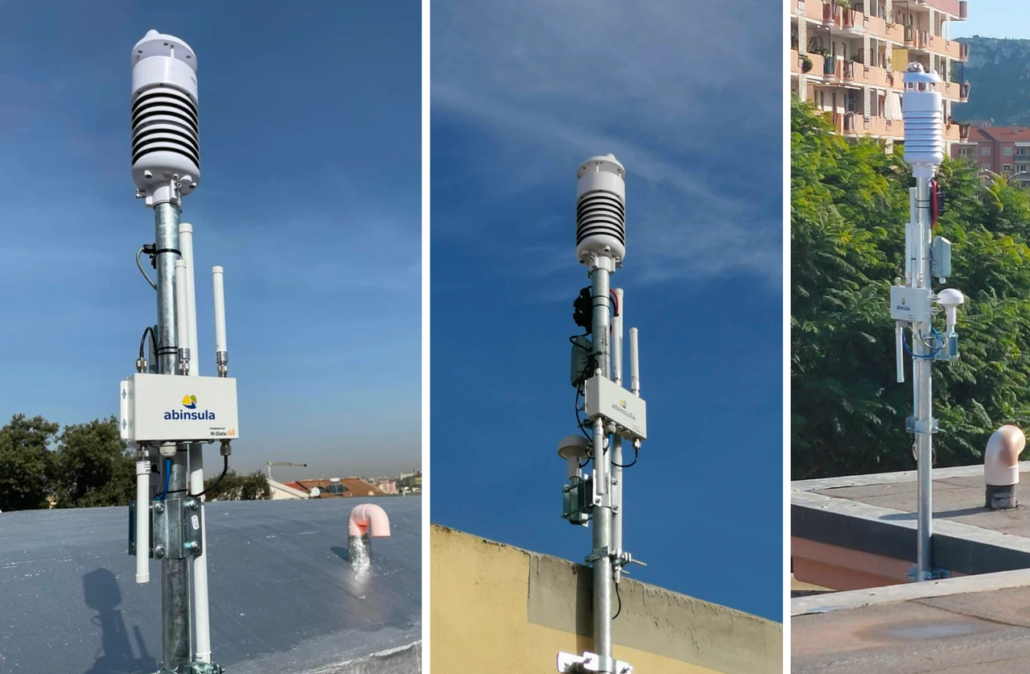
@Seeed Studio, SenseCAP Weather Sensor and Gateway Deployed on Rooftop in Cagliari
These projects are not four versions of the same warning system. What they show is that many of the underlying capabilities — distributed sensing, local processing, resilient communication and automated alerting — can already be assembled with accessible hardware.
The next practical question is how to bring those pieces together quickly in the field.
That is one role Seeed’s Hazard Response Mission Pack is designed to explore. Rather than functioning as a single hazard sensor, it provides a modular platform for integrating different devices and communication methods. Interfaces including RS485 and USB, together with LoRaWAN, Meshtastic and Wi-Fi connectivity, allow sensing devices, communication nodes and edge-computing components to be connected into a local system and adapted as deployment requirements change. The Mission Pack is not, by itself, a flood-prediction system, a landslide-warning product or a wildfire-warning system. It is a configurable technical base for sensing, processing, communication, localized warning and field response.
But the reusable hardware architecture is only one part of an early-warning system. What counts as a meaningful signal — the right datasets, thresholds, models and warning logic — depends on the hazard and the place. And an effective warning still has to reach communities through channels, languages and formats they can actually use.
Open hardware can make early-warning technology more accessible. Local data and expertise are what make it useful.
Building the next early-warning pilots together
This work is not new for us. Through Seeed’s Hazard Response initiative (learn more here), we have been exploring how sensing, edge computing, off-grid communication and open-source tools can be combined for disaster preparedness, monitoring and response. The project site brings together the Hazard Response Mission Pack, open-source resources and case studies across early warning, remote monitoring and resilient infrastructure.
We now want to take that work further by co-developing selected field pilots with NGOs, FabLabs and disaster-management agencies working on early warning and hazard resilience.
The most useful collaboration may not begin with a list of products.
It may begin with a river that is already being monitored but where existing stations are too sparse. It might be a mountainous community where communications become unreliable during extreme events. It could be an organization with years of local observations that wants to experiment with additional sensors or edge processing. Or it may be a research team that understands the signals associated with a particular hazard but needs a practical platform to test those ideas outside the lab.
Those are the kinds of problems we want to hear about.
Seeed can contribute open hardware, rapid prototyping, IoT and edge-AI engineering, and hardware sponsorship for selected pilots.
Our partners bring something equally important — and something a hardware company cannot manufacture: hazard expertise, field access, local data and an understanding of how risk is experienced on the ground. They know which signals matter, where a system can realistically be installed, who needs to receive a warning, which communication channels people trust and what happens after an alert is issued.
Together, the work becomes more than assembling another prototype.
It means deploying hardware in the field, collecting and structuring data, establishing meaningful thresholds, testing models, evaluating communication paths, learning from false alarms and failures, and iterating until a system begins to reflect the place it is meant to serve.
And where possible, an open approach can allow what is learned in one pilot — the hardware architecture, deployment methods, software and lessons from the field — to become a starting point for others facing similar problems.
The next practical early-warning system is unlikely to come from a hardware company working alone.
It will come from engineers building alongside the people who understand the hazard, the landscape and the communities living with it.
If your organization is already working on flood, landslide, wildfire or other hazard monitoring — and has a field site, existing data, local expertise or a real deployment challenge — we would like to hear from you. Contact us at [email protected] to explore what we could build and test together.
