From Hearing Clearly to Understanding Sound: How reSpeaker Brings Voice AI into Real-World Scenarios
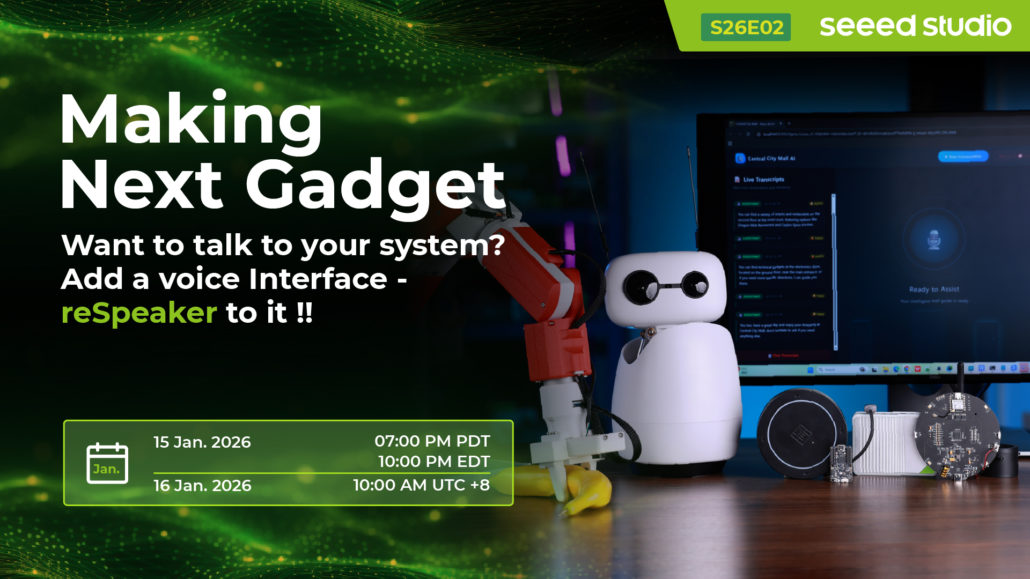
Voice AI has never been short of powerful models. Speech-to-text, large language models, and text-to-speech systems are evolving at an incredible pace. Yet when Voice AI moves from demos into real environments—shopping malls, offices, robots, or public spaces—it often fails for a much more basic reason: the system cannot hear well enough. Recently, we hosted a live stream showcasing how reSpeaker is used across multiple real-world scenarios. This article is a structured look at what it revealed: once you can capture clean, reliable audio, what does that actually enable? And more importantly, where does reSpeaker fit in the larger Voice AI picture?
Voice AI Starts with Sound — but It Doesn’t End There
reSpeaker is a front-end audio capture platform. Its job is simple but critical: capture sound clearly and reliably in real environments. But voice is more than sound waves.
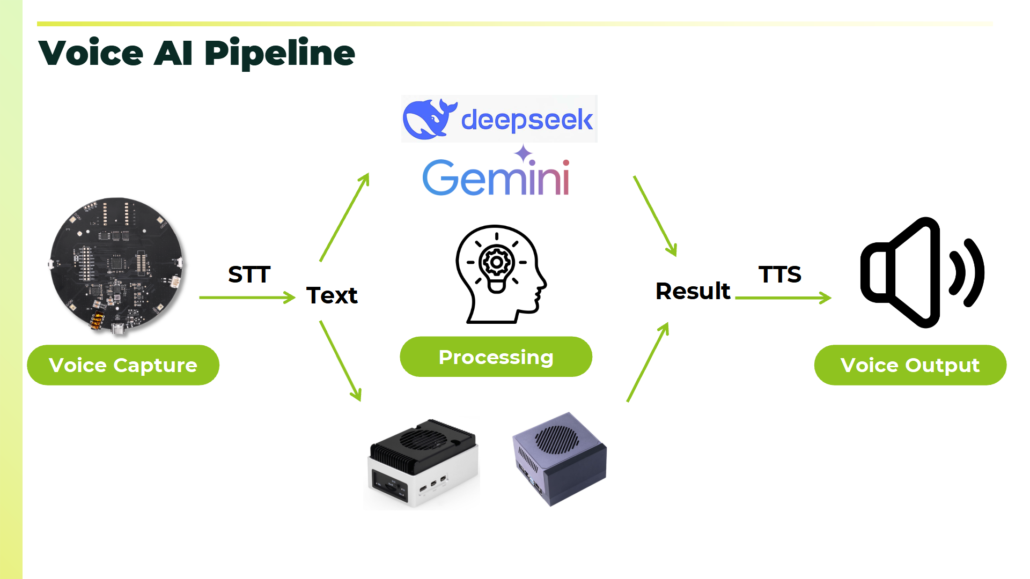
In a typical Voice AI pipeline, audio captured by reSpeaker flows through:
- Speech-to-Text (STT)
- Local or cloud-based AI processing (LLMs)
- Text-to-Speech (TTS) or action execution
This pipeline is how AI connects with the physical world. Voice and vision are the two most natural interfaces between humans and machines — and reSpeaker sits right at that entry point.
Once clean audio is available, an entire ecosystem of applications becomes possible.
Voice Agents in Smart Retail: Reducing Friction Between People and Space
One of the most mature and impactful applications of reSpeaker today is voice agents in smart retail and commercial spaces. In malls, museums, and large public venues, visitors constantly ask questions like:
- Where is the cinema?
- Is there a quiet place to make a phone call?
- Where can I eat with my family?
The real pain point isn’t information — it’s access to information, fast and naturally.
By combining reSpeaker with Agora’s Conversational AI, we demonstrated a real-time Q&A voice agent that:
- Responds almost instantly
- Understands natural language
- Uses emotional feedback and on-board LED to indicate and reflect response states
This design turns voice interaction into something users can feel, not just hear. A positive answer triggers a warm color visual response; a negative one communicates sadness clearly.
The result is a deployable, low-friction voice interface that reduces information bottlenecks — without adding signs or human staff.
reSpeaker: The Smart Ear for Embodied AI
When voice agents gain physical form — screens, speakers, robotic arms — they become robots. This is the essence of embodied AI.
During the livestream, we showcased Reachy Mini, using a customized linear 4-microphone reSpeaker array. With reSpeaker, the robot could:
- Hear commands clearly
- Understand intent
- Translate voice input into physical actions
In robotics, movement is easy. Understanding speech in noisy environments is not.
Motors, mechanical structures, and vibrations introduce heavy interference. This is where reSpeaker’s hardware design and onboard acoustic algorithms become critical.
In this setup, reSpeaker is not the brain — it’s the smart “ear” of the robot, enabling consistent and reliable voice interaction across platforms.
Looking ahead, Seeed will launch a split-design reSpeaker for robotics, allowing microphones and core boards to be placed independently. This gives robot designers far more flexibility while improving audio quality by positioning microphones closer to sound sources.
Security and Safety: Not Just Seeing, but Hearing Abnormal Events
Security systems traditionally rely on vision. But many real-world safety scenarios are incomplete without sound.
By combining Vision AI and Voice AI, systems become significantly more reliable.
This livestream cip introduced the newly released Sound Event Detection Module D1, which allows reSpeaker to continuously monitor and detect five critical audio events:
- Gunshots
- Glass breaking
- Baby crying
- Smoke(fire) or CO alarms (T3/T4)
- Snoring
The module runs continuously, consumes low power, and processes everything locally at the edge. When an event is detected, alerts can be triggered immediately — including timestamps, location, and event type.
This makes it ideal for schools, hospitals, public spaces, and unmanned environments, where early audio detection can prevent escalation before visual confirmation is even possible.
Smart Meetings Reimagined: Hear Clearly, Then Understand What Was Said
Meetings don’t waste time because they happen — they waste time because no one summarizes them afterward.
In the final demo, we showed how reSpeaker can act as a long-term, privacy-friendly meeting assistant:
- Local recording and processing
- STT-based transcription
- AI-generated summaries, key points, and action items
Everything runs locally, without relying on the cloud, making it ideal for fixed conference rooms and privacy-sensitive environments.
The result is not just clearer audio, but actionable insights generated automatically.
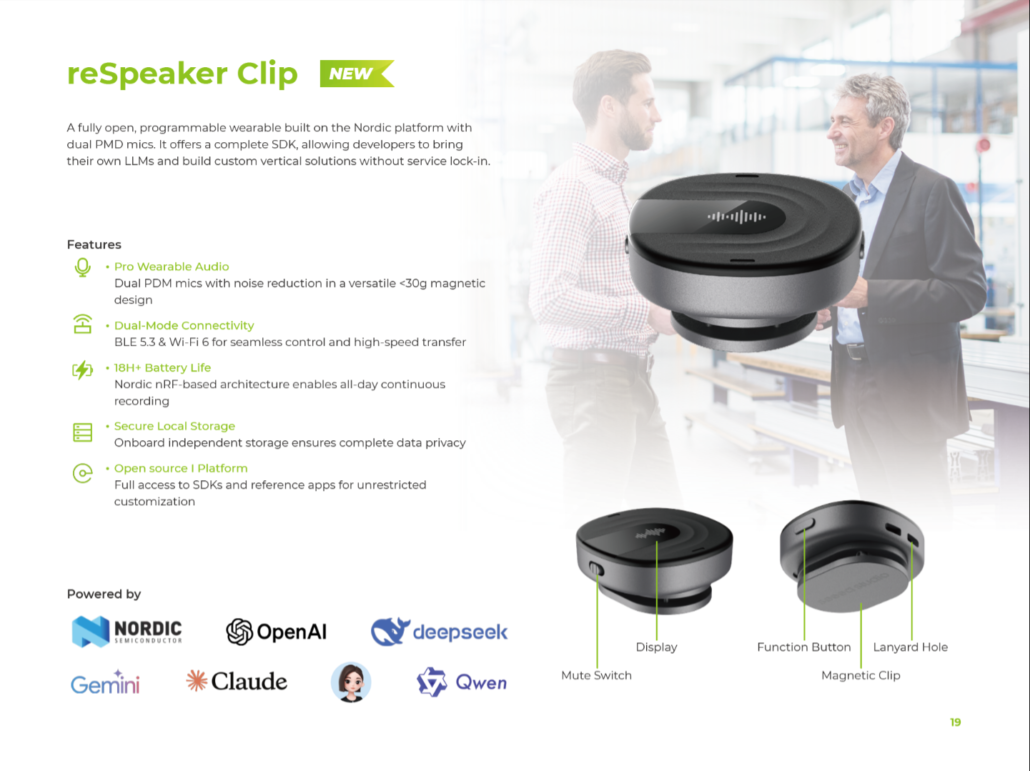
In the coming months, we will be launching the new wearable reSpeaker Clip. This mini-sized device is designed to be easily clipped onto your collar or worn with magnetic attachment, offering both convenience and comfort. With low power consumption and long-lasting battery life, reSpeaker Clip is perfect for intelligent meeting and conversation recording. By pairing it with the accompanying app, users can enjoy real-time speech transcription, conversation summaries, and more, making meetings and communication more efficient and seamless. Whether for work or everyday use, reSpeaker Clip will be an essential tool for your smart voice experience.
The True Power of Sound in Voice AI: From Clarity to Action
In every demo we’ve shared, from smart retail to robotics, security systems, and meeting tools, there’s been one consistent theme that ties it all together: the journey from sound to action.
At the core of all these applications lies a simple truth: sound is the most natural interface between humans and machines. It’s the first step toward intelligent interaction. But hearing clearly isn’t the end goal—it’s just the starting point. What matters is what comes next: understanding sound.
reSpeaker plays a pivotal role in this transition. It doesn’t just pick up sound; it captures it with incredible clarity and precision. From there, the magic happens. Once the sound is clear, the system can move to the next step—understanding it. And from that understanding, meaningful actions can be taken, whether it’s responding to a voice agent, triggering a robot’s movement, or activating a security response.
This transition, from sound to understanding, and from understanding to action, is where the real value lies. It’s what enables Voice AI to move beyond simple commands into something truly intelligent and interactive.
In essence, reSpeaker is not just about hearing; it’s about empowering systems to truly listen, understand, and act.
Where reSpeaker Fits in Your System
If you’re building solutions for:
- Smart retail
- Robotics
- Security and safety
- Meeting systems
reSpeaker may not be your final product — but it can be the most reliable voice interface in your system.
With an expanding product lineup, including sound event detection modules, robotics-focused designs, and upcoming wearable devices, reSpeaker is becoming a flexible platform for bringing Voice AI into real-world applications.
Watch the full Live Stream here: Making Next Gadget | Want to talk to your system? Add a voice Interface -reSpeaker to it !!
Learn more about reSpeaker: Microphone Array – Vision AI & Sound AI
Learn more about Reachy Mini x reSpeaker: How reSpeaker Acts as the Smart Ear for Reachy Mini
About Author
