How to Choose the Right NVIDIA Jetson Carrier Board for Your Embedded System
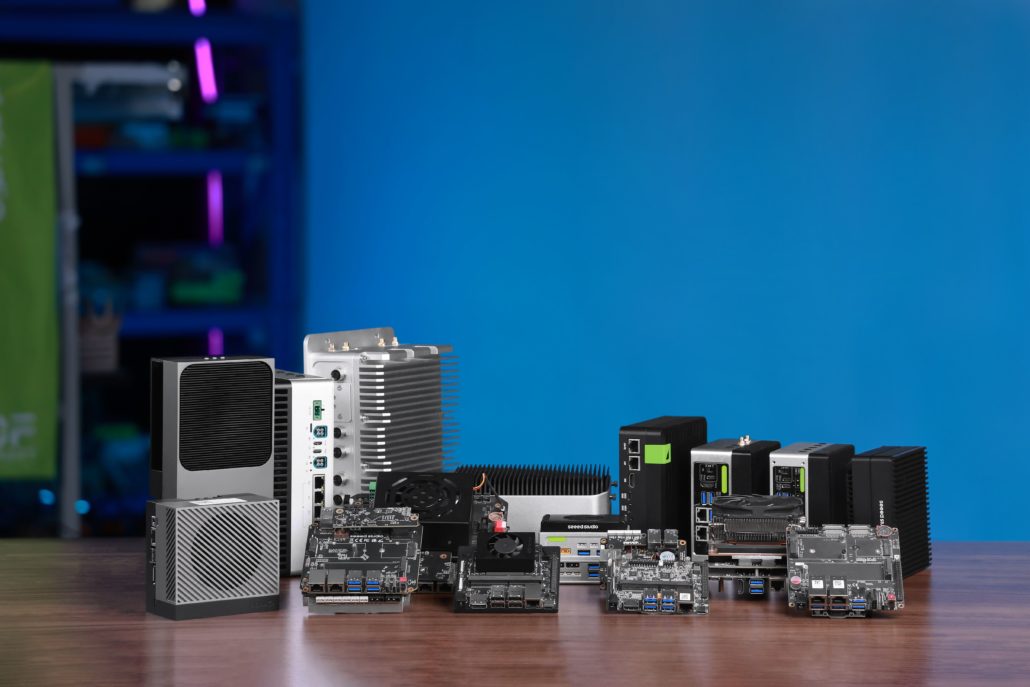
By Liyan Gong Last Updated on: February 9, 2026TL; DR: Selecting an appropriate NVIDIA Jetson carrier board requires a system-level perspective rather than a simple comparison of interfaces or specifications. A practical selection approach starts by identifying the Jetson module tier, then evaluating system form factors, connectivity requirements, and future expansion needs. By clarifying design priorities and understanding how different carrier board architectures emphasize different capabilities, it becomes possible to narrow down options efficiently and make informed, justifiable choices.
Jetson modules provide computing power, but it is the carrier board that determines whether an embedded system can actually be deployed: how peripherals are connected, how the enclosure is designed, how thermal and power constraints are handled, and whether the system can evolve in the future.
In many Jetson projects, the carrier board is not discussed early, yet it often becomes a limiting factor later in development. A common mistake is choosing a carrier board purely based on port count and spec sheets, while ignoring system-level constraints. In real deployments, limitations often come from mechanical size, power and thermal design, camera integration stability, networking topology, and future expansion. A better approach is to confirm the Jetson module first, define the project’s top priority (size, cameras, connectivity, or expandability), and pick a board that matches that focus. This article approaches carrier board selection from a system design perspective, offering a reusable and practical decision path, and demonstrates how that path leads to concrete board choices through a real project example.
We also present a reusable decision framework and demonstrates how it can be applied to real projects to bridge the gap between abstract requirements and concrete carrier board selection.
1. Jetson Carrier Boards Used as Selection Examples in This Tutorial
| Product | Supported Jetson Modules | Key Characteristics | Typical Use Direction |
| reComputer Super J401 Carrier Board | Orin Nano / Orin NX | Super / MAXN support; –20 °C to 65 °C; onboard Wi-Fi / Bluetooth / LTE | Edge AI and vision systems requiring integrated wireless or cellular connectivity |
| reComputer Robotics J401 Carrier Board | Orin Nano / Orin NX | Robot-oriented design; preinstalled JetPack 6.2 and Linux BSP | Robotics and multi-sensor systems emphasizing fast deployment and software consistency |
| reComputer J401 Carrier Board | Orin Nano / Orin NX | Open-source design; balanced interfaces (USB, GbE, M.2, CSI, HDMI) | Prototyping and platform-style development |
| A603 Carrier Board | Orin NX / Orin Nano | Compact footprint; clearly scoped interfaces | Space-constrained embedded devices with defined requirements |
| A608 Carrier Board | Orin NX / Orin Nano | Communication- and COM-oriented design; system interconnect focus | Systems with complex networking and interconnection needs |
| reComputer Mini J501 Carrier Board | Jetson AGX Orin | Industrial / control I/O; GMSL camera expansion | High-performance platforms and advanced robotics or control systems |
2. Jetson Carrier Board Selection Workflow and Design Principles
The following diagram outlines a high-level approach to Jetson carrier board selection, focusing on module tier, system form, and design priorities.
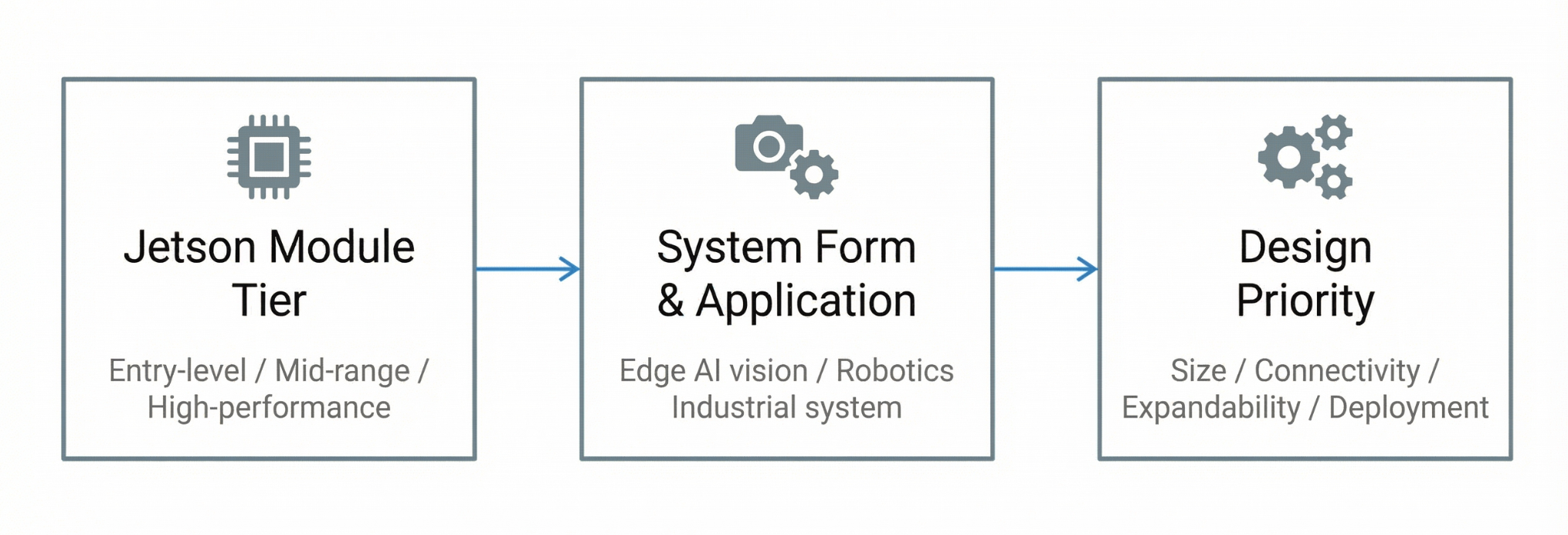
Module Tier Defines the Design Boundary
Different Jetson modules—such as Orin Nano, Orin NX, and AGX Orin—vary significantly in performance, power envelope, and available interfaces. The module tier directly limits the feasible carrier board options and the overall system architecture.
The Carrier Board Is Part of the System Design
A carrier board should never be considered in isolation. It must work together with peripherals, enclosure design, thermal solutions, and power delivery to form a complete and reliable system.
Design Priorities Must Be Explicit
Size, connectivity, expandability, and deployment constraints rarely can be optimized simultaneously. Making trade-offs explicit is essential for a selection process that can actually be executed.
3. Example-Driven Selection: An Edge AI Vision System
Project Background
- Jetson module: Orin NX / Orin Nano
- Cameras: 2–4 channels
- Networking: Ethernet as primary, with optional wireless or cellular backup
- Mechanical constraints: Limited space, with future expansion in mind
This configuration represents a common edge AI vision deployment.
3.1 Initial Filtering by Module Tier
Since the system uses Orin NX / Orin Nano, carrier boards designed primarily for Jetson AGX Orin are not the primary focus at this stage. Their strengths lie in higher compute density and complex control workloads.
The candidate set therefore narrows to carrier boards supporting Orin NX and Orin Nano.
3.2 Defining Design Priorities
In this project, selection discussions typically revolve around:
- Whether onboard wireless or cellular connectivity is required
- How strict the mechanical space constraints are
- Whether additional peripherals are expected in later revisions
- Whether the project is still in a prototyping phase or nearing productization
3.3 From Design Priorities to Concrete Board Choices
With priorities clarified, the carrier board choice becomes a matter of matching capability emphasis rather than comparing raw specifications.
Connectivity-first systems
Wireless or cellular backup required, minimal external modules.
- Recommended Carrier Board: reComputer Super J401 Carrier Board The integrated Wi-Fi, Bluetooth, and LTE support addresses system-level connectivity requirements directly, simplifying wiring, power management, and field deployment.
Compact and integration-focused systems
Tight enclosure constraints, well-defined interfaces.
- Recommended Carrier Board: A603 Carrier Board In these scenarios, having “just enough” interfaces in a compact layout is more valuable than maximum expansion. A603 supports a cleaner transition toward product-ready designs.
Systems with complex interconnection requirements
Multiple subsystems, communication buses, or future expansion.
- Recommended Carrier Board: A608 Carrier Board Its communication-oriented design makes it better suited as a central node in more complex systems.
Early-stage prototyping and platform development
Requirements not fully frozen, need to reduce iteration risk.
- Recommended Carrier Board: reComputer J401 Carrier Board Broad interface coverage and flexibility make it a strong starting point for bringing the system up quickly.
Robot-oriented systems
Multi-sensor integration, faster deployment, standardized software stack.
- Recommended Carrier Board: reComputer Robotics J401 Carrier Board For robotics projects, the combination of hardware layout and prevalidated software environment can significantly shorten integration time.
For additional assistance in choosing the right embedded system, you can also visit our Jetson-based product selection tool. It offers helpful recommendations based on your specific requirements.
4. From Prototyping to Production and Customization
As a project moves toward production, interface requirements stabilize, and constraints such as size, cost, and supply consistency become more critical. While general-purpose carrier boards accelerate validation, they are not always optimal for final products.
A common and effective approach is to validate the system on a mature carrier board, then refine the design by trimming interfaces and optimizing the layout. For teams targeting volume deployment or tighter integration, Jetson-based carrier board and system ODM services provide a structured path from prototype to production-ready hardware.
Conclusion
A reusable approach to Jetson carrier board selection can be summarized in three steps: identify the module tier, define the system form, and prioritize design constraints.
By following this process and applying it to a concrete project, you can move from abstract requirements to well-justified carrier board choices—and lay a solid foundation for future productization and customization.
About Author
Liyan Gong
10 years in the IoT hardware industry. I’m here to share practical guides on Home Assistant, NVIDIA Jetson, Meshtastic/Meshcore, Raspberry Pi, LoRa, PCB/PCB Assembly and more to help bring your creative ideas to life.
Hi There — I want to have a good solution for my home AI and wondering if a Jetson would be better than the NVIDIA 3060 that I use now, or a 3090 which would cost me about the same as a Jetson AGX… can you help me decide which one would have better performance ?
For a home AI system, it really depends on your specific use case. In terms of raw compute performance, an RTX 3060 or 3090 will generally outperform a Jetson AGX. However, Jetson platforms are designed for low-power, always-on edge deployment, while desktop GPUs are typically better suited for higher local inference workloads.