LIA: An Open Meshtastic GPS Tracker Built for Off-Grid Use
Meet LIA, J. G. Aguado’s open-source Meshtastic GPS tracker. Explore its GNSS, Wio-SX1262 radio, power design, testing record and printable enclosure from Meshtastic Build-Off 2026 Competition Issue 21.
LIA began with a moment that many pet owners will recognize. During a countryside walk, Lia, the dog who gave the project its name, wandered much farther than expected. Commercial trackers existed, but their dependence on cellular coverage, cloud accounts and recurring subscriptions felt poorly matched to the problem. J. G. Aguado instead asked whether a small device could send location and status through a community-owned radio mesh. His answer became LIA, an open-source pet and asset tracker built around Meshtastic.
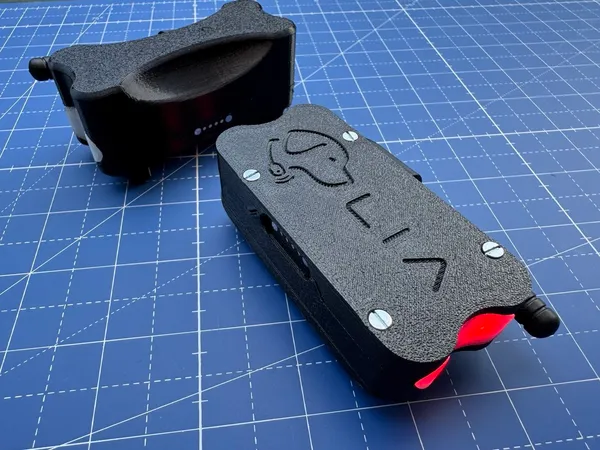
Two finished LIA enclosure variants show how the project moved beyond a bare node into a collar-ready device. Project image: J. G. Aguado.
A hardware competition built around reproducibility
The Meshtastic Build-Off 2026 challenged makers to create real hardware rather than stop at a concept render or software mock-up. Entrants had to build around one of three Seeed Studio radio modules, Wio-WM1110, Wio-SX1262 or Wio-LR1121, run Meshtastic firmware, place the official competition silkscreen on the PCB, and publish a public repository. A complete submission also required at least three high-resolution photos and a demonstration video of at least 30 seconds.
More than ten projects reached the finish line after months of layout changes, assembly work and firmware debugging. Evaluation considered Meshtastic integration, functional completeness, PCB and enclosure execution, practical value, documentation, optional features and community response. Seeed Studio reviewers were joined by reviewers from the official Meshtastic project, including Ben and Jonathan Bennett. That mix matters because a visually polished enclosure could not compensate for weak firmware evidence, and a clever code change still had to survive inside a usable physical device.
WHY LIA STOOD OUT LIA did not present one successful screenshot as proof. It published the trail from first boot to RF traffic, GNSS fixes, sleep failures, wiring corrections, direct-message behavior, production files and multiple enclosure revisions.
A tracker designed as a complete endpoint
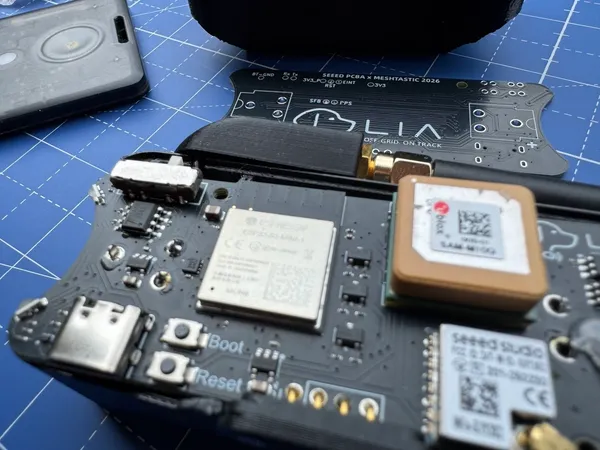
The architecture joins an ESP32-S3-MINI-1 host, a u-blox SAM-M10Q GNSS receiver, a MAX17048 battery fuel gauge, an LSM6DSOX motion sensor and a Wio-SX1262 radio module on a purpose-built board. The host does more than forward coordinates. It decides when GNSS and radio power should be available, reads the physical mode switch, handles charge and motion status, interprets commands, and chooses when a new position is worth sending.
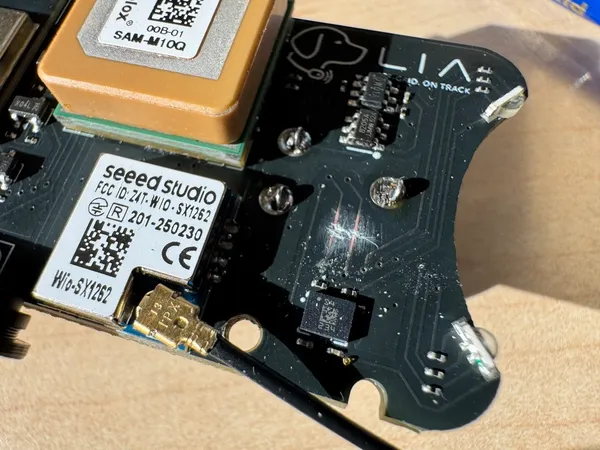
The exposed board makes the division of labor visible: ESP32-S3 for application control, SAM-M10Q for positioning, and Wio-SX1262 for the LoRa radio path. Project image: J. G. Aguado.
The finished behavior is similarly deliberate. In continuous mode, LIA stays awake and reports frequently for an active walk or search. In tracker mode, it wakes, waits for a valid position, sends it, powers down the GNSS and radio rail, and returns to deep sleep. A third switch position cuts system power while leaving charging available. Direct messages can request GPS or battery status, enable or disable motion and charging notifications, control the LED, or return a help list. The result is not merely a beacon. It is an addressable field endpoint that can be queried and managed over the same low-bandwidth path that carries its position.
Why Wio-SX1262 fits a custom Meshtastic tracker
LoRa is the radio modulation. Meshtastic supplies the higher-level packet formats, device roles, routing behavior and applications that allow compatible nodes to form a mesh. A custom product still needs a dependable bridge between its host processor and that network.
The Wio-SX1262 module packages Semtech’s SX1262 transceiver, an active temperature-compensated crystal oscillator and the RF interface in a compact module controlled over SPI. Seeed’s technical documentation provides the pinout and reference design, including the BUSY, reset and interrupt lines, DIO3-controlled TCXO supply and the antenna matching guidance. This lets the ESP32-S3 concentrate on GNSS, sensor logic and power policy while the module handles LoRa transmission and reception.
For Meshtastic builders, that separation has a practical advantage: SX1262 is already a familiar radio family in the ecosystem. The module does not remove the need for correct power sequencing, antenna layout or a board variant, but it reduces the amount of RF circuitry a maker must reinvent. LIA demonstrates the module’s real value by embedding it in a complete system and documenting the integration work above it.
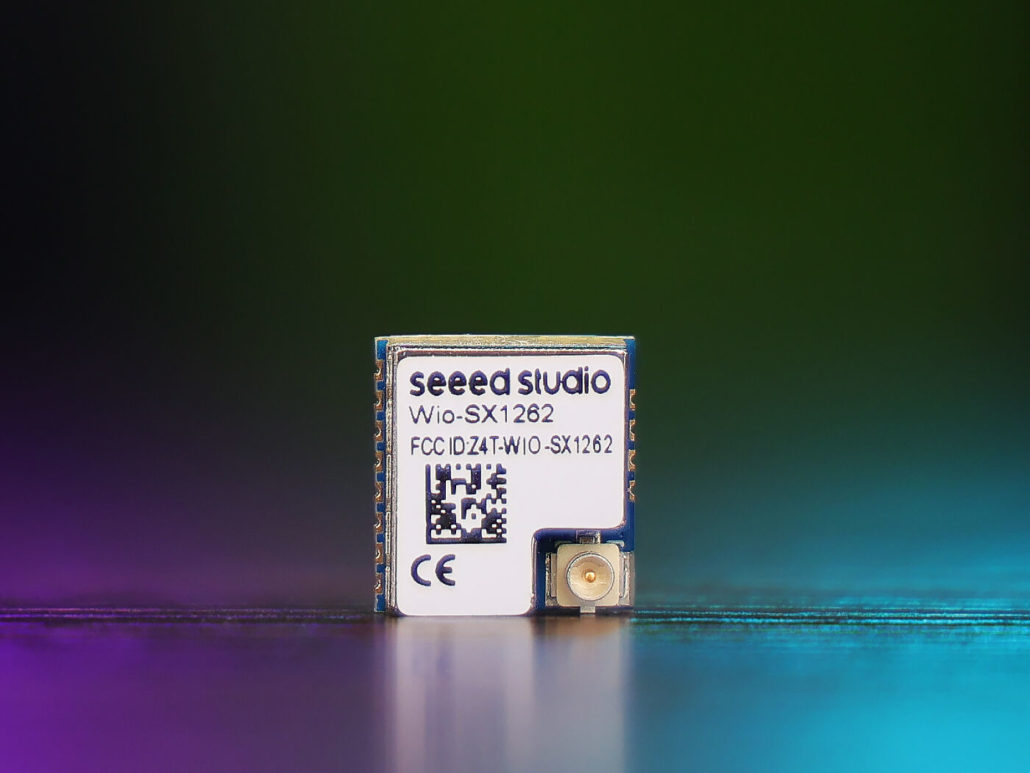
BUILD WITH THE SAME RADIO Seeed Studio provides Wio-SX1262 application resources, reference material and purchase options for makers who want to develop their own Meshtastic node.
The build record reads is more than professional
First boot, then real radio traffic
The development history starts with the unglamorous essentials: a board definition that compiled, flashed and reached a USB serial console, followed by control of the shared peripheral power rail for the SX1262 and GNSS receiver. The first on-air test then exposed two crashes. One came from reading a global object before Meshtastic had constructed it. The other came from calling the logging system before that system itself was ready. Aguado traced both faults against the built firmware rather than guessing from symptoms, moved the initialization points, and then confirmed that another node received the test message in the official Meshtastic app.
From a test string to a position that reached the right person
The temporary sender became a dedicated TrackerService. Stock Meshtastic support detected the SAM-M10Q, so the firmware could replace a fixed test string with a native position packet. It rejects an empty 0,0 coordinate, packages the valid position and directs it to a predefined destination node. This is an important product choice. A pet tracker should not treat every coordinate as a general announcement simply because the radio network is shared.
The privacy design also evolved through use. An early version relied on a named private channel, but users could configure the name or key incorrectly and receive no obvious explanation. Direct messages in the official app can also use identity-based encryption in ways that do not behave like ordinary channel traffic. LIA therefore simplified the model: position, status and command replies now address one known node directly. The project did not cling to its first architecture. It changed when real interaction exposed unnecessary friction.
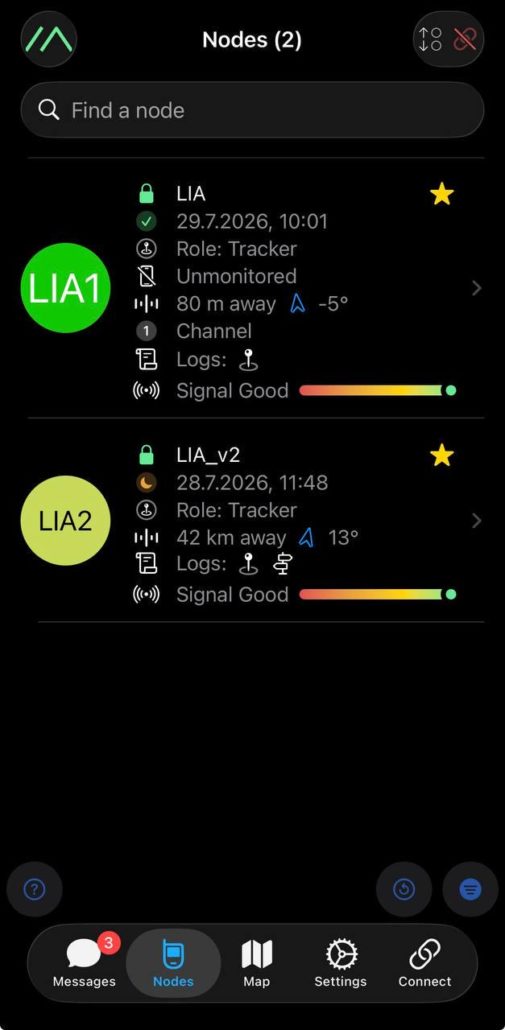
A real LIA position displayed in the official Meshtastic app. Exact coordinates are intentionally omitted. Project image: J. G. Aguado.
Evidence across the whole packet and power path
The radio evidence is modest but useful. During testing, the custom board joined a live 39-node mesh and exchanged LoRa traffic. One captured condition showed -49 dBm RSSI and 6 dB SNR with a rebroadcast observed. This is not a universal range benchmark, and the project does not present it as one. It is stronger in another way: it proves that the antenna path, Wio-SX1262 wiring, board definition, Meshtastic stack and host application operated together over the air.
GNSS was isolated in the same spirit. A tiny Meshtastic-free test acquired an outdoor cold fix in about 36 seconds with ten satellites. The position then moved through the host object, Meshtastic packet and SX1262 radio path until it appeared at the intended receiver. Each boundary was observable, so a successful map point was supported by a chain of intermediate evidence rather than faith in one final screen.
The low-power path produced one of the project’s most instructive failures. LIA initially cut the shared radio and GNSS rail before Meshtastic’s own shutdown observers had completed. The SX1262 asserted during the resulting SPI failure. Aguado fixed the ordering by registering LIA’s power-cut hook after the radio and GPS hooks, then recorded two full sleep-and-wake cycles with clean radio standby, GPS power-down and renewed transmission. The lesson is broadly reusable: low power is not a single deep-sleep call. Every subsystem must be allowed to shut down in the right sequence.
The documented I2C repair, from exposed traces to protected jumper wires. Publishing the correction makes the next hardware revision more trustworthy, not less. Project images: J. G. Aguado.
From corrected prototype to reproducible product
The physical execution deserves equal attention. The repository includes the KiCad project, schematics, a bill of materials, placement data, fabrication outputs, STEP files and printable enclosure parts. There are two electronics and battery configurations and three enclosure variants: a detachable 18650 design, a fixed 18650 design and a smaller fixed enclosure for a 1000 mAh pouch cell. The variants are not decorative renders disconnected from the board. Their internal volume, charging access, antenna path, LED window and collar attachment respond to the actual assembly.
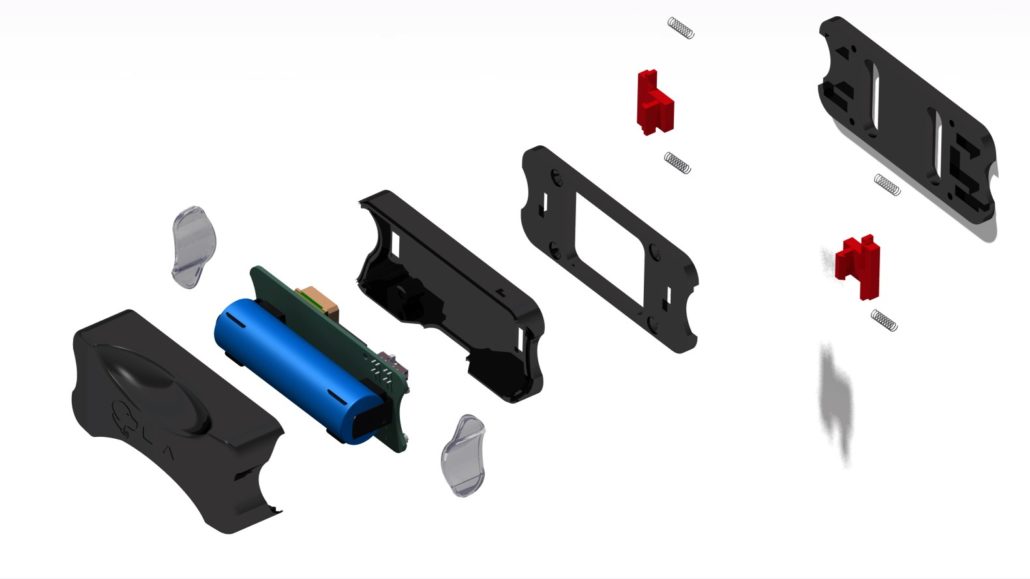
The exploded enclosure shows how the PCB, battery, light window, shells and collar attachment were designed as one mechanical system. Project render: J. G. Aguado.
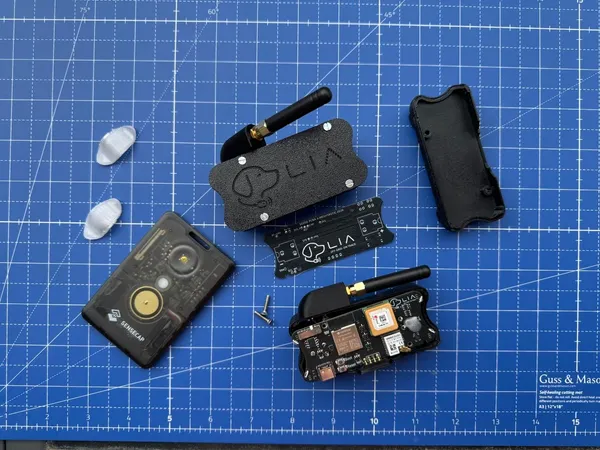
That coherence is what makes the project more than a clever radio demonstration. The photographs show hand-finished housings, visible fasteners, antenna clearances and different mounting choices. The source files let another builder inspect where those decisions came from. A reader can move from schematic to firmware service, from production data to enclosure CAD, and from a documented fault to its physical repair.
Why LIA became a winning reference design
LIA solves a recognizable problem with an architecture suited to the problem. It can report location without putting a cellular subscription or cloud account in the core path. It sends to a known recipient, monitors its own energy state, and changes behavior between active tracking and a sleep cycle. Just as importantly, it is honest about experimental limits. A captured RF condition is labeled as a link snapshot, not a range guarantee. A cold-fix time is a measured instance, not a universal promise. Early power estimates are separated from measured results.
The author behind that discipline is J. G. Aguado, a Vienna-based engineer and maker whose public motto is “Design, Make, Test, Repeat.”(from the github personal brief). His wider project portfolio includes hardware for sensing, power measurement and electronics education. LIA expresses the same approach in unusually complete form: make the board, test the boundaries, record what broke, correct the design and leave enough evidence for somebody else to continue.
For the Meshtastic community, this is the project’s lasting contribution. LIA is simultaneously a useful tracker concept and a detailed reference for building richer mesh endpoints. It shows that reliable open hardware is not defined by the absence of mistakes. It is defined by how visibly and methodically those mistakes are turned into better hardware.
EXPLORE THE PROJECT Read the complete documentation, firmware, production files, validation notes and enclosure designs in the LIA website and GitHub repository.
LIA documentation – Project overview, hardware, firmware and enclosure documentation
LIA development history – Chronological bring-up, failures and corrections
LIA GitHub repository – Source, production files and validation notes
J. G. Aguado on GitHub – Author profile and wider project portfolio
Meshtastic Build-Off 2026 – Competition requirements and eligible modules
About Author

Congratulations Jon, an elegant and efficient design. As a dog owner I can see the clear and logical design choices for each feature, and as a part-time tinkerer I’m impressed with your attention to detail. Thanks for the example, new horizons abound.
Thanks Ricardo! Happy to contribute!
Would there be a possibility of greater miniaturization for the little Pupi Yorkshire Terrier?
Perhaps you could consider using the T1000-E as the tracker. We hope your lovely Yorkshire terrier will like it.
Awesome design and execution! Bravo
I will convey this to the original author. Thank you for your liking and support!
Thanks Peter!