6 LeRobot SO-ARM101 Projects: From Teleoperation to Imitation Learning
Looking for practical LeRobot projects to build with SO-ARM101?
The SO-ARM101 is one of the most accessible open-source robot arms for learning real-world robotics with Hugging Face LeRobot. Beyond basic leader-follower teleoperation, the platform can be used to collect robot datasets, train imitation learning and Vision-Language-Action (VLA) policies, explore dual-arm manipulation, build mobile robots, and even experiment with reinforcement learning in NVIDIA Isaac Lab.
In this guide, we’ve collected six open-source LeRobot and SO-ARM101 projects, ranked from beginner-friendly to advanced. Together, they provide a practical learning path from your first teleoperation demo to more advanced embodied AI systems.
Whether you’re just getting started with LeRobot or looking for your next SO-ARM101 project, you can use the list below to find a project that matches your experience level.
What Are LeRobot and SO-ARM101?
LeRobot is Hugging Face’s open-source robotics framework for building, training, and deploying real-world robot learning systems. It provides tools for robot control, teleoperation, dataset collection, imitation learning, Vision-Language-Action models, and policy deployment.
SO-ARM101 is a low-cost open-source robotic arm designed to work with the LeRobot ecosystem. A typical leader-follower setup lets developers teleoperate the robot, record synchronized camera and robot data, train a policy on the collected demonstrations, and deploy the trained model back to the physical arm.
That makes SO-ARM101 a practical platform for learning the complete LeRobot workflow: teleoperate → record → train → deploy.
6 LeRobot SO-ARM101 Projects at a Glance
| Project | Difficulty | What You’ll Learn | Best For |
|---|---|---|---|
| SO-ARM101 Teleoperation | ★★☆☆☆ | Teleoperation, datasets | Beginners |
| Imitation Learning | ★★★☆☆ | ACT, VLA, policy training | Robot learning |
| Wireless Teleoperation | ★★★☆☆ | ROS 2, micro-ROS | Mobile robotics |
| Dual-Arm Learning | ★★★★☆ | Bimanual manipulation | Advanced manipulation |
| XLeRobot | ★★★★★ | Mobile manipulation | Embodied AI |
| Isaac Lab RL | ★★★★★ | PPO, sim-to-real | RL developers |
Project 1: SO-ARM101 Teleoperation and LeRobot Dataset Collection
Difficulty: ★★☆☆☆
Wiki Tutorial: Getting Started with SO-ARM101 Robotic Arms in LeRobot
Start with the basics of robotic arm teleoperation and data collection.
In this project, an SO-ARM101 leader arm controls a follower arm while a USB camera records the task. You’ll learn how to connect the arm to a PC, perform simple teleoperation tasks, record demonstrations with LeRobot, and visualize the resulting dataset.
It’s a practical introduction to the complete data pipeline behind imitation learning—from robot control to dataset recording and visualization.
What You’ll Learn
- SO-ARM101 leader-follower teleoperation
- LeRobot dataset recording
- Camera-based visual feedback
- Dataset visualization
- The basics of imitation learning data collection
Required Equipment:
| Part | Quantity |
| SO-ARM101 Assemble Kit | ×1 |
| USB Camera | ×1 |
| PC | ×1 |
Project 2: Train an SO-ARM101 Imitation Learning Policy with LeRobot
Difficulty: ★★★☆☆
Wiki Tutorial: Train and Evaluate Your SO-ARM101
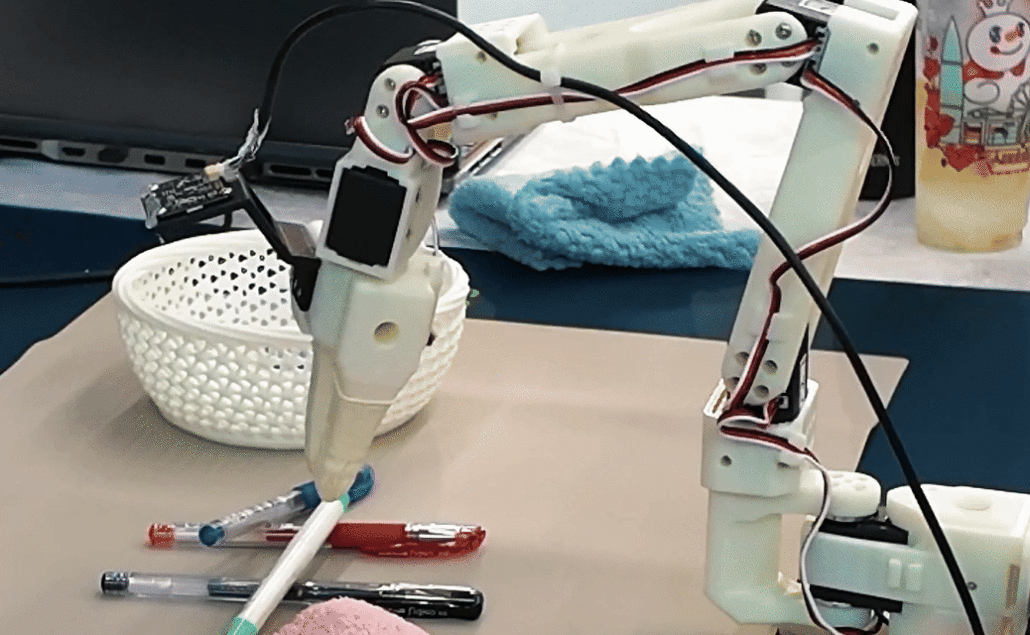
Ready to move beyond teleoperation? Use your SO-ARM101 dataset to train an imitation learning policy with LeRobot.
This project introduces six leading models, including ACT (Action Chunking with Transformers), SmolVLA, Pi0.5, and GR00T N1.5. You’ll collect demonstrations, prepare the dataset, configure a model, train the policy, and evaluate it directly on the robot.
Along the way, you’ll see how transformer-based policies predict robot actions and how VLA models connect visual observations with language instructions.
What You’ll Learn
- Demonstration data collection
- Dataset preprocessing
- ACT and VLA model training
- Policy evaluation on SO-ARM101
- Vision-based robotic manipulation
Required Equipment:
| Parts | Quantity |
| SO-ARM101 Assemble Kit | ×1 |
| USB Camera | ×1 |
| PC | ×1 |
Project 3: Dual-Arm Imitation Learning with SO-ARM101
Difficulty: ★★★★☆
Wiki Tutorial: Complete Guide to Double-Arm SO-ARM Training
Video Tutorial:
Single-arm manipulation is only the beginning. With two SO-ARM101 arms and LeRobot, you can explore synchronized dual-arm teleoperation and bimanual imitation learning.
The project focuses on collecting synchronized demonstrations from two arms and training policies for tasks that require coordinated manipulation. Think folding clothes, washing dishes, or assembling objects—tasks that are difficult to perform with a single arm.
A multi-camera setup provides a third-person view, while leader-follower teleoperation captures coordinated movements from both arms.
What You’ll Learn
- Dual-arm teleoperation
- Synchronized data collection
- Bimanual coordination
- Multi-camera setups
- Dual-arm imitation learning
Required Equipment:
| Parts | Quantity |
| SO-ARM101 Assemble Kit | ×2 |
| USB Camera | ×2 (Select Quantity based on task difficulty) |
| PC | ×1 |
| Third-Person Camera Mount | ×1 |
| Robotic-Arm Data Collection Box | ×1 (optional, for improved data collection environment) |
Project 4: Wireless SO-ARM101 Teleoperation with XIAO ESP32-C3 and micro-ROS
Difficulty: ★★★☆☆
Wiki Tutorial: Wireless SO-ARM101 Teleoperation with XIAO ESP32-C3 and micro-ROS
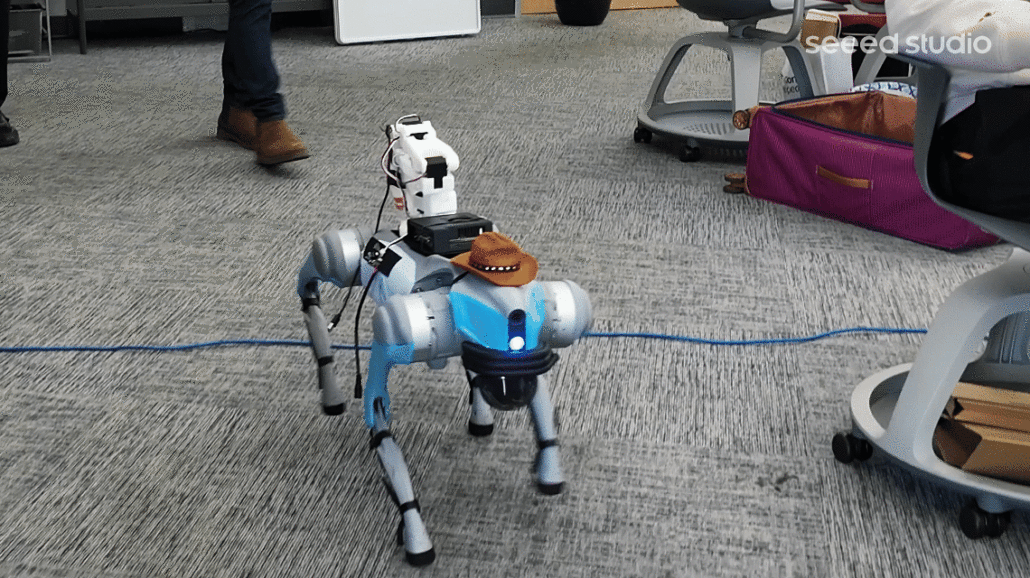
Want to remove the cables? This project enables wireless SO-ARM101 teleoperation using the Seeed Studio XIAO ESP32-C3 Bus Servo Adapter, ROS 2, and micro-ROS. Instead of connecting the leader and follower arms directly, the system sends joint commands over Wi-Fi, making the SO-ARM101 setup more flexible and easier to integrate into mobile robotic platforms.
The SO-ARM101 leader arm connects to an Ubuntu PC, where LeRobot reads the leader’s joint positions and maps them to the follower. The PC then sends these commands through ROS 2 and a micro-ROS Agent, while the XIAO ESP32-C3 on the follower receives the commands over a 2.4 GHz Wi-Fi network and controls the six STS3215 servos.
The system also supports real-time joint-state feedback from the follower to the PC through ROS 2. Combined with servo calibration, joint limits, startup pose checks, and communication watchdogs, these features make the wireless teleoperation system more reliable for hands-on robotics development.
With the cables removed from the leader-follower communication link, the SO-ARM101 can be explored in applications beyond a fixed desktop setup, such as mobile robots, robotic dogs, and other moving platforms. It’s also a practical way to learn how LeRobot, ROS 2, micro-ROS, and wireless robot control can work together in a real-world robotic arm system.
What You’ll Learn
- Wireless robotic arm control
- XIAO ESP32-C3
- micro-ROS
- ROS 2 communication
- Wi-Fi-based teleoperation
Required Equipment
| Parts | Quantity |
| SO-ARM101 Assemble Kit | ×1 |
| XIAO ESP32-C3 Bus Servo Adapter for the follower | ×1 |
| PC(Ubuntu 22.04 ) | ×1 |
| 2.4 GHz Wi-Fi network | ×1 |
Project 5: Build an XLeRobot Household Robot with Dual SO-ARM101 Arms
Difficulty: ★★★★★
GitHub: Build an XLeRobot Household Robot
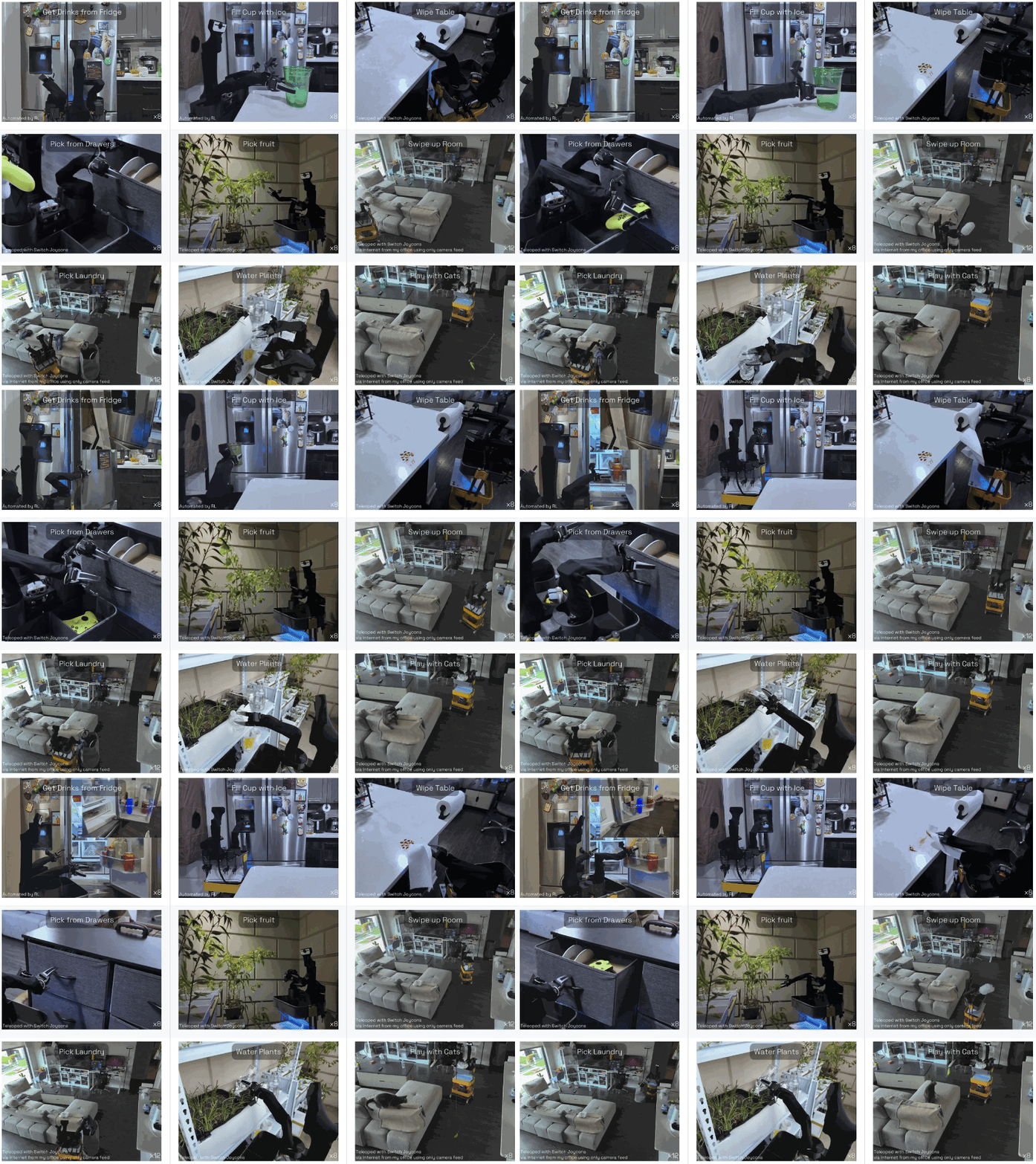
What if your SO-ARM101 could leave the desktop and move around your home?
The XLeRobot project combines two SO-ARM101 arms with a mobile base to create a household dual-arm robot. The platform integrates a Lekiwi mobile base, an Orbbec depth camera, and two robotic arms for mobile manipulation.
The result is a much more ambitious embodied AI platform capable of combining navigation, perception, and bimanual manipulation. Example applications include fetching drinks, watering plants, and cleaning surfaces.
What You’ll Learn
- Mobile manipulation
- Dual-arm control
- SLAM navigation
- 3D vision
- Embodied AI on mobile robots
Required Equipment
The original project provides a complete BOM for building the robot from individual components. Pre-assembled kits can also be used to reduce assembly time.
| Parts | Quantity | |
| Body Parts | SO-ARM101 Assemble Kit | ×2 |
| Lekiwi Mobile Base | ×1 | |
| Motors:STS3215 Servo (12V) | ×5(3 for base + 2 for head.) | |
| Utility cart | ×1 | |
| Power Station | ×1 | |
| Orbbec Deapth head cam | ×1 | |
| Assembly Tools | M3 Screws and Nuts Set | ×1 |
| Flush cutter | ×1 | |
| Screwdriver Set | ×1 | |
| Electronics | PC / Raspberry Pi 5 | ×1 |
Project 6: SO-ARM101 Reinforcement Learning with NVIDIA Isaac Lab
Difficulty: ★★★★★
Github:Reinforcement Learning with the SO-ARM100 / SO-ARM101 in Isaac Lab
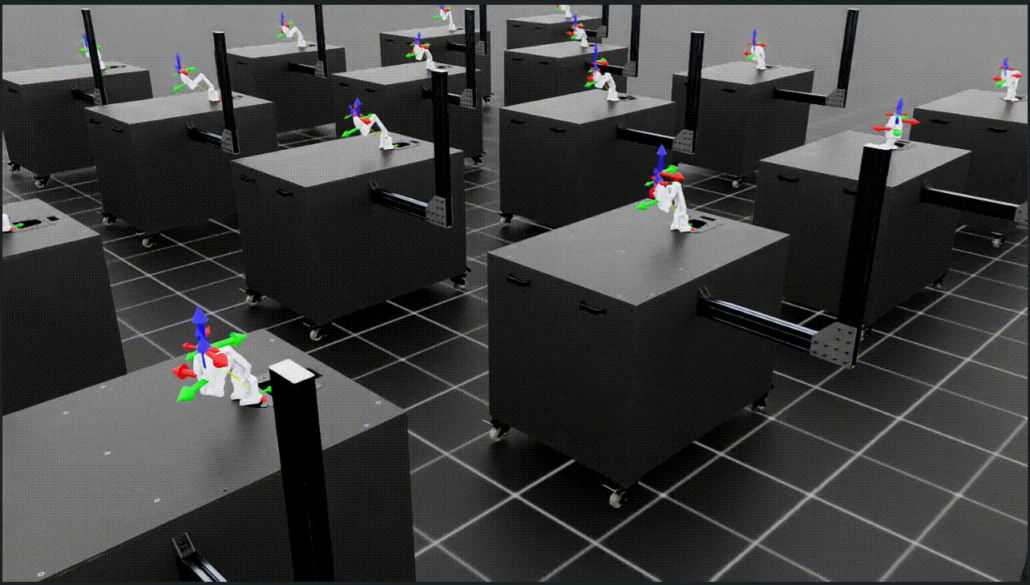
Ready to move from imitation learning to reinforcement learning (RL)?
This open-source project brings SO-ARM100 and SO-ARM101 into NVIDIA Isaac Lab, allowing you to train robot policies entirely in simulation.
Instead of collecting large amounts of real-world demonstration data, you can define tasks such as reaching and grasping, design reward functions, and train policies across thousands of simulated environments.
The project also introduces key robotics concepts such as PPO, domain randomization, and sim-to-real transfer. GPU-accelerated simulation makes it possible to run large-scale RL experiments on a local workstation.
Hardware note: An NVIDIA RTX GPU with 16–24 GB VRAM is recommended, along with 32 GB of system RAM.
Required Equipment:
| Equipment | Quantity |
| PC with NVIDIA RTX GPU | ×1 |
Which LeRobot SO-ARM101 Project Should You Start With?
One of the strengths of the SO-ARM101 + LeRobot ecosystem is that you don’t need to start with an advanced embodied AI project.
If you’re completely new to robot learning, start with leader-follower teleoperation and LeRobot dataset recording. Once you understand the data pipeline, move on to training an ACT or VLA policy and deploying it on the physical robot.
Developers interested in more complex manipulation can then explore dual-arm SO-ARM101 systems, while ROS developers can experiment with wireless control and mobile platforms such as XLeRobot. For those interested in reinforcement learning and sim-to-real research, the SO-ARM101 Isaac Lab project provides a natural next step.
Together, these projects turn SO-ARM101 from a desktop robot arm into a practical platform for exploring the broader LeRobot ecosystem—from data collection and imitation learning to VLA models, mobile manipulation, and reinforcement learning.
About Author
