Inside an Industrial LoRaWAN Gateway: How WM1302 Powers the reComputer R1225
LoRaWAN gateways connect large numbers of low-power devices across farms, utilities, buildings, and industrial sites without requiring a cellular connection for every sensor. As IoT deployments scale, gateways are evolving beyond packet forwarding. Engineers increasingly need multi-channel reception, edge processing, protocol translation, local storage, flexible backhaul, remote maintenance, and continued operation during network outages.
This shift calls for an open, adaptable architecture that combines LoRaWAN connectivity, edge computing, and industrial I/O. The reComputer R1225 paired with the WM1302 LoRaWAN gateway module demonstrates how these capabilities can be brought together in one industrial platform.
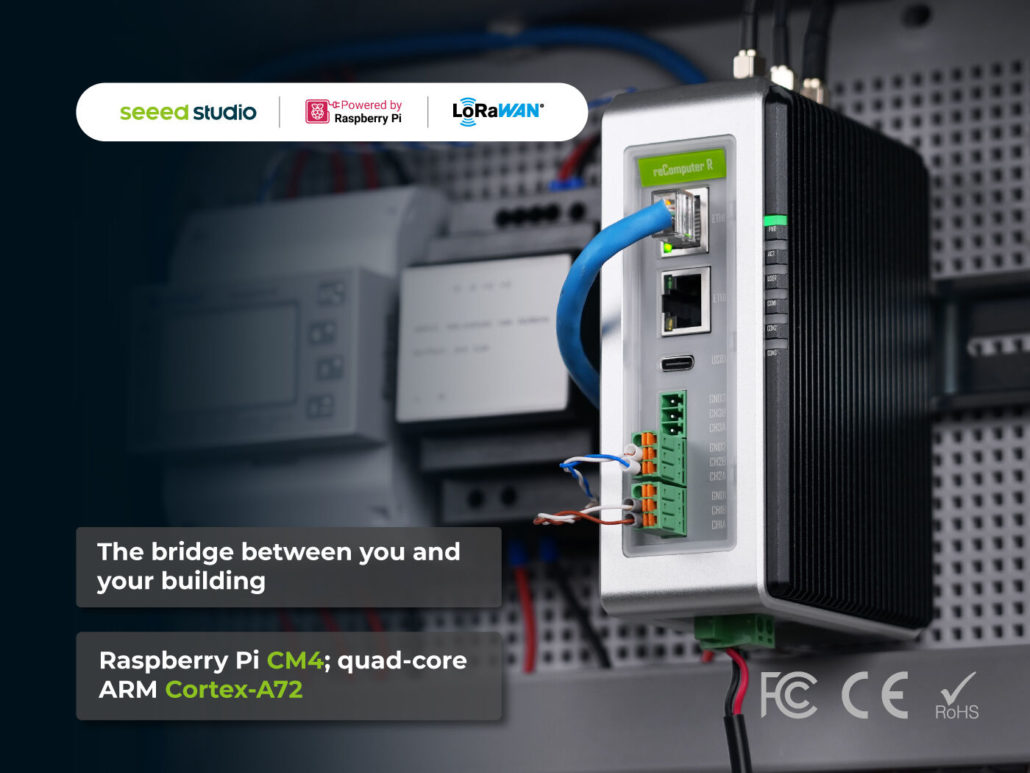
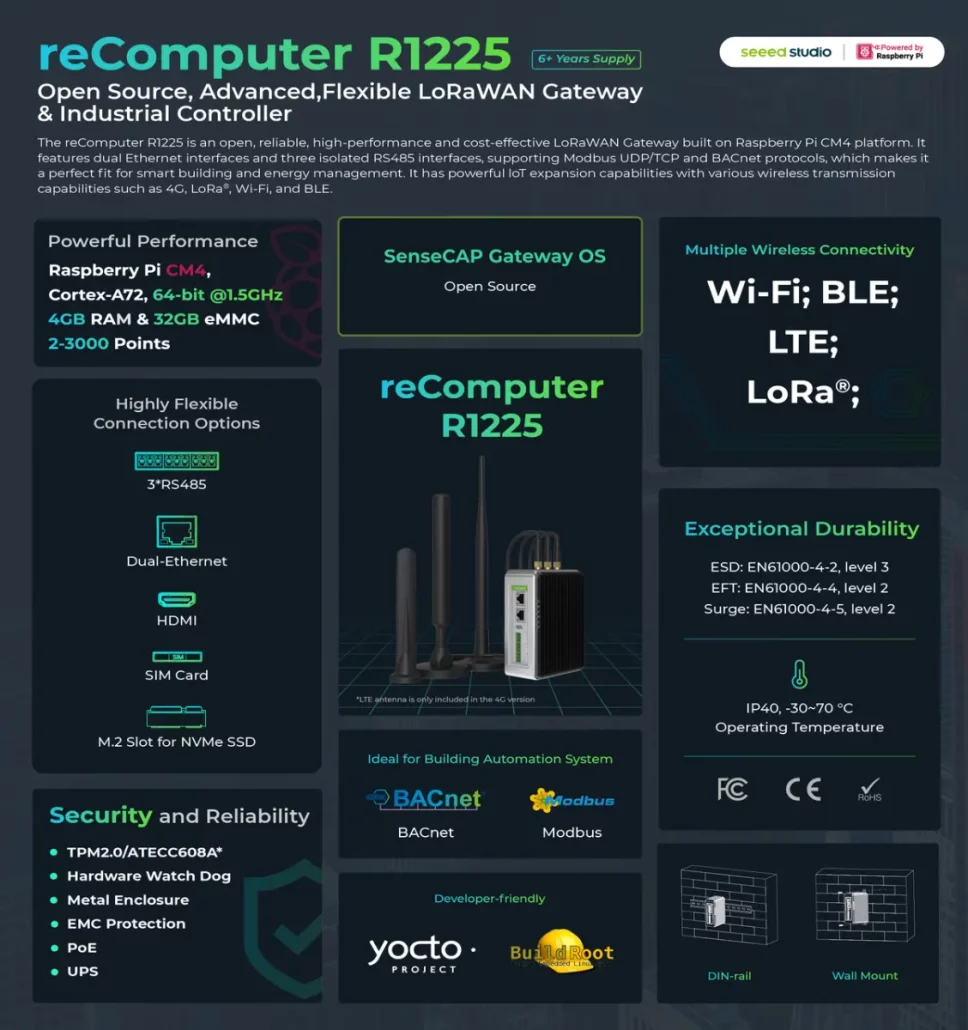
The reComputer R1225 with WM1302 addresses these problems through a deliberate separation of responsibilities. WM1302 is the multi-channel LoRaWAN concentrator that receives and demodulates radio traffic. R1225 adds a Raspberry Pi Compute Module 4, Linux, industrial interfaces, storage, local software, and Ethernet or optional 4G backhaul. Together, they turn LoRaWAN reception into a serviceable edge platform that can bridge wireless sensors, existing operational technology, and cloud applications without forcing every function into the radio module itself.
Why a concentrator is different from a single LoRa receiver
A single-channel LoRa receiver can be adequate for a controlled experiment. A LoRaWAN gateway listens to many independent end devices. Packets may arrive on different frequencies and spreading factors, sometimes at overlapping times. The receiver must search that radio space, detect valid frames, and report timing and signal metadata without asking the Linux CPU to demodulate raw RF waveforms.
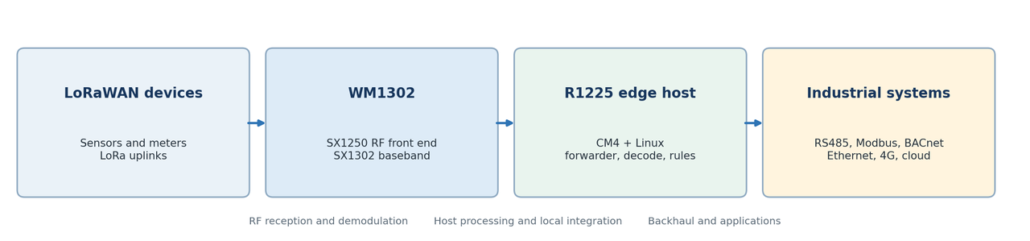
Responsibility flows from LoRaWAN radio reception to host processing and then to industrial systems. WM1302 and R1225 solve different parts of the path.
The SX1302 baseband inside WM1302 is designed for that workload. Semtech specifies detection across ten eight channels and as many as sixteen simultaneous packet demodulations, with LoRa spreading factors SF5 through SF12 and bandwidths of 125, 250, and 500 kHz, plus (G)FSK support. Regional channel plans and the RF front end still determine how a deployed gateway is configured.
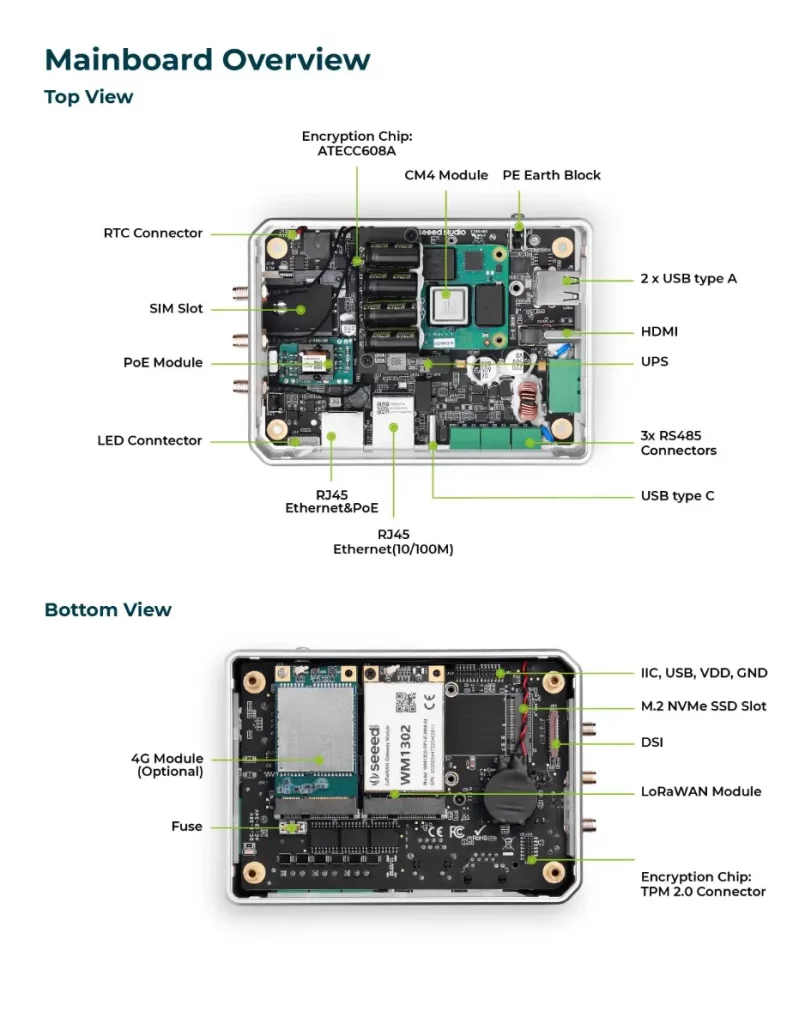
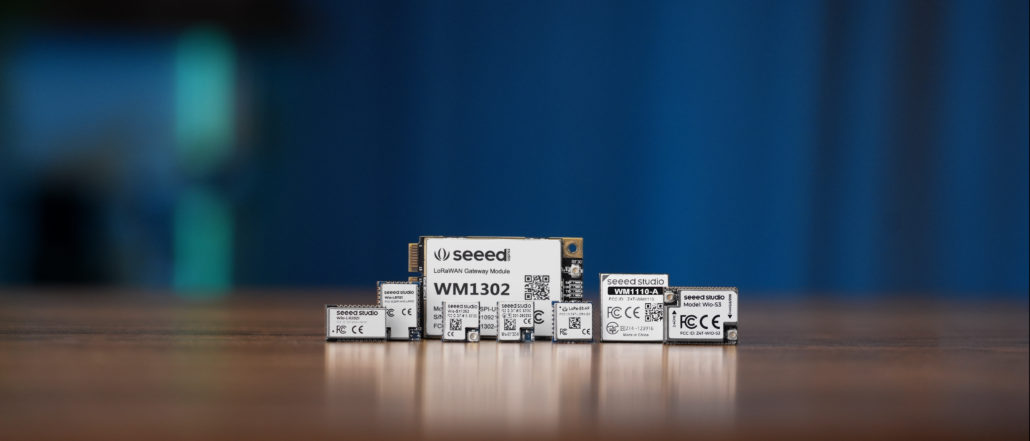
WM1302 packages the SX1302 with SX1250 radio front ends in a 30 mm by 50.95 mm Mini PCIe form factor. Seeed offers regional variants and both SPI and USB host interfaces. The module documentation lists sensitivity down to -139 dBm at SF12 and 125 kHz, a U.FL antenna connector, listen-before-talk support, and an operating range of -40 to 85 C. These characteristics reduce the RF integration work required to give a host computer multi-channel LoRaWAN reception.
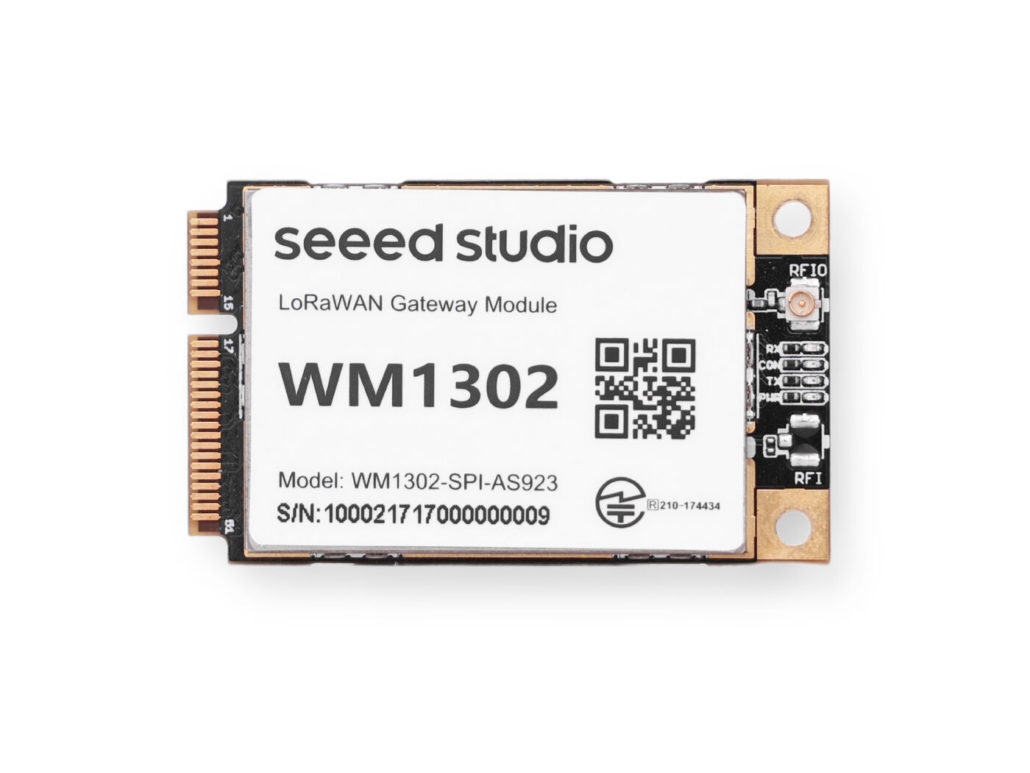
See the WM1302 technical documentation for regional variants, electrical specifications, pinout, and SPI versus USB behavior.
WM1302 handles radio traffic, R1225 makes it operational
On receive, the SX1250 front end converts the selected spectrum into signals the SX1302 can process. The baseband searches configured channels and spreading factors, validates LoRa frames, and exposes packet data and RF metadata to the host. On transmit, host software schedules a downlink and the concentrator creates the corresponding baseband signal.
R1225 supplies that layer with a Raspberry Pi Compute Module 4, a quad-core Cortex-A72 CPU at 1.5 GHz, 4 GB of RAM, and 32 GB of eMMC. The documented software options include Raspberry Pi OS, Ubuntu, SenseCAP Gateway OS, ChirpStack, LoRa Basics Station, and a packet forwarder. An integrator can therefore choose a thin forwarding architecture, a local LoRaWAN network server, or a hybrid design with site-level decoding and cloud-level management.
| Layer | Primary component | What it contributes |
| RF and baseband | WM1302: SX1250 + SX1302 | Receive and transmit LoRa, detect configured channels and spreading factors, and provide packet timing and RF metadata. |
| Gateway transport | R1225 host software | Configure the concentrator and move traffic through a packet forwarder or LoRa Basics Station. |
| LoRaWAN network services | Local or remote network server | Manage device sessions, frame counters, security, and MAC-layer behavior. |
| Industrial application | R1225 edge apps or upstream systems | Decode payloads, normalize data, map points to Modbus or BACnet, store, alert, and visualize. |
The practical advantage is separation of concerns. A radio coverage issue can be investigated at the concentrator and antenna layer. A failed cloud connection can be handled at the backhaul layer. A wrong engineering unit can be corrected in the payload decoder. Each problem has a clearer owner and a more testable boundary.
How the combined gateway works at a real site
Consider a cold-storage facility with LoRaWAN temperature sensors across several rooms and older compressors already connected to an RS485 control network. WM1302 receives uplinks from the wireless sensors across the configured channels. R1225 host software forwards the LoRaWAN frames to a local or remote network server, then an edge application decodes temperature and battery values.
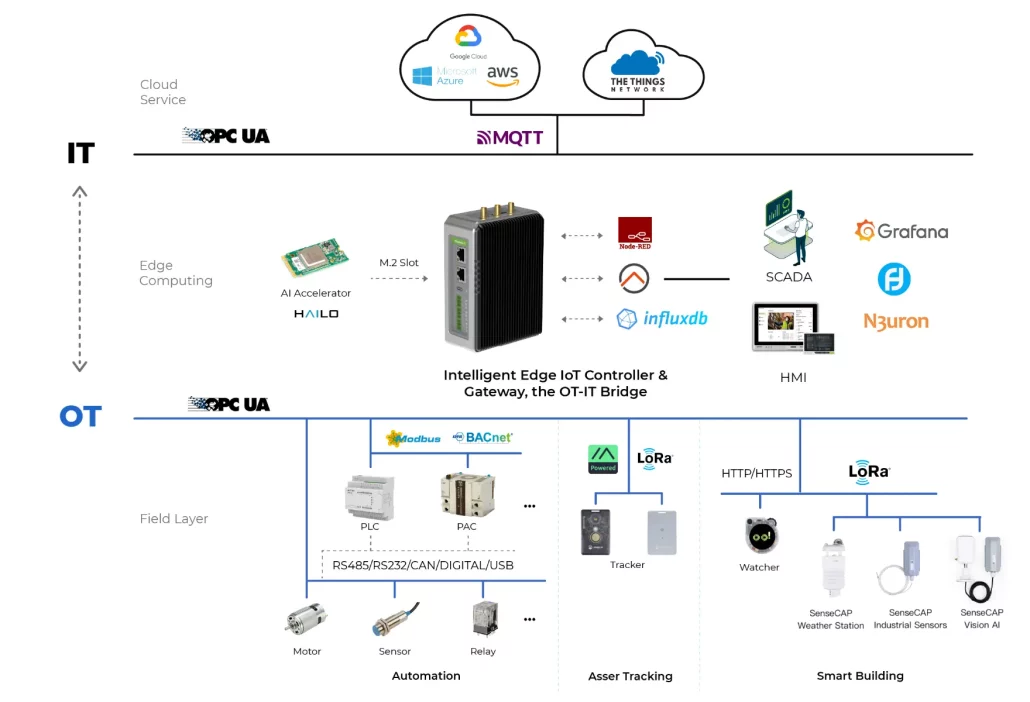
The application can compare each temperature with a site threshold, store readings locally, and expose selected values to the existing building-management system. R1225 provides three isolated RS485 ports for protocols such as Modbus RTU, while Ethernet can connect the plant network and a service or backhaul network. Optional 4G in the first Mini PCIe slot can provide an independent WAN path, while WM1302 occupies the second Mini PCIe slot as the LoRaWAN concentrator.
If the primary internet link fails, the local rule can still raise a site alarm and queue records for later upload. When connectivity returns, software can replay the retained data according to its own ordering and retention policy. The gateway does not perform this workflow automatically out of the box. The integrator must still define payload models, thresholds, register maps, BACnet objects, and conflict policy. The value is that the required radio, compute, and industrial I/O layers already exist in one deployable platform.
Industrial interfaces reduce the gap between the proof of concept and deployment
A development board, concentrator card, and bench supply can prove that packets are arriving. A field gateway must solve a different set of problems: isolated serial connections, defined power inputs, watchdog recovery, mounting, temperature range, and maintainable networking.
R1225 provides three RS485 channels isolated on both signal and power, with optional 120-ohm termination. Its two Ethernet ports include Gigabit Ethernet with IEEE 802.3af PoE and a second 100 Mbps interface. Power can enter through PoE, 9 to 36 VDC, or 12 to 24 VAC. The fanless IP40 enclosure supports DIN-rail or wall mounting, and the documented operating range is -30 to 70 C.
The supercapacitor-based UPS is intended to bridge a brief interruption for controlled handling. Seeed reports approximately 37 seconds at idle and 18 seconds at full CPU load under its test conditions. A configurable hardware watchdog provides another recovery mechanism. Together they reduce the infrastructure work an OEM must complete before testing its own data model and business logic.
For exact interfaces, power input details, protocol notes, and deployment guides, refer to the reComputer R1225 documentation.
What the measured power data means for system design
At 24 V input with firmware 1.2.3, the documented base idle condition measured 3.048 W. LoRa transmission at maximum configured power measured 5.424 W. Simultaneous 4G and LoRa transmission measured 6.768 W, while full four-core CPU load with both radios transmitting reached 7.440 W. The workbook also records a 4.548 A inrush transient.
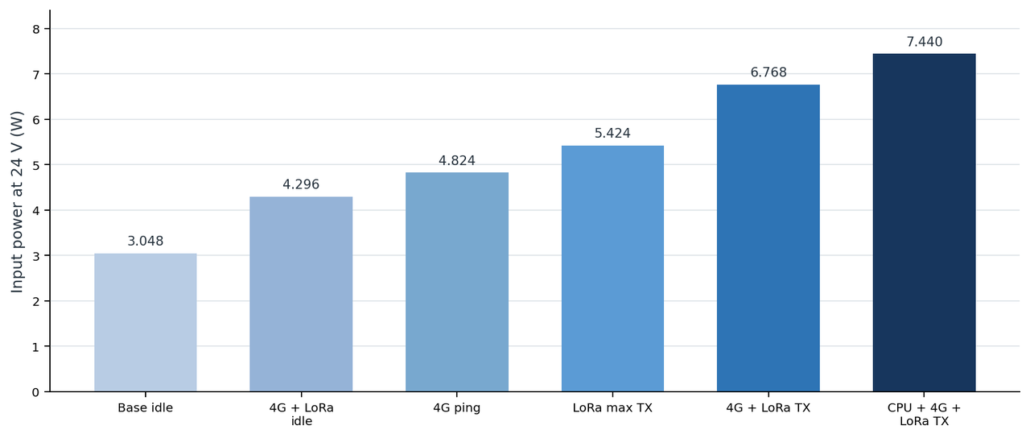
Lab reference values at 24 V input from the supplied R1225 power-consumption workbook. Values describe one documented setup, not worst-case guarantees.
For a panel designer, the conclusion is concrete. A supply should not be selected from the 3 W idle figure alone. Radio transmission, CPU workload, modem activity, startup current, ambient temperature, and peripherals all affect margin. The measured values provide a useful starting point for budgeting, while final sizing still requires the chosen R1225 configuration and actual application workload to be validated.
Three deployment patterns and the business value behind them
1. Environmental monitoring across a remote site
LoRaWAN sensors can cover dispersed assets with modest data rates, while WM1302 receives their traffic through one gateway point. R1225 can normalize measurements, buffer them during a WAN outage, and send summarized records upstream through Ethernet or 4G. Deploy workers and engineers gains continuity and lower backhaul dependence without placing a full cellular modem at every sensor.

2. Building automation retrofit
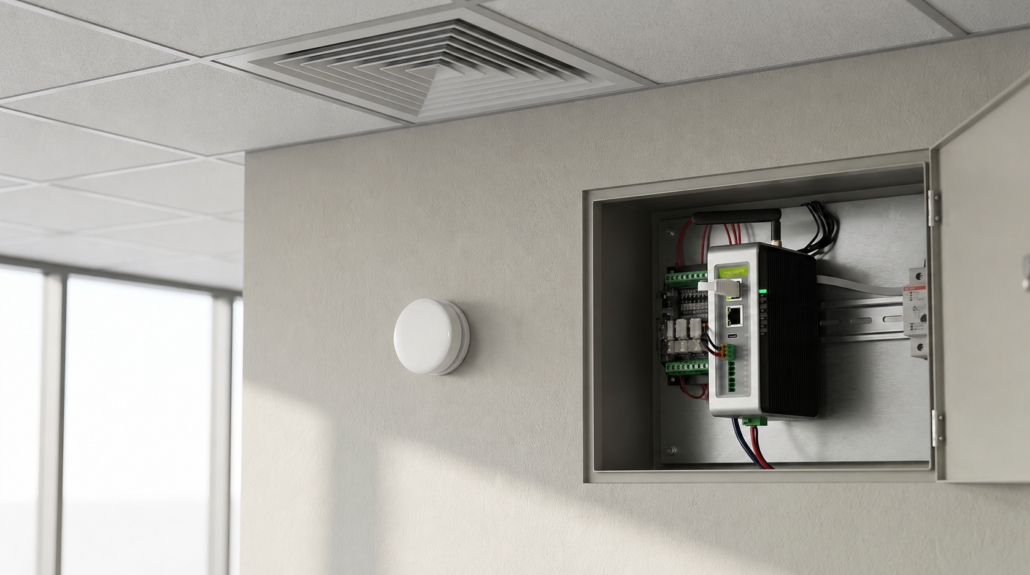
Wireless LoRaWAN sensors can be added where new cabling is disruptive, while existing plant equipment continues to use RS485, Modbus, or BACnet. An edge application on R1225 maps decoded sensor values into the building-management data model. Building director and manager can extend visibility without replacing the installed control system.
3. Distributed industrial equipment
A local service can watch machine-state packets, preserve rare fault events, and keep immediate rules on site. Fleet history and cross-site analytics can remain in the cloud. This split reduces unnecessary upstream traffic and prevents every operational decision from depending on WAN latency. It also gives IT and operations teams a clearer way to decide which data must leave the site and which behavior must survive locally.
Frequently asked questions
What is the difference between a LoRaWAN gateway module and a complete gateway?
A module such as WM1302 concentrates LoRa RF traffic and presents packet data to a host. A complete gateway adds the computer, operating system, network connections, storage, power design, enclosure, management, and any local applications.
Can R1225 translate LoRaWAN data into Modbus or BACnet automatically?
It provides the Linux compute and industrial interfaces needed for that integration. An application must still decode each payload and map values to the required registers or BACnet objects.
Why run edge software if the data ultimately goes to the cloud?
Local software can filter, buffer, alert, and keep essential behavior available when the WAN is slow or unavailable. It can also reduce upstream traffic and integrate local equipment without routing every exchange through a remote service.
What is the difference between SPI and USB WM1302?
The SPI version connects the SX1302 and companion control device to the host over SPI with separate chip-select signals. The USB version adds an STM32L4 bridge. R1225 uses an SPI WM1302 in its LoRaWAN Mini PCIe slot.
Can R1225 work with ChirpStack or LoRa Basics Station?
Both are listed in the R1225 software stack. Final configuration, credentials, regional channel plan, and network-server compatibility remain the responsibility of the deployment team.
Future Prospect
The broader direction of LoRaWAN gateway design is clear. Gateways are evolving from transparent bridges into modular edge systems that can connect large fleets of low-power devices, continue essential site behavior during cloud or WAN disruption, and translate wireless data into the operational protocols already used by buildings and industrial equipment. At the same time, IoT architecture is becoming more distributed. Cloud platforms remain important for fleet management and cross-site analytics, but filtering, buffering, protocol conversion, and time-sensitive decisions increasingly belong closer to where data is produced.
This trend makes separation of concerns more valuable. The radio layer must remain optimized for reliable multi-channel LoRaWAN reception, while the host layer needs enough openness and compute capacity to evolve with new applications, backhaul choices, security policies, and local systems. A modular boundary between concentrator and edge computer lets teams update one layer without redesigning the other, and it makes failures easier to isolate and maintain across a long deployment life.
Seeed supports that engineering path at more than one level. Developers who already own the host, enclosure, and system architecture can integrate WM1302 as the concentrator layer. Teams that need a deployable industrial platform can begin with reComputer R1225, its Linux environment, isolated RS485, storage, Ethernet, and optional cellular backhaul, then build their own data model and applications on top.
About Author
