Transmission Tower Weather Station: How S700-C Supports Power Line Monitoring
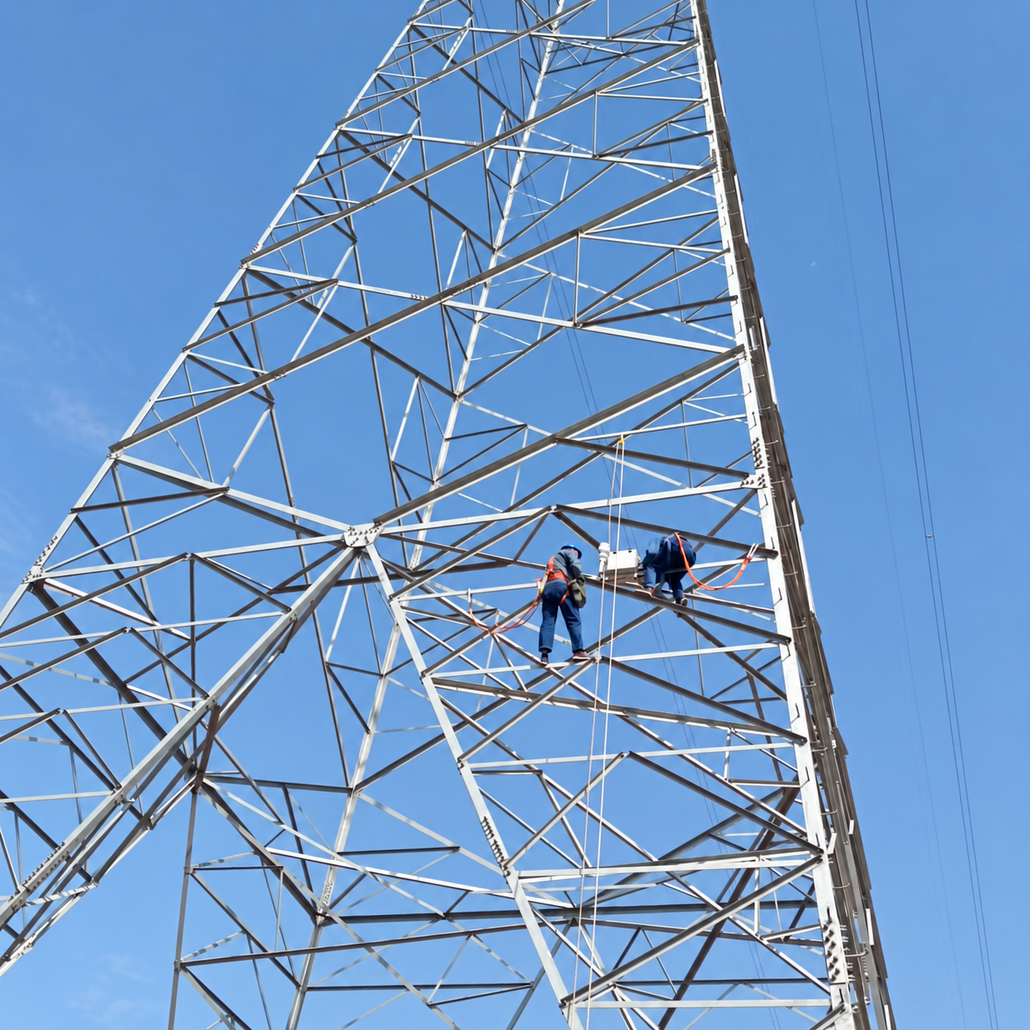
Wind cools an overhead conductor, but the effect depends on wind speed and the direction of airflow relative to the line. Air temperature and solar radiation also affect the conductor’s thermal state. Readings from a Transmission Tower Weather Station give utilities local weather context when they review line conditions alongside current and asset data.
An Australian IoT company is developing a large-scale LoRaWAN monitoring system for long-term outdoor deployment on transmission towers. The planned network comprises approximately 40,000 tower sensor nodes and 1,000 gateway and reference-station sites. It brings together measurements of the surrounding environment, tower structural condition and events along the line. The company selected the SenseCAP S700-C to provide local weather measurements within this wider monitoring system.
Challenge: Connect Transmission Tower Weather Station Data to Line Conditions
A transmission corridor can cross areas with different wind and rainfall conditions. A regional weather report may describe the day broadly, but the company needs records associated with the towers and line sections under review.
That distinction matters in two types of work. For a thermal assessment, the company needs to know whether wind is cooling a particular line section and how local temperature and sunlight contribute to its conditions. When a tower sensor reports a structural change or an event, the company needs the weather record from the same location and period to help reconstruct what happened and decide where to investigate.
The scale of the planned network adds a deployment requirement. Weather sensors must be practical to mount at selected tower sites and suited to extended outdoor operation, while their readings must fit the company’s five-minute reporting schedule.
Solution: Add a Transmission Tower Weather Station to the Tower Network
To address these challenges, the Australian IoT company approached Seeed for a weather monitoring solution that could provide local readings at selected towers, fit its five-minute reporting schedule, and operate across a large outdoor network. The goal was to support conductor thermal assessments and event investigations, so the team could identify which line sections needed closer inspection.
Measure Wind Speed and Direction Along the Corridor
For the company, wind direction becomes more useful when viewed relative to the line’s orientation. The company can bring that local reading together with air temperature, solar radiation, line current and conductor information when reviewing the conditions of a selected section. Five-minute minimum, maximum and average wind records can show both the prevailing conditions and shorter changes within the reporting window. And that’s the reason why they choose SenseCAP S700-C as the first weather station.
SenseCAP S700-C weather station measures wind without rotating cups or a mechanical vane. Its ultrasonic transducers send sound between sensing points; wind changes the sound’s travel time depending on its direction. Comparing those travel times produces wind speed and direction readings. S700-C specifies wind speed accuracy of ±0.3 m/s at speeds up to 10 m/s, ±3% from 10 to 50 m/s, and wind direction accuracy of ±3°.
Put Rainfall Beside Tower Events
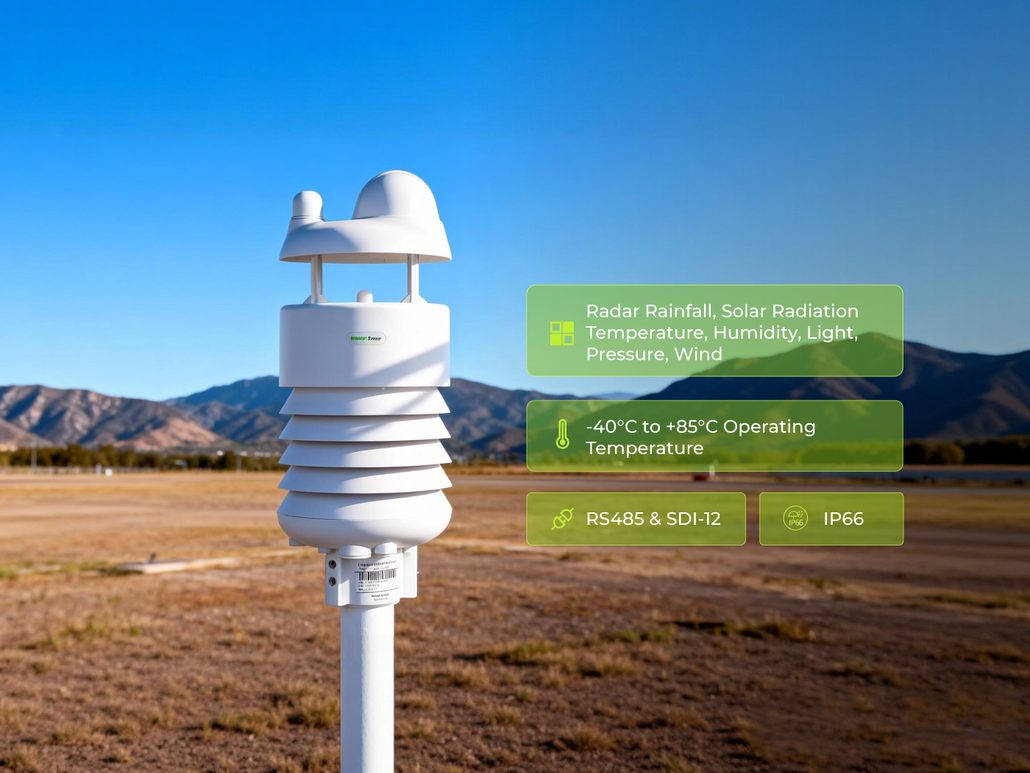
S700-C uses radar to measure rainfall. It sends microwave signals toward falling drops and analyzes the reflected signals, including their Doppler shift, to estimate rain intensity. Because the measurement does not depend on a collection funnel or tipping mechanism, it reduces the mechanical servicing associated with those parts at remote tower sites. Its specified rain-intensity range is 0–300 mm/h, with ±10% accuracy and 0.01 mm/h resolution.
Rainfall records give the company a way to examine an event in context. If the wider tower monitoring system flags a change, the company can compare its timestamp with local rain intensity, wind conditions and the tower’s structural sensor records. That combined view helps the company identify which section and time period to examine in a follow-up review.
Design the Transmission Tower Weather Station for Long-Term Outdoor Deployment
S700-C brings wind, radar rainfall, air temperature, humidity, barometric pressure and solar radiation measurements into one compact sensor head. Its ultrasonic wind and radar rainfall measurements avoid the moving wind cups, vane and tipping mechanism that would otherwise add mechanical inspection points across a distributed deployment. The unit carries an IP66 rating and a specified operating temperature range of −40°C to +85°C.
The company also uses the reComputer R1225 LoRaWAN gateway as part of the network that carries tower-side data into its monitoring system.
Bring Weather and Asset Data into the Same Review
The value of the network lies in connecting each measurement to a location, a time and a task for the company’s operations team.
| Tower-side record | Reviewed together with | Operational use |
| Wind speed and direction, air temperature, solar radiation | Line current, conductor information and records for the same line section | Assess the local environmental conditions relevant to conductor thermal behaviour |
| Five-minute minimum, maximum and average wind speed | Structural condition records from the same tower and period | Examine whether a recorded change coincided with sustained wind or a shorter period of stronger wind |
| Rain intensity and timing | Event records and subsequent inspection findings | Reconstruct the weather during an event and select sections for closer review |
| Tower weather readings | Reference-station readings | Compare observations and identify measurement points that need checking |
The company’s planned workflow is to collect tower-side readings, report the required five-minute statistics and bring weather, structural and event records together by tower location and timestamp. This gives an operations team a defined path from an incoming record to a targeted review.
Results: A Clearer Path to Deployment at Scale
By assigning local weather sensing, structural monitoring, event detection, gateways and reference stations distinct roles within one system, the company has a clearer plan for organizing data across its large transmission-tower network. Seeed Studio thanks the company for choosing SenseCAP S700-C and the R1225 gateway for its intelligent LoRaWAN transmission tower monitoring solution.
If you have similar weather monitoring needs, contact us at [email protected]. Tell us about your project, and the Seeed team will put together a detailed solution for you.
Seeed Studio is helping lead this transition through the SenseCAP weather station portfolio. SenseCAP combines industrial-grade sensing, compact all-in-one hardware, open communication protocols, flexible data paths, and a repeatable deployment architecture.
Seeed Studio works with more than 200 partners and over 1,000 customers across 120+ countries, with SenseCAP deployments spanning greenhouse and vineyard monitoring, smart-city observation, renewable-energy sites, environmental research, and industrial facilities. This is the direction professional weather monitoring is taking, and SenseCAP is building the products and integration ecosystem needed to move it forward.
Notes: This article is based on a real customer project. Names and identifying location details have been changed to protect the customer’s identity. Images sourced online are used for visual reference.
About Author
