LoRaWAN vs 4G: Which Is Best for Smart Safety Tracking Solutions?
When you are planning an indoor safety system, whether it’s for a school, a hospital, or a factory, one big question always comes up: Which network should I use? LoRaWAN or 4G? It’s a valid question, and not an easy one.
For most indoor tracking deployments, LoRaWAN is the recommended option. It offers stronger coverage in enclosed spaces, lower power consumption, and easier scalability for large facilities. This blog breaks down why LoRaWAN tends to outperform 4G indoors.
LoRaWAN vs 4G: Why it Matters for Indoor Smart Safety
More organizations today are adopting wearable panic button badges, to strengthen their indoor safety systems. These badges enable real-time location tracking, discreet SOS alerts helping teams respond to emergencies faster, which is essential in many different environments. For example, under Alyssa’s Law in the United States, schools are required to have a silent panic alert system that directly notifies authorities during emergencies.
But here’s the thing, none of that works reliably without the right network. So before you roll out hundreds of devices, it’s worth understanding how these two networks perform indoors, and why LoRaWAN is often the smarter choice.
Comparison of 4G and LoRaWAN
| LoRaWAN | 4G | |
| Connectivity Type | Use gateways to transmit small data over long distances. | Connects directly to cellular towers via SIM or eSIM; no gateway required. |
| Power Consumption | Ultra low. Devices can run for months to years on a single charge. | High. Frequent data transmission drains power quickly, needs regularly charging. |
| Network Dependency | Network managed privately through gateways. | Depends on telecom carrier coverage and signal quality. |
| Indoor Coverage Range | Strong indoor coverage when combined with BLE beacons; easily scales across multi-floor buildings. | Limited indoor coverage. Walls and dense materials weaken the signal and reduce accuracy. |
| Data Transmission | Sends data or alerts at customisable intervals to save battery. | Real-time transmission. Best for scenarios requiring instant communication. |
| Cost | Low overall cost. No recurring fees; ideal for large-scale deployments. | Higher recurring costs for data plans and device management. |
| Best Use to Case | Indoor environments like schools, hospitals and factories. | Outdoor or mobile scenarios like moving vehicles or fields. |
Connectivity Overview
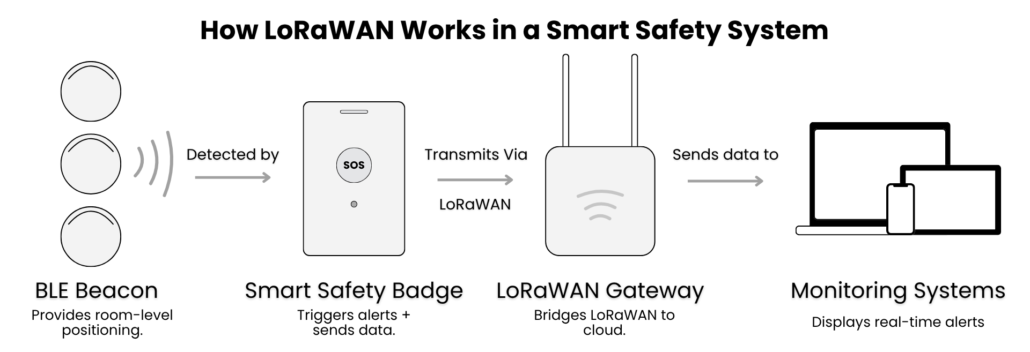
LoRaWAN is designed for long-range, low power communication, sending small data packets through gateways that relay information to the cloud. Each gateway can support hundreds or even thousands of devices, making it ideal for large-scale indoor environments.
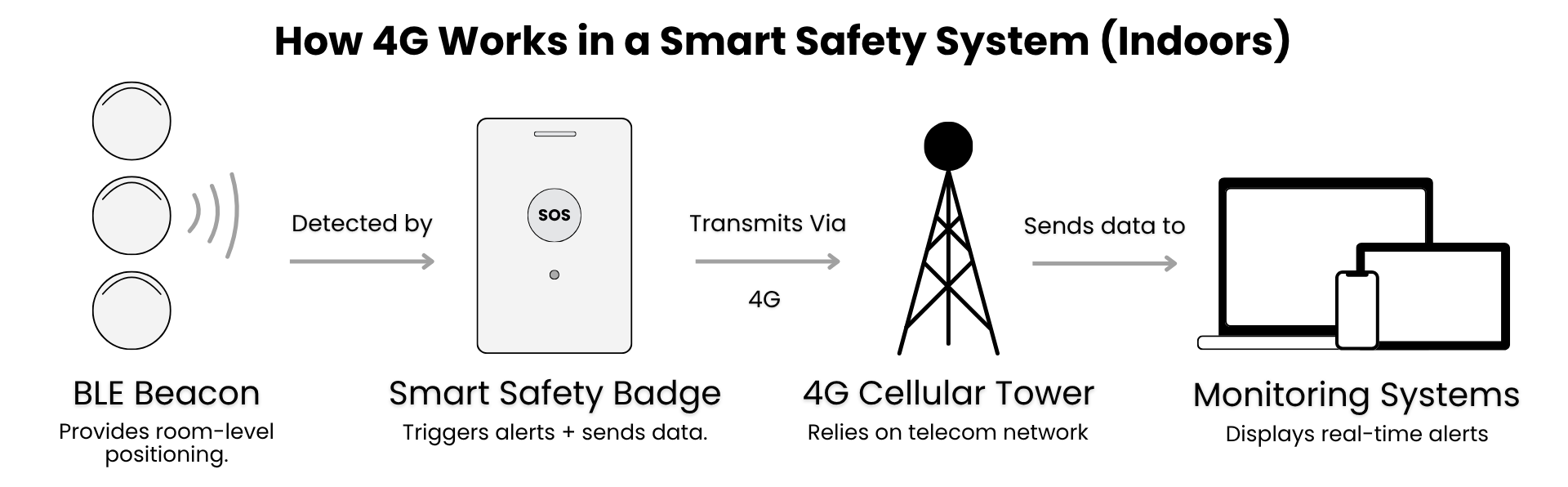
4G, on the other hand, connects directly to a nearby cell tower using a SIM or eSIM card. To improve indoor positioning, 4G networks can also integrate with Bluetooth Low Energy (BLE) beacons. In this setup, BLE beacons provide room-level positioning, while 4G handles transmission to the cloud through the telecom network. This combination allows smart safety badges to maintain reliable connectivity and accurate positioning inside buildings.
Power and Maintenance
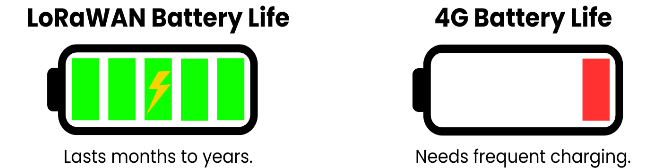
LoRaWAN-powered devices are optimized to send data only when necessary. They can be configured to send periodic location updates from every minute, every few hours to even once a day. This flexibility allows wearable panic button badges to operate for months, sometimes even years, on a single battery. That’s a huge advantage for environments where charging hundreds of badges regularly would be a logistical headache.
4G devices, by constrast, are meant for continuous, real-time data updates. That speed comes at the cost of higher energy consumption. In deployments where devices are required to actively transmit or move constantly, frequent recharging becomes unavoidable.
Network Dependency
With LoRaWAN, you can build your own private network. The gateways are installed on-site, and data is routed directly to your chosen platform or cloud. That means no dependence on your telecom carriers and far fewer disruptions. This is especially useful for schools, hospitals, or industrial sites that prioritize data security and stable indoor connectivity.
4G, however, depends entirely on telecom carriers. Every badge requires its own connection, which means your system is only as reliable as your provider’s network. In places where signals are weak, such as, thick-walled buildings, remote facilities, devices may lose connection entirely.
Indoor Coverage and Signal Design
LoRaWAN is built for stability in such environments. It uses low-frequency radio waves that penetrate obstacles more effectively. Combined with Bluetooth Low Energy (BLE) beacons, the system can achieve room-level accuracy tracking.
Read more: Wearable BLE + LoRaWAN Trackers: The Ultimate Hybrid for Seamless Indoor Personal Safety
4G signals, however, often weaken as they pass through walls, steel structures, or multiple floors. In complex indoor spaces like campuses or hospitals, this can cause dead zones and inaccurate location data.
Difference in Cost
LoRaWAN keeps deployment costs low, one gateway can support hundreds of devices with no SIM or recurring data fees.
4G becomes expensive at scale due to monthly data plans, SIM management, and increased maintenance.
When 4G Makes More Sense
While LoRaWAN is ideal for large-scale indoor environments, 4G still has its place. It performs best in outdoor or mobile scenarios where real-time tracking is critical.
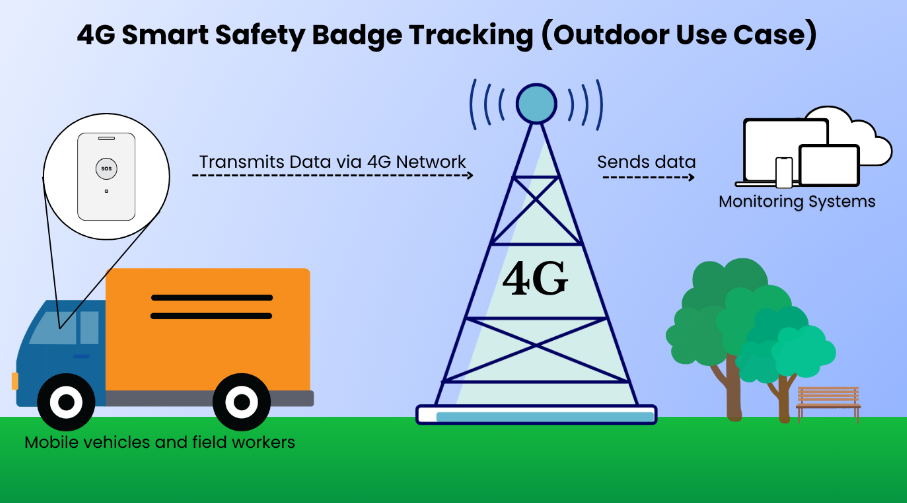
If your project involves personnel or vehicles that move beyond LoRaWAN gateway coverage, 4G provides reliable, continuous data transmission anywhere there’s cellular service. For example, field workers or lone-worker safety applications often rely on 4G devices for instant alerts and continuous connectivity.
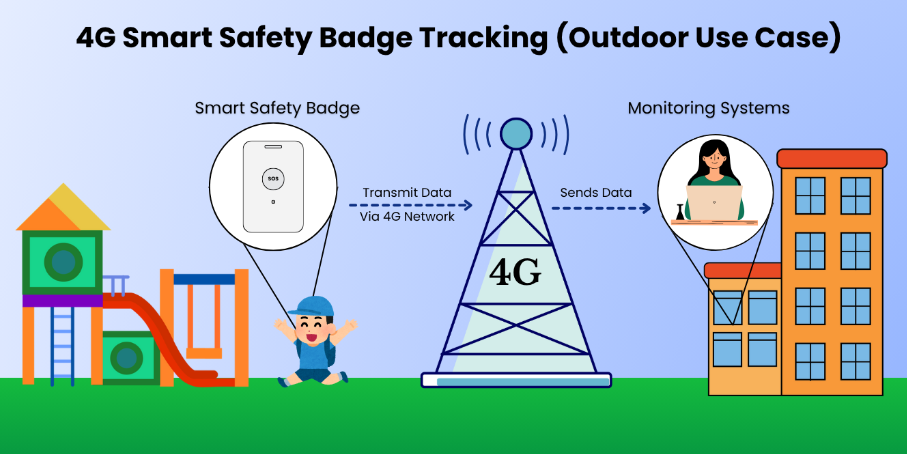
Beyond workplaces, 4G-based smart safety badge can also be used for personal safety tracking. For example, helping parents monitor their children’s location during commutes. The same real-time communication can provide families with peach of mind and instant notification in case of emergencies.
LoRaWAN can complement 4G in areas with poor or inconsistent cellular coverage, when devices need to be used in remote zones, basements and tunnels. Many solution providers deploy hybrid setups that combine both networks to ensure coverage across different environments.
The Takeaway
To conclude, for indoor environments like schools or hospitals, LoRaWAN remains the most efficient connectivity option for smart safety systems. While 4G is suitable for outdoor or highly mobile users, it struggles indoors due to weak signal penetration, higher power usage, and reliance on carrier networks for both connectivity and cost.
That’s why most large-scale indoor safety deployments combine LoRaWAN with BLE beacon setup. It delivers strong and precise signal coverage across the facility while keeping the power consumption and operational costs low.
Customisation for Real-World Deployments
We know every environment requires a different approach to smart safety. That’s why Seeed Studios provides adaptable safety solutions that can be customized to fit into your deployment needs. From configuring button trigger logic and firmware integration with your current system to adjusting hardware design. We tailor every detail to match your environment.
No matter the environment, our goal is to help you deploy a reliable, scalable and easy-to-maintain safety network that is ready for use.
Build Your Indoor Safety Network With Our LoRaWAN Solutions
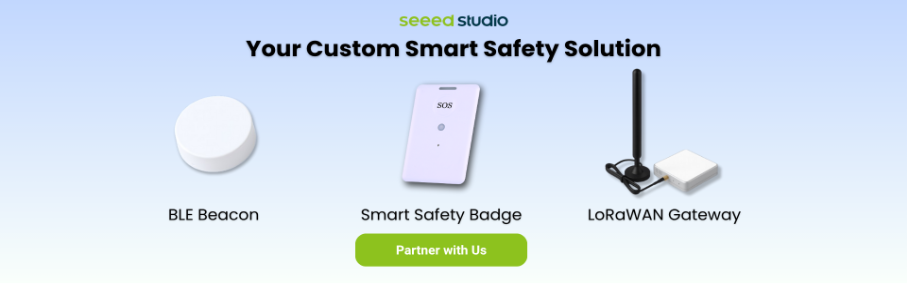
At Seeed Studio, we design, develop and manufacture LoRaWAN smart badges, along with LoRaWAN hardware and BLE beacons that power them. Our hardware and engineering support help you achieve seamless integration and reliable performance, wherever safety matters most.
Read more about Seeed’s custom IoT solutions for LoRaWAN smart badges here.
Other Related Resources
Wearable BLE + LoRaWAN Trackers for Indoor Safety
How to Plan BLE Beacons and LoRaWAN Gateways Placement
How Far Can BLE And LoRaWAN Signals Reach?
About Author
