In our previous article, we explored the raw wireless performance of the XIAO ESP32-C5 and its potential across wireless security and smart home ecosystems. As a budget-friendly, dual-band Wi-Fi 6 microcontroller, it successfully fills the 5GHz gap that previously limited independent hardware research. Today, we are moving from theory to execution to showcase a definitive real-world case study of the XIAO ESP32-C5 in action within the cybersecurity space.
The Evolution of Pocket-Sized Pentesting
🛡️ Why XIAO ESP32-C5 for Wireless Security?
📋 Currently Supported Firmware:
GhostESP: Provides a polished, mobile-friendly web interface that serves as a portable wireless audit “Swiss Army Knife.”
Bruce Firmware & ESP32 Marauder is waiting for support…
🛠️ Hardware Setup & Recommendations
- Core Board: Seeed Studio XIAO ESP32-C5.
- Antenna: A high-gain Dual-Band 2.4GHz/5GHz U.FL antenna (essential for capturing weak 5GHz packets).
🔍 Practical Security Testing Case
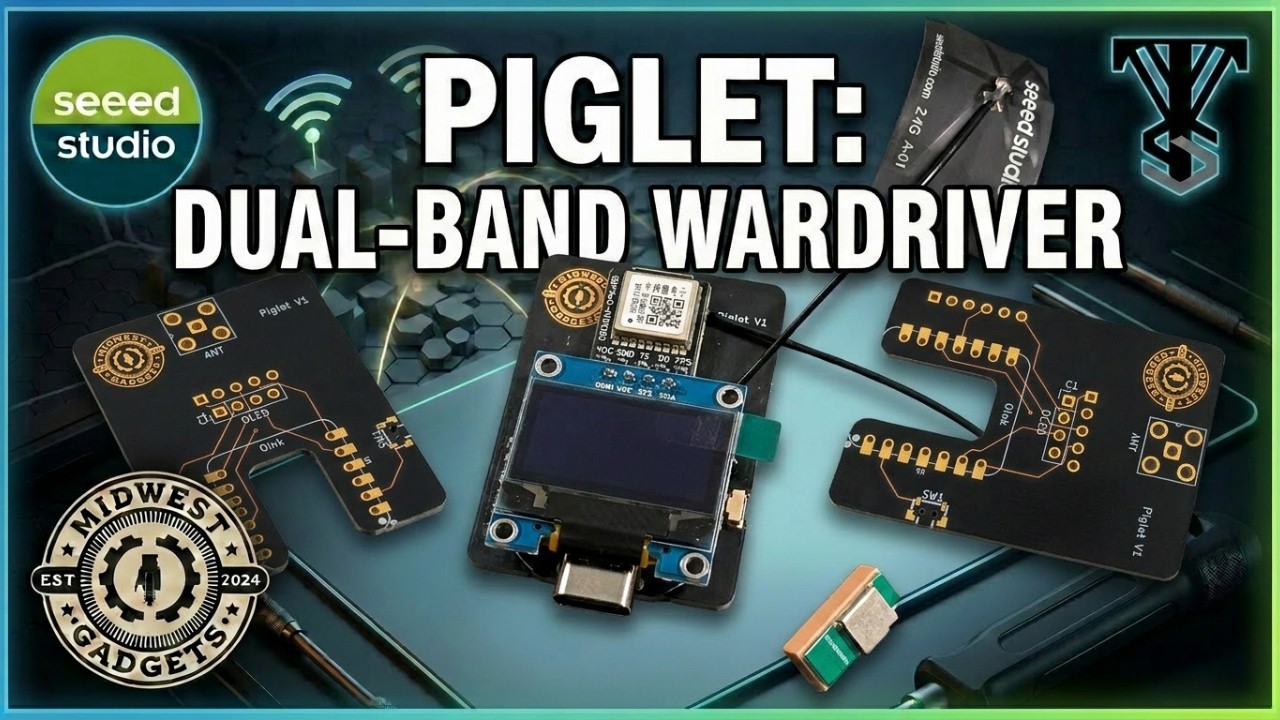
[ Case 1 ] The "Piglet" Project — Open Source Dual-Band Wardriver
💡What It Is:
The “Piglet” is an open-source, DIY pocket-sized dual-band War Driver (a device used to map and log the locations of wireless networks).
Designed by Hamspice from Midwest Gadgets, it is a hardware gadget that enthusiasts can solder together using a custom PCB. It combines the dual-band Wi-Fi 6 capabilities of the Seeed Studio XIAO ESP32-C5 with accurate GPS tracking to scan, identify, and log nearby Wi-Fi networks onto a storage card while on the move.
🛠️How It Works:
ual-Band Recon & GPS Sync: The core MCU (XIAO ESP32-C5) runs a passive background scan, catching Wi-Fi beacon frames across both 2.4GHz and 5GHz frequencies. Simultaneously, the onboard high-accuracy ATGM336H GPS module locks onto satellites to get precise geographical coordinates.
Log Logging (The Payload): The ESP32-C5 pairs the captured Wi-Fi network information (SSID, MAC address, signal strength) with the exact GPS coordinates and time stamps, continuously writing this tracking data onto an SPI SD Card module.
User Interaction: A 0.96-inch OLED display shows live system stats, randomized start-up animations, and GPS status (blinking when locked). A single physical tactile switch button allows the user to cycle through different UI screens or toggle the display on/off to save battery.
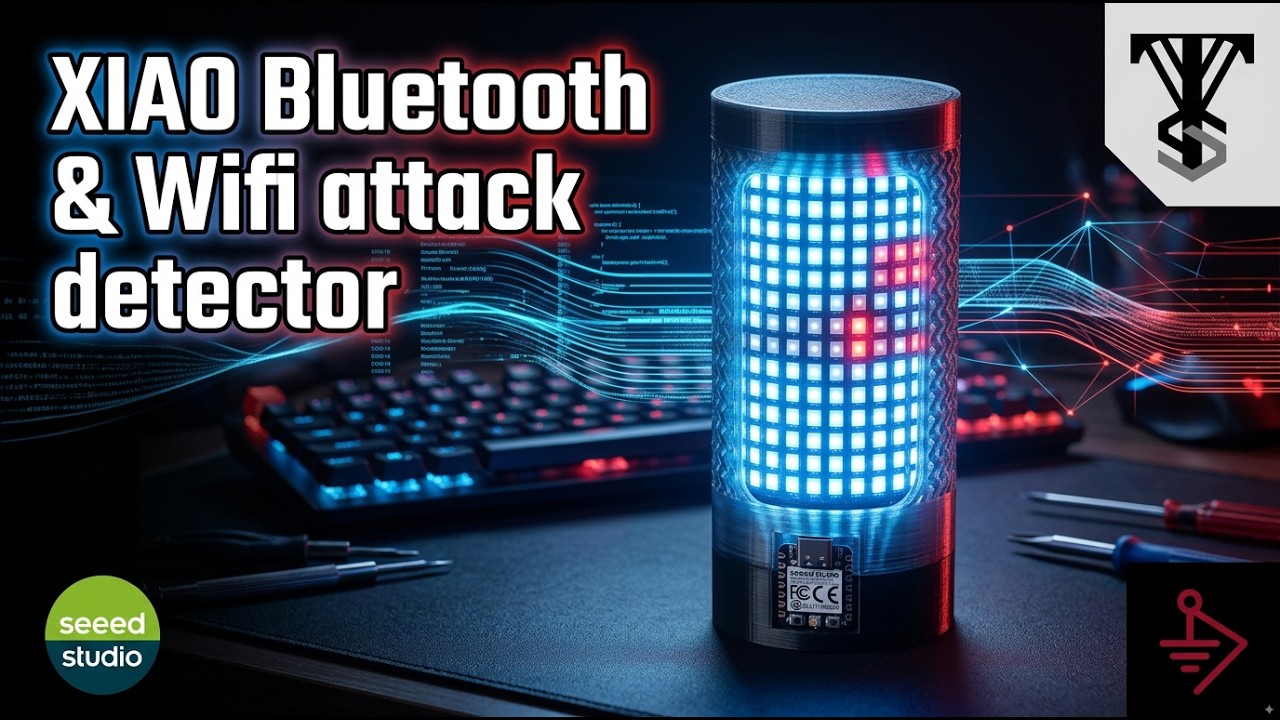
[ Case 2 ] Portable Real-Time Wireless & Bluetooth Attack Detector
The Tech: It combines a tiny ESP32 microcontroller with a 6×10 RGB LED matrix inside a 3D-printed case.
The Defenses: The chip constantly monitors the airwaves. If it detects a wireless attack, the nightlight flashes a red warning.
The Controls: It hosts its own local Wi-Fi network. You connect with your phone to change the light modes (fade, wave, flicker) or read the security attack logs.
When it detects Bluetooth spam, a sudden surge of nearby Bluetooth devices, or someone entering the house, the device starts flashing as an alert.
[ Case 3 ] Single-Chip Dual-Band Wi-Fi Spectrum Analyzer
💡What It Is:
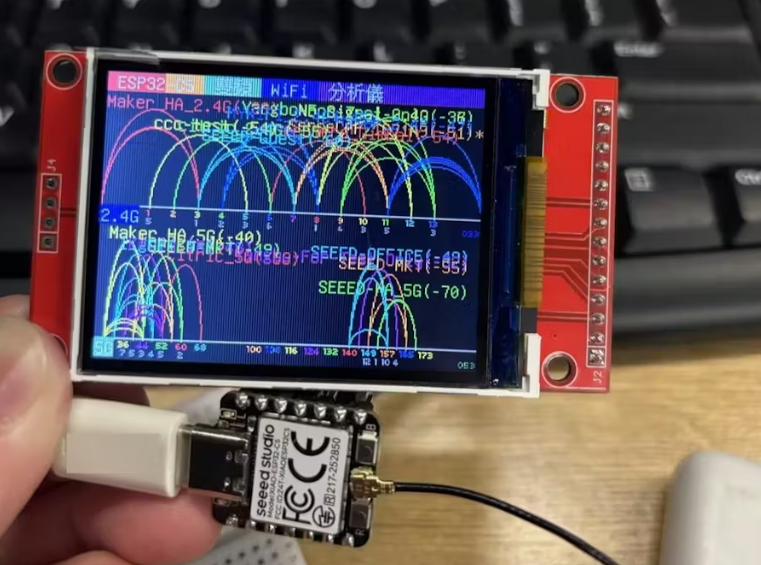
This is a portable Wi-Fi analyzer and spectrum detector. It scans surrounding wireless signals in real time and graphically displays channel utilization and signal strength across both 2.4GHz and 5GHz bands on a connected screen. Users can carry it anywhere to assess local network congestion, making it easy to select the cleanest, lowest-interference channel for their own wireless routers.
🛠️How It Works:
RF Scan: The ESP32-C5 continuously hops through all 2.4GHz and 5GHz channels to catch Wi-Fi beacon frames.
Data Extraction: For every network found, it grabs two raw values: Channel Number (where it is) and RSSI (how strong it is).
Coordinate Mapping: The code converts these values into screen coordinates: X-axis = Channel, Y-axis = Signal Strength.
Parabolic Render: It draws each network as a parabolic curve on the screen. Overlapping curves instantly show you which channels are congested.
[ Case 4 ] A DIY Multi-Channel Wireless Security Cluster
💡What It Is:
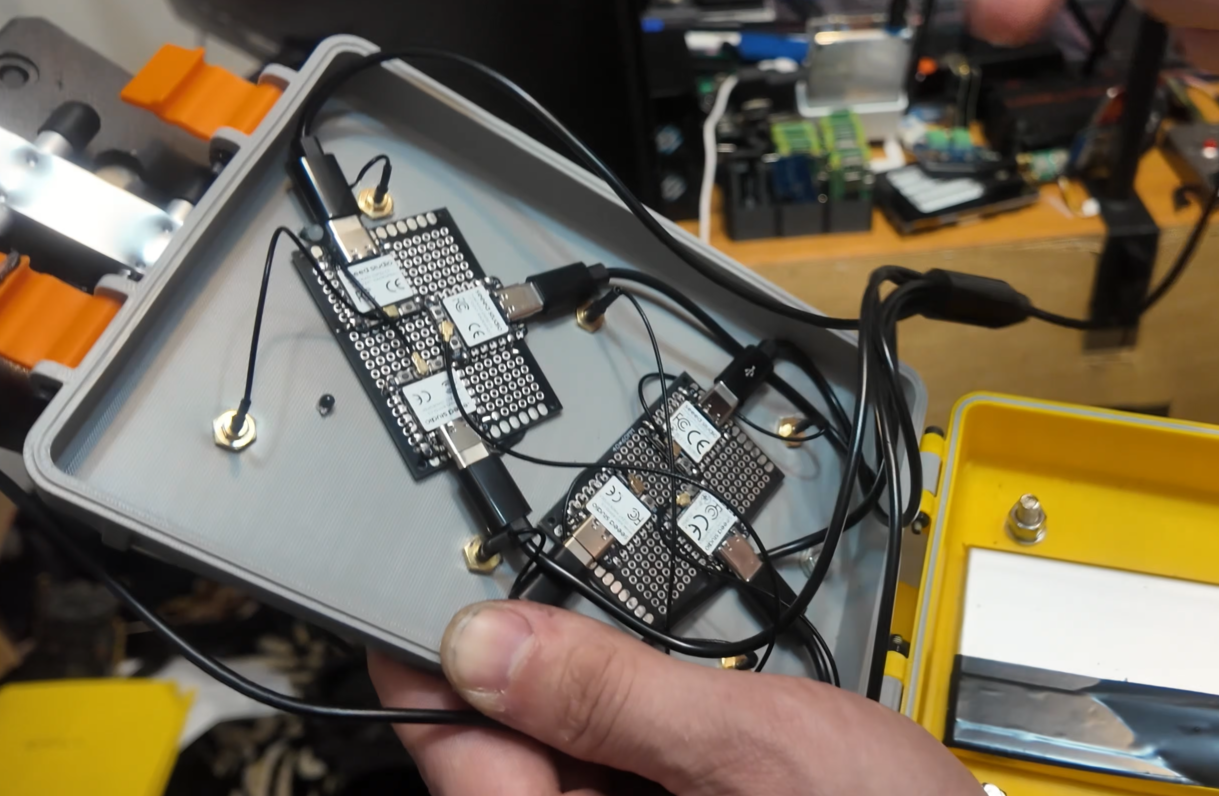
The “BIS Combobulator” is a DIY, high-performance hardware cluster tool designed for War Driving (wireless network mapping) and Red Team cybersecurity testing.
Built by tech makers Cal and Zeke, it pairs multiple Seeed Studio XIAO ESP32-C5 microcontrollers inside a 3D-printed, weatherproof enclosure equipped with heavy-duty magnets for vehicle mounting. Running on the Biscuit Manager app ecosystem, this portable “device army” leverages the dual-band Wi-Fi 6 capabilities of the ESP32-C5 to intercept, map, or stress-test wireless networks on a massive scale.
🛠️How It Works:
Parallel Scanning: Instead of one chip scanning everything, the workload is split. Individual ESP32-C5 nodes are assigned to lock onto and monitor separate, specific channels simultaneously.
Dual-Mode Execution:
War Driving: The nodes capture overlapping signals at high speeds, logging up to 150 networks per foot while driving.
Red Team Testing: The cluster coordinates to send simultaneous Deauthentication (Deauth) frames, instantly disconnecting multiple target devices across 2.4GHz and 5GHz bands.
Simple Parallel Power: Due to the low power draw of the C5 chips, the entire cluster runs on a basic 6-way USB splitter powered by a single 6,000 mAh battery, lasting up to 6 hours.
🛡️ Mitigation, Compliance & Ethics
- Enforce Strict WPA3-Only Mode: Eliminate WPA2 Transition Modes to prevent downgrade vulnerabilities.
- Mandate PMF (Protected Management Frames): Ensure management frames are encrypted to mitigate unauthorized disassociation risks.
- Isolate IoT Infrastructure: Place Zigbee/Thread gateways and Wi-Fi 6 IoT devices on strict, monitored VLANs away from corporate data.
End Note
Hey community, we’re curating a monthly newsletter centering around the beloved Seeed Studio XIAO. If you want to stay up-to-date with:
🤖️ Cool Projects from the Community to get inspiration and tutorials
📰 Product Updates: firmware update, new product spoiler
📖 Wiki Updates: new wikis + wiki contribution
📣 News: events, contests, and other community stuff
Please click the image below👇 to subscribe now!