Fri3d Camp Brings LoRa Learning Into the Woods with Seeed Studio Wio-SX1262
From a Welcome Badge to Lasting Confidence
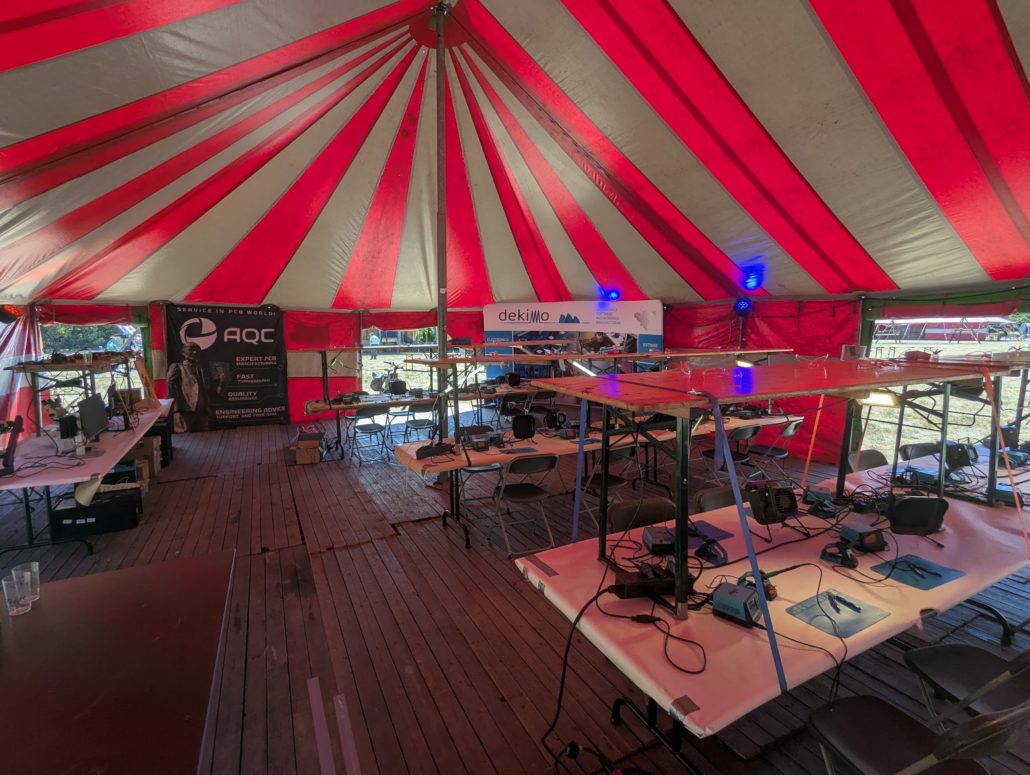
Founded in 2014, Fri3d Camp is a biennial, family-friendly summer camp in Belgium for makers, hackers, aspiring engineers, artists, technology enthusiasts, and do-it-yourselfers. Held over three days, the camp brings together people with different interests and levels of experience to exchange knowledge, collaborate on projects, explore new ideas, and enjoy technology in an informal outdoor setting.
Technology, making, and education are at the heart of Fri3d Camp. More than 650 adults and children join over 150 activities covering electronics, programming, robotics, 3D printing, and art. Participants learn, teach, and solve problems together, turning the camp into a community shaped by everyone involved. Each attendee also receives a programmable electronic badge for creating LED displays, games, weather applications, and hardware extensions. Running a customized version of MicroPythonOS, the 2026 badge welcomes beginners while supporting advanced development in C++.
Across the three-day camp, children learn alongside adults, beginners work with experienced engineers, and participants become teachers by sharing what they discover. Through building, repairing, and experimentation, they gain practical skills, confidence, and new relationships. Fri3d Camp gives young people access to technical knowledge in an open and supportive environment, encouraging them to see themselves as creators, engineers, researchers, and artists. By nurturing curiosity and shared learning, the camp helps prepare a new generation to understand and shape technology.
An Open Badge Designed to Grow with LoRa
Every participant receives a programmable electronic badge built around an ESP32-S3-WROOM-1-N16R8 module, supported by a CH32X035 microcontroller for additional I/O. The open hardware design brings together a 2-inch IPS touchscreen, a six-axis IMU, buttons, a joystick, addressable LEDs, a buzzer, microSD storage, audio interfaces, a 2,000 mAh battery, and multiple expansion points.
Rather than limiting the badge to a fixed set of functions, Fri3d Camp exposes its hardware and software through open documentation. Beginners can use it to create games, control LEDs, read sensors, or build a weather application, while experienced developers can inspect, modify, and repurpose the complete system.
LoRa was considered early in the development process, but adding a sub-GHz radio to more than 700 badges would have increased the cost of the entire production run, even though only some participants required long-range communication. The team therefore prepared the main PCB for LoRa while offering the radio as an optional upgrade.
Participants who selected the upgrade could solder a Wio-SX1262-N directly onto the badge. The standard kit paired the module with a compact spiral antenna, while an additional SMA expansion supported an external 5 dBi 868 MHz antenna. This approach kept the base badge accessible and financially sustainable while giving interested builders a practical path into LoRa assembly, antenna selection, and outdoor radio experimentation.
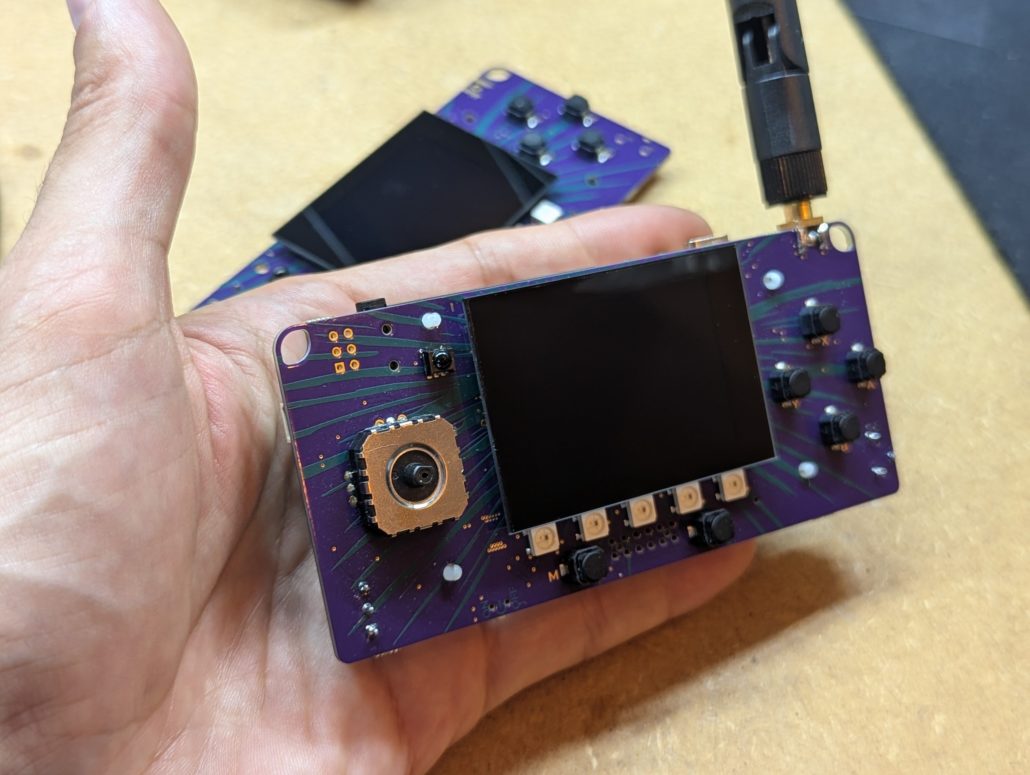
The Fri3d Camp 2026 badge combines a display, physical controls, LEDs, sensors, battery power, and expansion points on one wearable board. Source: Fri3d Camp.
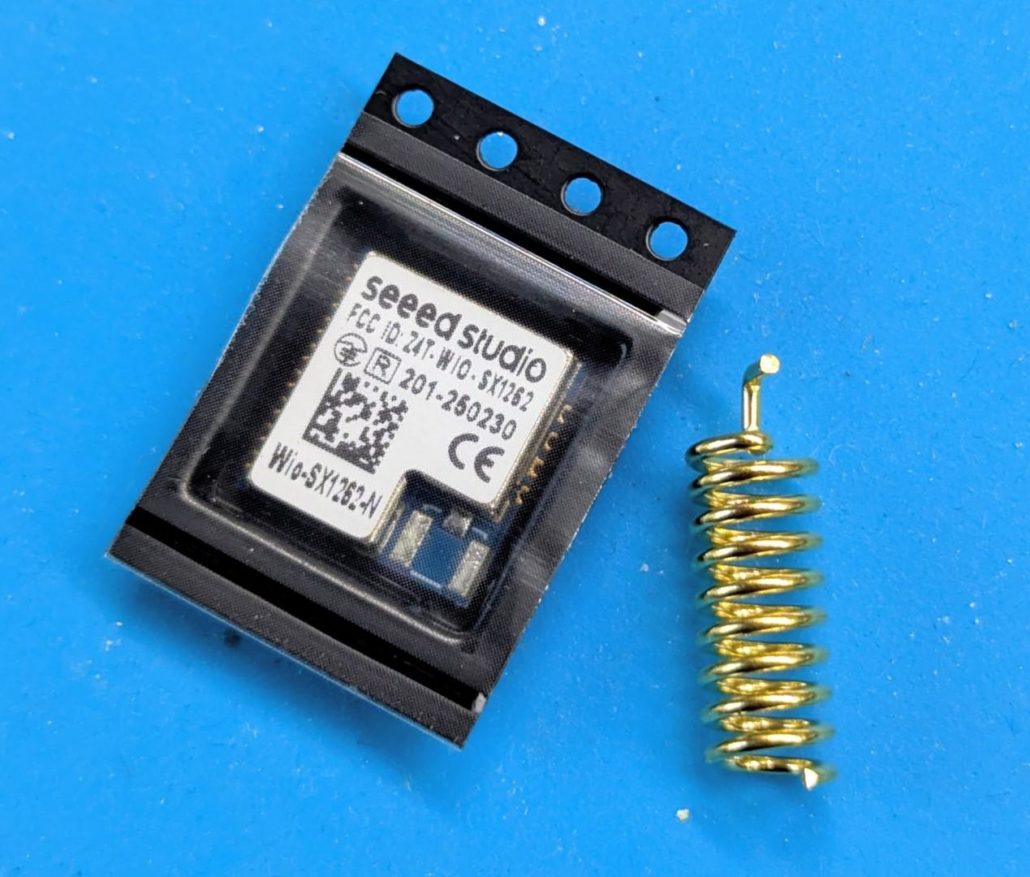
The official LoRa kit pairs the Wio-SX1262-N module with a compact spiral antenna. Source: Fri3d Camp LoRa kit documentation.
From Radio Architecture to Antenna: Why Wio-SX1262 Fit the Badge
The Fri3d Camp badge already had a capable application processor in the ESP32-S3. It could manage the display, physical controls, sensors, applications, and overall user experience. What the design needed was a compact radio building block that could be integrated into the existing PCB without forcing the team to recreate the complete RF section around a bare transceiver.
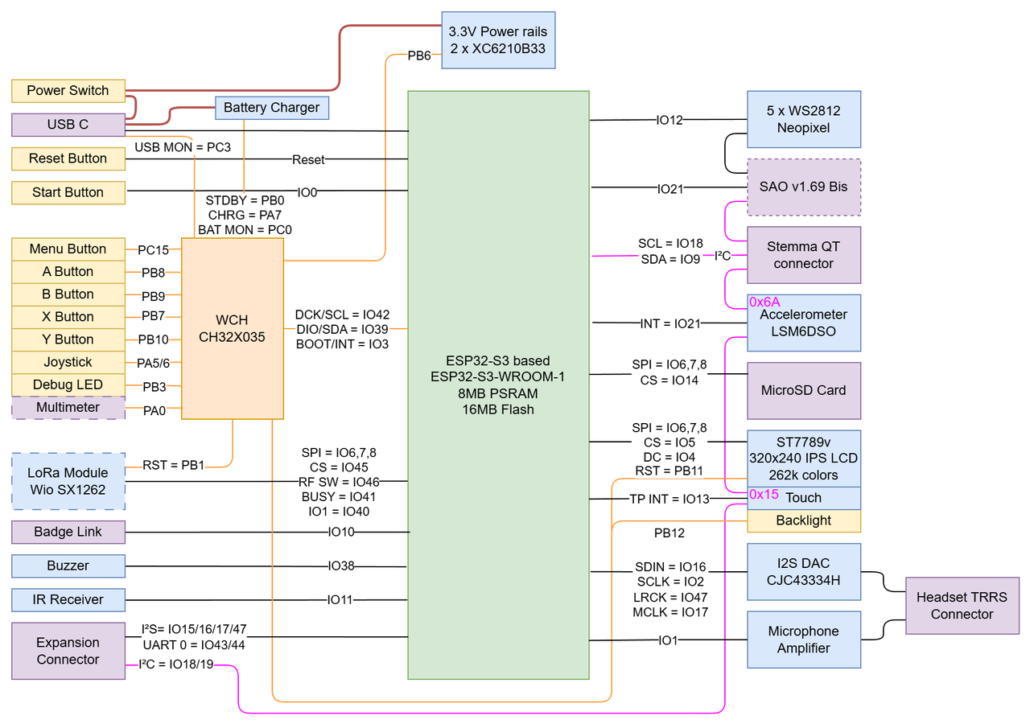
The Wio-SX1262 packages Semtech’s SX1262 sub-GHz transceiver with the supporting RF reference and power architecture required for a reusable radio module. It communicates with an external microcontroller over SPI, supports LoRa and (G)FSK modulation, covers common 868 and 915 MHz designs, and can transmit at up to +22 dBm. An active TCXO provides a stable RF reference, while the module’s DC-DC design supports the power requirements of low-power connected devices.
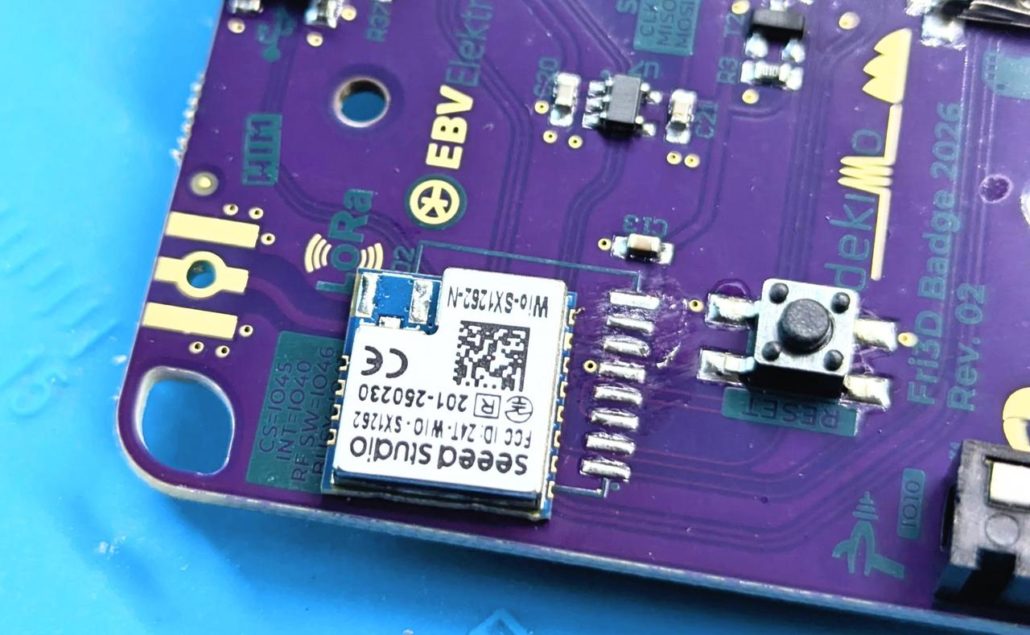
The Wio-SX1262-N is positioned directly on the badge PCB before the remaining module pins are soldered. Source: Fri3d Camp LoRa kit documentation.
For Fri3d Camp, the antenna interface was as important as the radio itself. Seeed offers an IPEX version for products that use an external antenna and cable, as well as the Wio-SX1262-N with SMT-packaged RF pins. The badge team selected the Wio-SX1262-N so the antenna connection could be routed directly through the badge PCB. This allowed the same radio design to support the compact spiral antenna included in the standard LoRa kit and the optional SMA expansion used with external 868 MHz antennas.
The integration process also became part of the educational experience. Builders first positioned the module on the prepared PCB footprint and soldered a single pin to hold it in place. Before continuing, they checked the alignment from both sides of the board. The remaining pins could then be soldered carefully, with particular attention paid to avoiding bridges between the side pins and the module’s metal shield. The official instructions recommended using flux when the solder did not flow cleanly, a practical lesson that helped many first-time builders complete the assembly successfully.
Once the module was installed, participants completed the RF path by selecting and mounting an antenna. The spiral antenna offered a compact solution for general use and could be soldered directly to the designated pads. Builders who chose the SMA expansion needed to heat the connector body sufficiently, create reliable solder joints, and attach an external 868 MHz antenna. The documentation also emphasized an essential RF precaution: an antenna should always be connected before the radio is operated, since an unterminated RF output can damage the power stage.
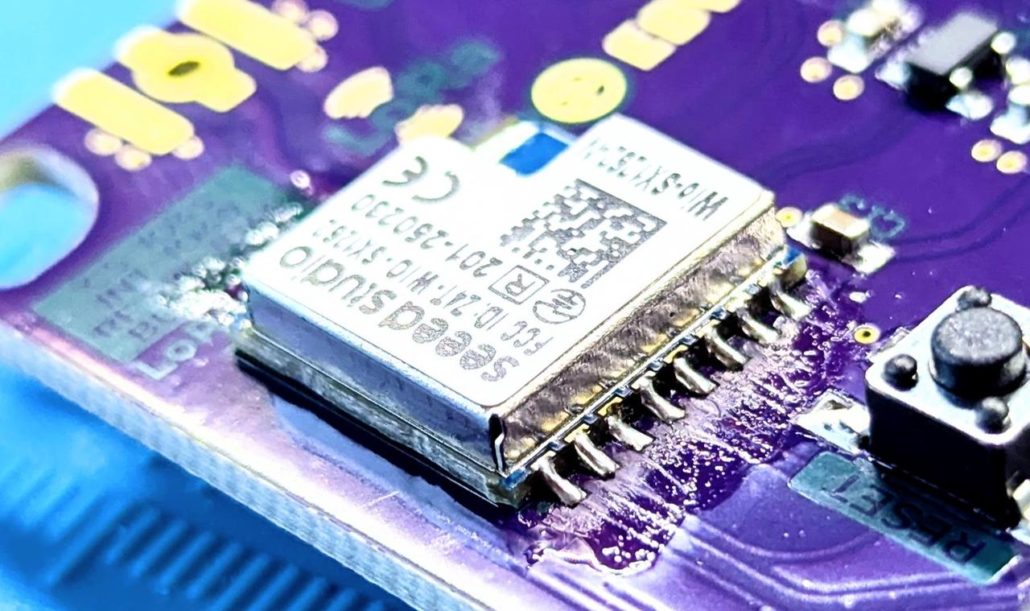
One side of the Wio-SX1262-N after soldering. The close spacing rewards careful alignment, controlled heat, and generous flux. Source: Fri3d Camp LoRa kit documentation.
Using a module did not eliminate the need for RF engineering. The badge still required a controlled antenna path, an appropriate ground strategy, correct power sequencing, regional frequency configuration, and an antenna suited to the intended use. What Wio-SX1262 changed was the project’s starting point. Instead of rebuilding the SX1262 support circuitry for every design, the team could integrate a documented radio block and concentrate its engineering effort on the host board, antenna implementation, software, assembly experience, and field application.
That balance made the module particularly suitable for Fri3d Camp. It was compact enough to become part of the badge, flexible enough to support two antenna strategies, and accessible enough to turn RF integration into a supervised community build. Nearly 200 modules were ultimately hand-soldered by participants and then used in real activities, demonstrating how a module-level radio design can move from PCB integration to practical outdoor experimentation.
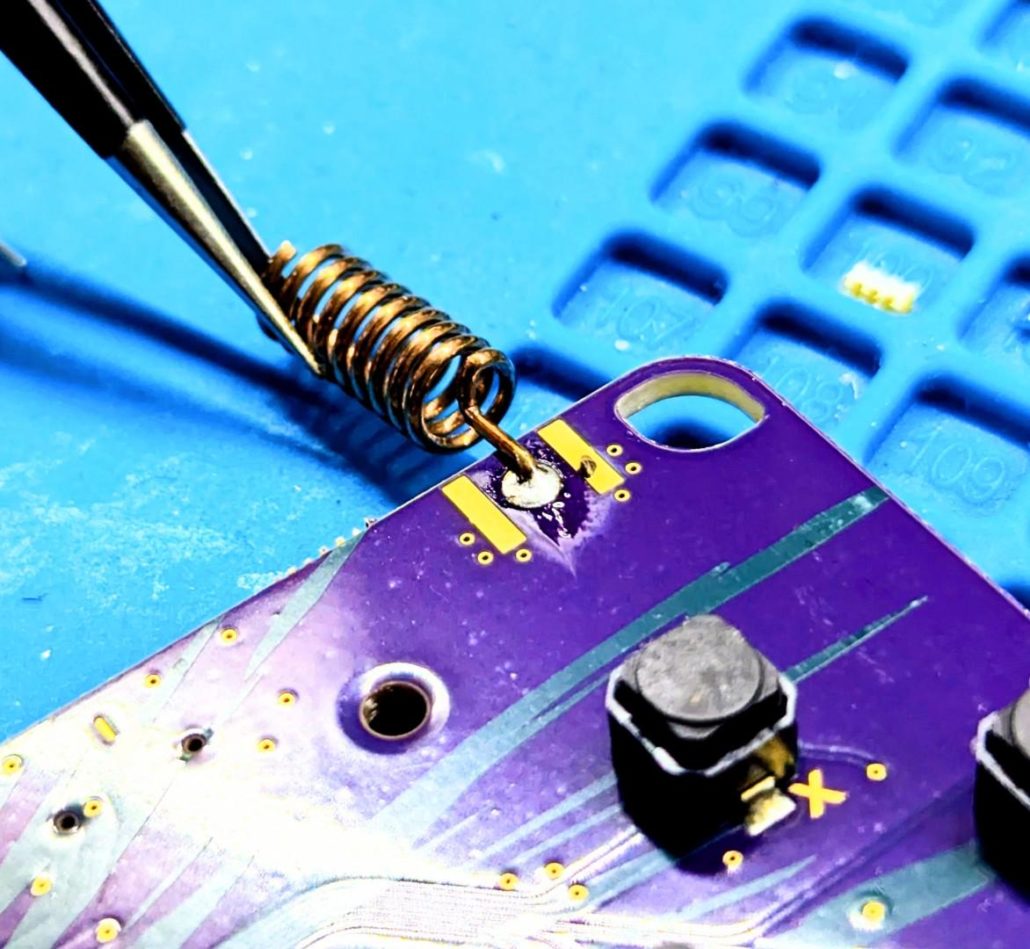
The compact spiral antenna soldered directly to the badge’s LoRa antenna pads. Source: Fri3d Camp LoRa kit documentation.
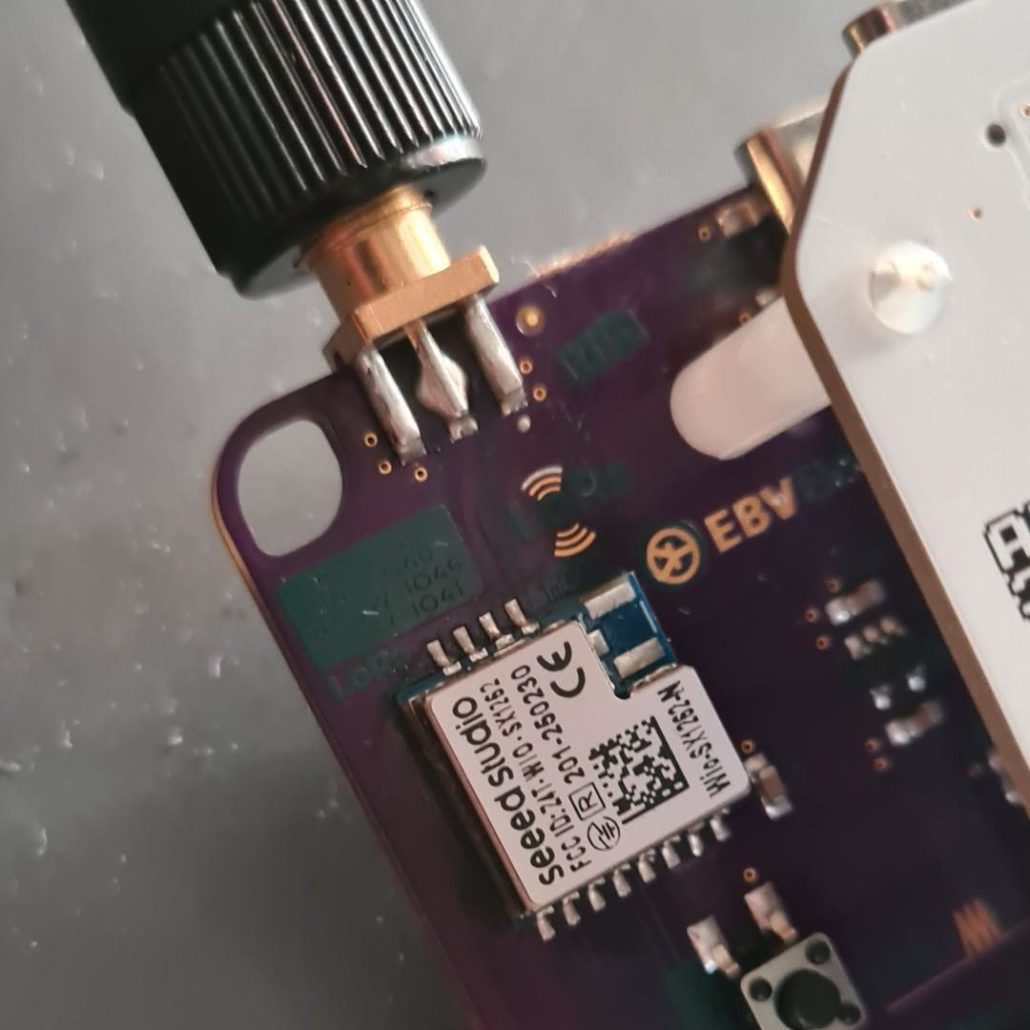
The SMA expansion seen from the rear of the board, providing a robust connection for an external 868 MHz antenna. Source: Fri3d Camp LoRa kit documentation.
Nearly 200 Modules, Soldered by Campers
This was not a demonstration performed by the badge team behind closed doors. Nearly 200 Wio-SX1262 modules were hand-soldered by attendees. Some participants had enough experience to complete the work alone. Others relied on people at the soldering area to help align the module, correct a joint, or add the right amount of flux.
Wim Van Gool, who led badge development, described the hand assembly as an additional challenge, but said that with help and flux, almost all of the modules survived. That should not be read as a formal production-yield claim. It is more useful as evidence of a successful community build: a fine-pitch RF module was integrated at meaningful scale by people with mixed levels of experience, and the result was immediately put to use.
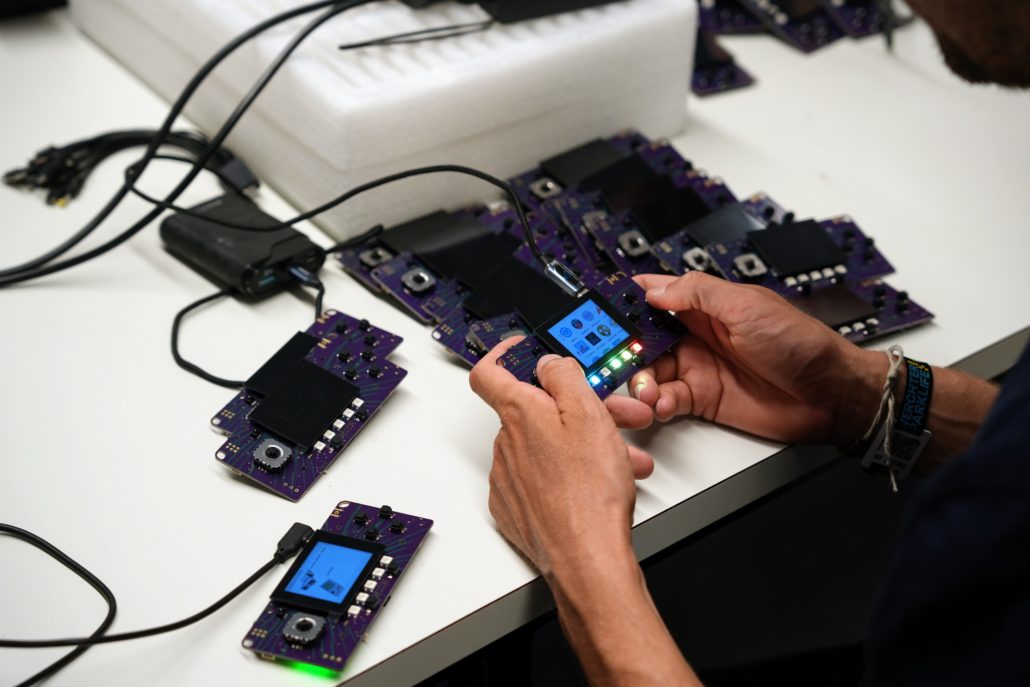
Assembly and testing turned the LoRa upgrade into a collaborative activity rather than a preinstalled feature. Source: Fri3d Camp.
A Fox Hunt Made Radio Behavior Visible
Once the modules were installed, the camp needed an activity that could make an invisible radio signal understandable. Hans Robeers and Frederik De Bleser supplied the answer with a LoRa fox-hunting workshop.
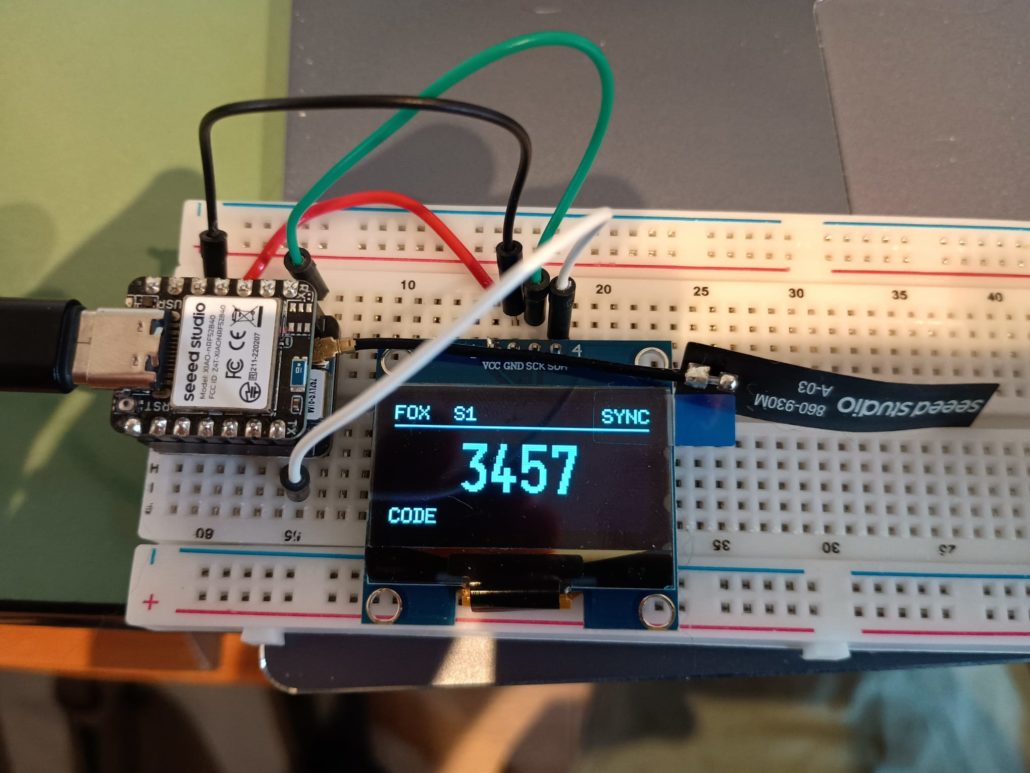
The activity extended the camp’s open-hardware approach beyond the wearable badge. The hidden foxes were purpose-built around XIAO development boards, creating compact LoRa beacons that could be placed around the campsite and detected by participants. Rather than relying on finished commercial equipment, both sides of the hunt became understandable building blocks: a programmable transmitter hidden in the woods and a badge-based receiver carried by the player.
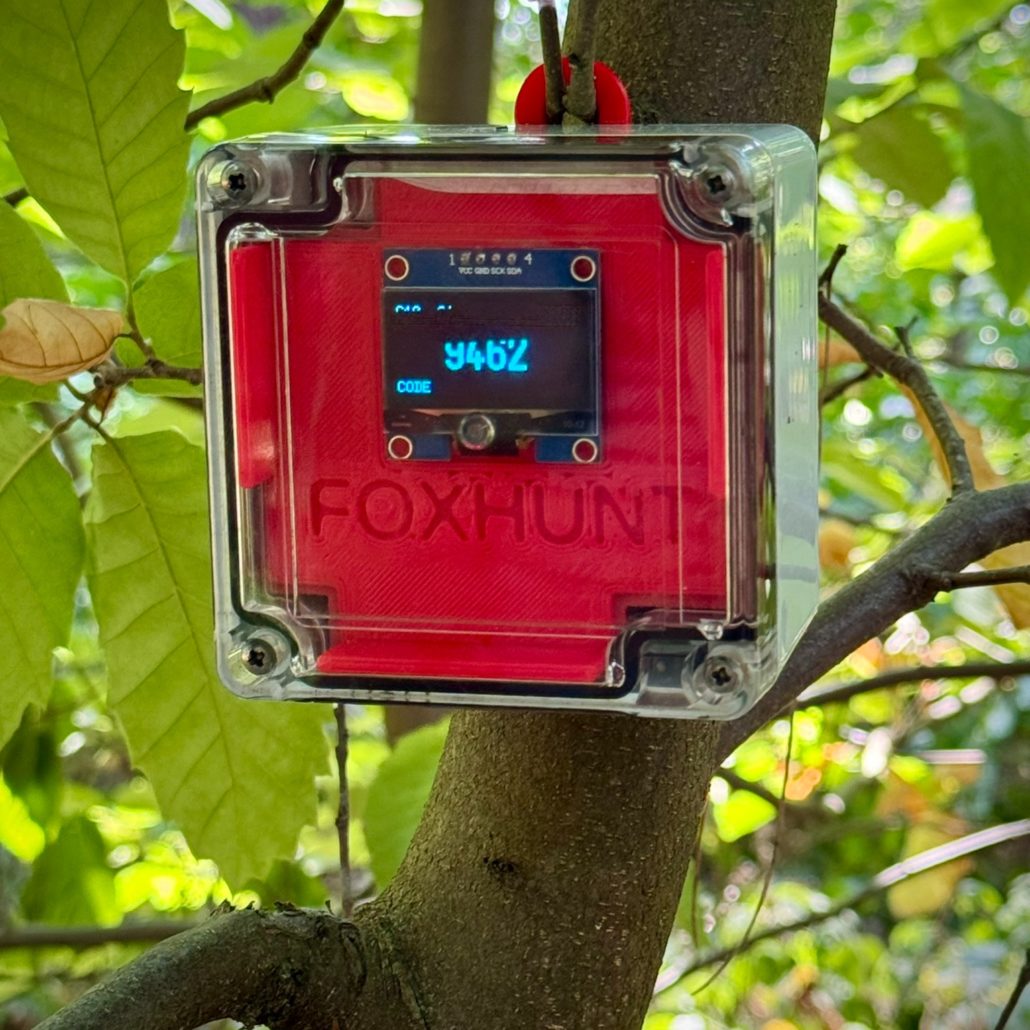
Radio fox hunting, also called amateur radio direction finding, hides small transmitters across an area and challenges players to locate them. Fri3d Camp participants built their own 868 MHz directional antennas and used the LoRa-enabled badge as the receiver and interface. They rotated the antenna, watched the received signal grow stronger or weaker, moved through the site, and repeated the process until they found the hidden beacon and entered its code in the badge application.
The workshop used a home-built Moxon rectangle designed for the 868 MHz band. Its compact two-element geometry provided a directional response without requiring a large or mechanically complex antenna. The supplied construction template for 1.5 mm² conductor specifies dimensions of A = 123.6 mm, B = 15.47 mm, C = 6.68 mm, D = 23.96 mm, and E = 46.11 mm, giving participants a reproducible design they could build during the camp.
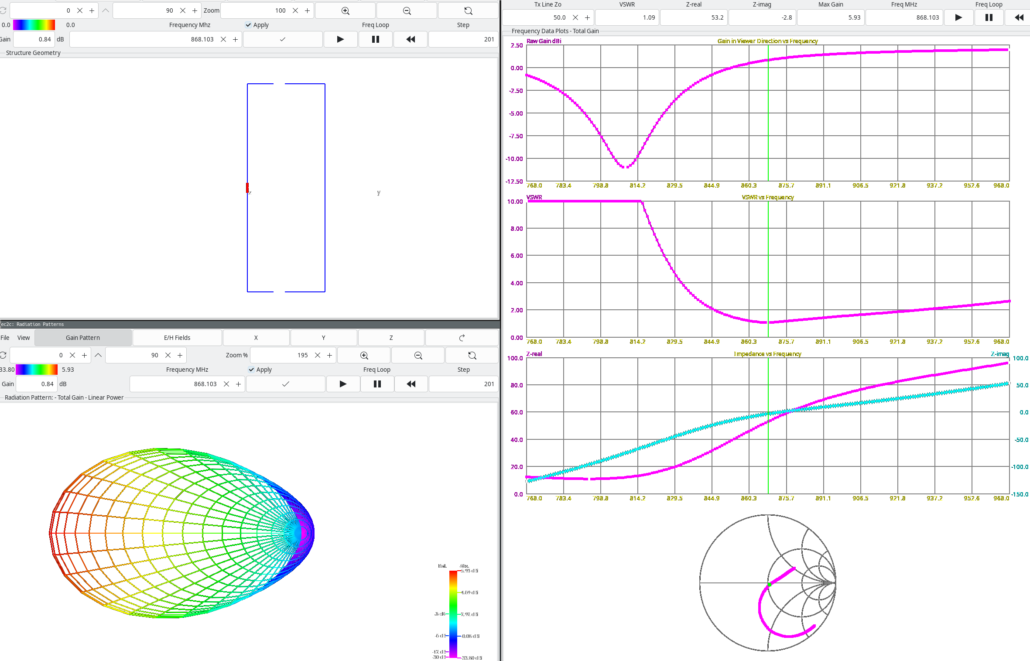
In the supplied simulation at approximately 868.1 MHz, the antenna showed a VSWR of 1.09, an input impedance of about 53.2 − j2.8 Ω, and a modeled maximum gain of approximately 5.9 dBi. These figures represent simulation results rather than field measurements, but the modeled radiation pattern helps explain the antenna’s role in the activity. As participants turned the antenna, its stronger forward response and weaker rear response produced observable changes in received signal strength, turning antenna directionality into something they could experience directly.
The game gave immediate meaning to concepts that can otherwise feel abstract. Antenna direction was no longer a radiation-pattern diagram. Signal strength was no longer just a number in a register. Both became physical clues that changed as the player turned, walked, and compared observations. Children could focus on finding the fox, while more experienced participants could think about polarization, multipath, gain, and the limitations of a home-built antenna.
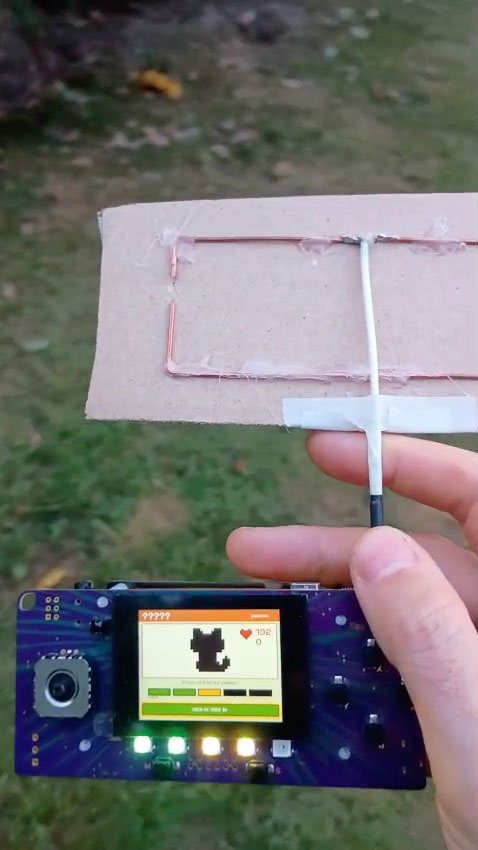
A participant-built directional antenna and LoRa-enabled badge ready for the fox hunt. Source: Fri3d Camp.
Lowering the Barrier Without Hiding the Work
The hardware experience was supported by a similarly open software path. The badge runs a customized version of MicroPythonOS, allowing beginners to build applications in Python while more advanced users can work in C++. The browser-based Fri3d-IDE combines an editor, terminal, device file browser, package management, USB and Bluetooth connections, and a virtual badge simulator.
Wim recalls seeing children with no previous programming experience follow the documentation and use the web IDE, simulator, and AI assistants to create games of their own. The software did not remove the need to think, test, or debug. It removed enough setup friction for an idea to become an application while the learner’s curiosity was still active.
“The spark and joy in kids’ eyes when their solder kit lights up is an unforgettable feeling.”
Wim Van Gool, Fri3d Camp badge development team lead
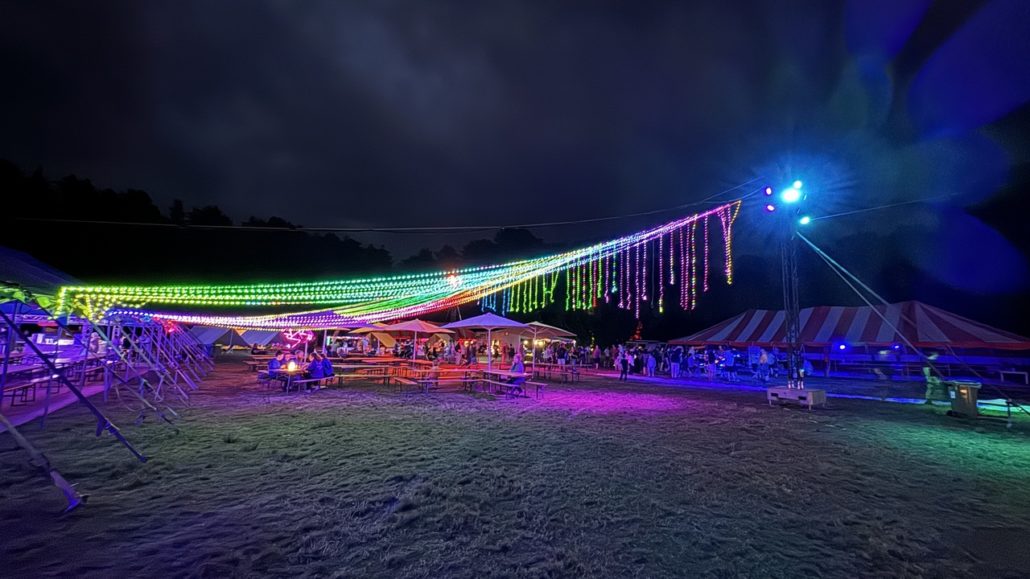
With Gratitude to the People Behind Fri3d Camp
We would like to offer our sincere appreciation to everyone who has made Fri3d Camp possible. Creating a place where children can encounter electronics, programming, radio, art, and engineering through their own hands is both an educational achievement and a meaningful contribution to the wider community.
For a young participant, one successful solder joint or first working program can become much more than a technical exercise. It can be the moment they begin to see themselves as someone capable of understanding technology, solving problems, and creating something new. By giving children the freedom to experiment, make mistakes, ask for help, and try again, Fri3d Camp helps cultivate curiosity, resilience, collaboration, and confidence at an age when such encouragement can have a lasting influence.
We are especially grateful to Wim Van Gool for his leadership in the badge development process and for the remarkable care he has brought to this project. From supporting participants during assembly to documenting the hardware and sharing the project openly, his contribution reflects the patient and often unseen work required to make an ambitious educational experience succeed. We also deeply appreciate the time, detailed explanations, photographs, and thoughtful assistance he has provided while helping us understand and present this story accurately.
Fri3d Camp demonstrates that technology education is not simply about teaching children to use new tools. It is about helping them understand that technology is something they can question, modify, repair, and build for themselves. That sense of agency is one of the most valuable lessons an educational community can provide.
Seeed Studio is honored that Wio-SX1262 became a small part of this experience. More importantly, we are grateful to Fri3d Camp, Wim, and the wider volunteer community for investing their knowledge, patience, and energy in the next generation of makers.
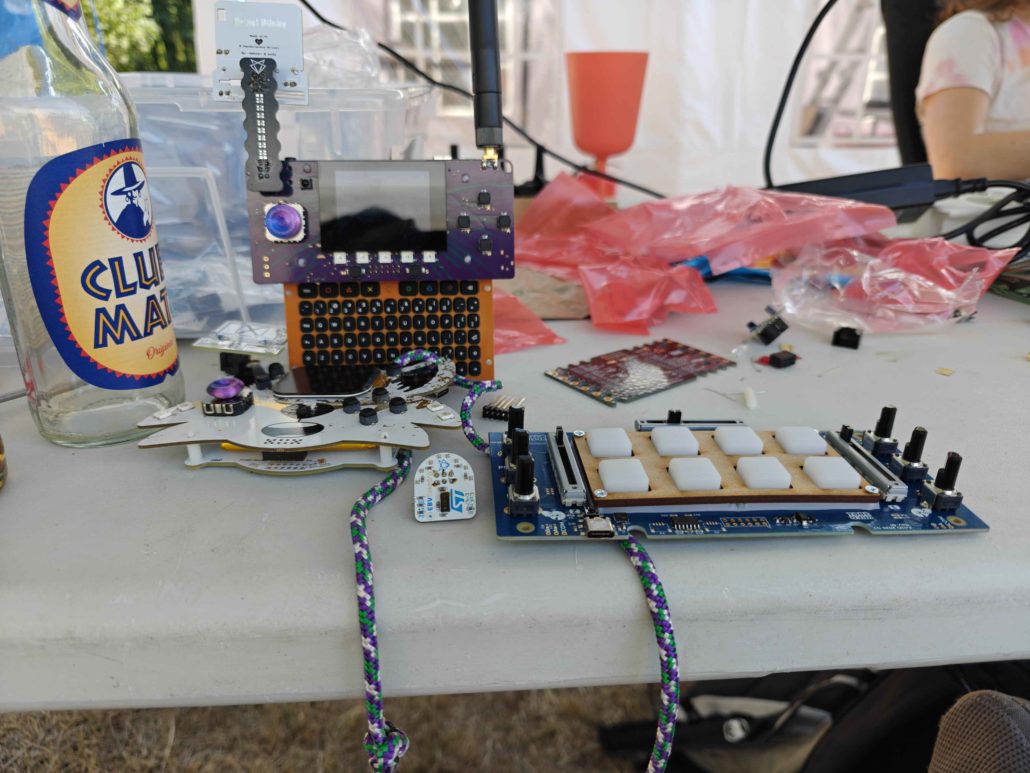
Explore the Project
- Fri3d Camp 2026 badge documentation
- Badge hardware and production files
- MicroPythonOS-based badge firmware
- Fri3d-IDE browser development environment
- LoRa kit assembly guide
- Fox-hunting workshop
- Wio-SX1262 product options
- Wio-SX1262 integration resources
The project was created by the Fri3d Camp community, with Wim Van Gool serving as badge development team lead. MicroPythonOS provided the operating-system foundation, while Hans Robeers and Frederik De Bleser developed the fox-hunting activity that brought the LoRa hardware into the woods.
For teams developing a custom LoRa endpoint, Seeed Studio can support module selection, firmware integration, RF and antenna design, reference designs, manufacturing preparation, and production planning.
About Author
