Agricultural Weather Station Guide: What to Measure and How to Choose
Agricultural weather stations give farms site-specific data for irrigation, spraying, greenhouse control, crop protection, and field planning. The most useful system is not simply the one with the longest sensor list. It is the one whose measurements, connectivity, power, and maintenance requirements match the crop environment and the decisions the farm needs to make.
This guide explores agricultural weather stations, covering essential farm weather measurements, key buying criteria, and how to deploy SenseCAP Combo, S700-B, and S700-C agricultural weather stations in greenhouses, fields, and orchards.
What Should an Agricultural Weather Station Measure and Why?
Agricultural weather stations usually monitor seven or eight environmental parameters. Wind speed and direction may be counted separately, while greenhouse systems may replace rainfall or wind with CO2. The measurements below explain why each channel matters and where it supports a real crop decision.
• Air temperature. Temperature data supports frost and heat alerts, growing-degree calculations, and the timing of planting, flowering, and harvest. In orchards and vineyards, a short cold period around bud break can matter more than a distant regional forecast, so measurements should represent the crop block itself.
• Relative humidity. Humidity helps teams interpret vapor pressure deficit, condensation, drying conditions, and disease risk when it is evaluated with temperature. Around strawberry or greenhouse vegetable canopies, persistently humid air can signal that ventilation or inspection is needed before visible crop damage appears.
• Wind speed and direction. Wind data helps identify safer spray windows, reduce drift risk, plan natural ventilation, and prepare for conditions that may damage crops or structures. For vineyards, orchards, and open fields, local wind at application height is more useful for spray decisions than a forecast from a distant station.
• Rainfall and rain intensity. Rain data supports irrigation adjustment, drainage checks, runoff assessment, field-access planning, and disease models that depend on wet conditions. A brief, intense storm over one field can create a different irrigation and inspection need from the daily total reported by a regional station.
• Solar radiation or light intensity. These channels indicate the energy or visible light reaching the crop. They support evapotranspiration estimates, irrigation models, greenhouse shading, and comparisons between exposed and sheltered zones. In greenhouse tomatoes or leafy greens, light data can be reviewed with temperature and humidity to understand whether shading and ventilation are aligned.
• Barometric pressure. Pressure trends add context to local weather changes and help explain shifts seen in wind, temperature, humidity, and rainfall. It is rarely the only parameter behind a farm action, but it strengthens the interpretation of a complete outdoor weather record.
• Carbon dioxide. CO2 is especially relevant in protected cultivation, where ventilation and enrichment can change concentration around the crop. For greenhouse tomatoes, cucumbers, or leafy greens, CO2 data reviewed with light, temperature, and humidity gives a more complete picture of the growing environment than outdoor weather measurements alone.
What to Consider When Choosing an Agricultural Weather Station?
Choose the station around the operating decision first, then verify accuracy, environmental protection, connectivity, power, installation, and maintenance. A longer parameter list only adds value when those channels are relevant and the farm can reliably collect and use the data.
Accuracy shows how close a reading is to the true value, but it should be read together with measurement range, resolution, repeatability, response time, sampling interval, and long-term drift. Compare specifications under the same conditions and pay particular attention to the channels that directly influence an operational threshold.
The table below summarizes the specifications commonly used to compare core agricultural weather measurements.
| Parameter | Common measurement unit | Common accuracy format | Other specifications to check |
| Air temperature | °C or °F | ±°C or ±°F | Range, response time, radiation shielding |
| Relative humidity | %RH | ±%RH | Accuracy at high humidity, hysteresis, drift |
| Wind speed | m/s, km/h, mph | ±m/s or percentage of reading | Starting threshold, range, gust response |
| Wind direction | Degrees | ±degrees | Dead band, orientation, compass alignment |
| Rainfall | mm or inches | ±percentage | Resolution per tip, maximum rainfall intensity |
| Solar radiation | W/m² | ±percentage | Spectral response, cosine response, calibration |
| Barometric pressure | hPa, mbar, Pa | ±hPa or ±Pa | Elevation correction, long-term drift |
On the other side, outdoor durability protects data continuity against rain, dust, UV exposure, temperature shifts, and seasonal weather. Connectivity determines whether readings can reach the farm team, an existing dashboard, an automation platform, or a private server at the required interval. Confirm that the stated protection applies to the assembled sensor, connectors, cables, logger, and power system rather than to one component alone.
Power and maintenance define the real deployment workload. Solar and battery-backed systems suit sites without mains power, while DC power may fit fixed infrastructure. Compact sensing, clear mounting requirements, remote configuration, local data caching, and fewer moving parts can reduce field visits. Large farms and sites with elevation changes, windbreaks, separate greenhouse compartments, or multiple irrigation zones may need several stations rather than one nominally central point.
Agricultural Weather Stations for Different Project Needs
SenseCAP is Seeed Studio‘s environmental monitoring line for IoT deployments, including agricultural weather stations for protected cultivation and outdoor farms. The main choice is not simply the number of built-in sensors. It is whether the product matches the growing environment and the data path already available on the farm. The Combo integrates greenhouse-focused sensing, 4G, local storage, solar charging, and battery backup in one unit. The S700-B and S700-C are compact outdoor sensor heads that connect through RS485 Modbus RTU or SDI-12 and can be paired with LoRaWAN or 4G data loggers. The sections below compare how each option measures, communicates, powers, installs, and fits into farm operations.
SenseCAP Combo 5-in-1 Sensor with 4G – For Greenhouses
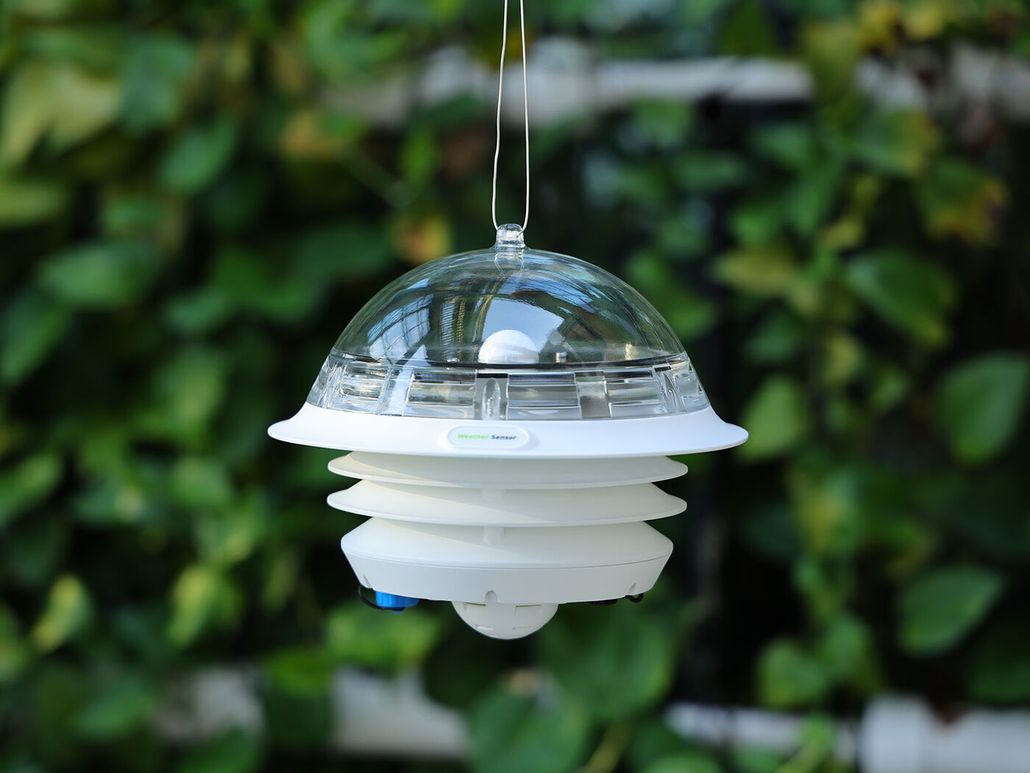
SenseCAP Combo packages sensing, cellular backhaul, power, and data continuity into one agricultural monitoring unit. It is the most direct of the three options for greenhouses because it can begin sending data without a separate LoRaWAN gateway or external logger. Its built-in measurements follow the greenhouse microclimate, while the RS485 port leaves room for soil, irrigation, or other Modbus sensors as the project expands.
• Built-in measurements. Combo measures air temperature, relative humidity, barometric pressure, light intensity, and CO2. This set is designed around the variables that change quickly inside protected cultivation and directly affect ventilation, shading, enrichment, and crop-zone conditions. One RS485 port can connect up to 10 external Modbus RTU sensors through a splitter when soil moisture, EC, irrigation, or additional environmental measurements are required.
• Connectivity and data access. Integrated global-band 4G and MQTT remove the need to build a separate gateway network. Data can be sent to the SenseCAP platform or a user-configured server, with HTTP, MQTT, and WebSocket APIs available for integration.
• Power and data continuity. The integrated solar panel and 5,200 mAh rechargeable battery support more than two weeks of operation without solar charging under specified conditions, and DC input is also available. Combo can cache up to 500,000 records during a network interruption and upload them after 4G returns, helping preserve a continuous greenhouse record when cellular service is unstable.
• Installation and protection. Combo supports hanging installation from greenhouse structures or pole mounting. Its IPX5, UV-resistant enclosure is intended for long-term environmental monitoring from 0 to 40°C. The combined enclosure reduces the number of separately mounted devices and is especially practical where power cabling and gateway placement would add deployment work.
• Best fit. Choose the Combo for greenhouses, nurseries, covered growing areas, and projects that prioritize direct cellular access, CO2, light, and quick deployment.
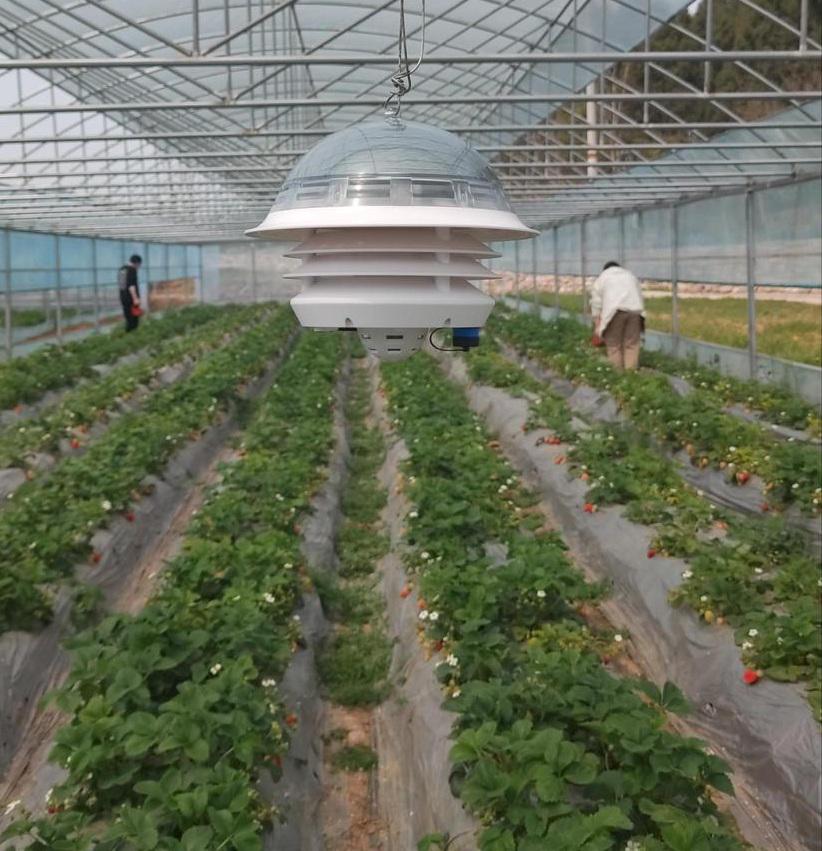
• Deployment in greenhouses. Place the combo above or near the crop canopy in a representative zone, away from heaters, fans, open doors, irrigation spray, and localized CO2 outlets unless one of those sources is the specific target of measurement. Large or compartmentalized greenhouses should use multiple units to capture meaningful differences between zones.
SenseCAP S700-B 7-in-1 Compact Weather Station – For Open-Field Agriculture
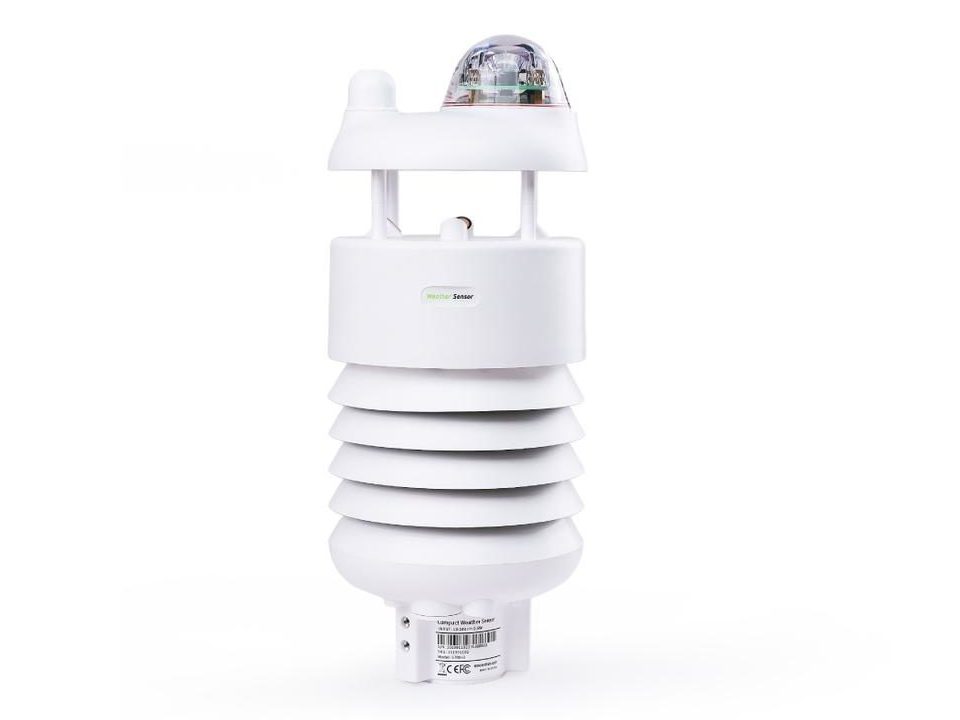
SenseCAP S700-B combines the weather channels most often used in open-field agriculture in one compact sensor head. Ultrasonic wind sensing, optical rainfall measurement, and a pyranometer provide a solid-state alternative to a collection of separately mounted instruments.
• Built-in measurements. S700-B measures air temperature, relative humidity, barometric pressure, ultrasonic wind speed and direction, optical rain intensity, global solar radiation, and sunshine duration. Rain range is 0 to 200 mm/h with 0.2 mm/h resolution, while global solar radiation covers 0 to 2,000 W/m². The combined record supports irrigation planning, evapotranspiration workflows, spray assessment, and crop-energy analysis.
• Connectivity architecture. The station outputs data through RS485 Modbus RTU or SDI-12. Pair it with the SenseCAP S2100 LoRaWAN Data Logger when long-range, low-power coverage and an existing LoRaWAN gateway are available, or use the SenseCAP Sensor Hub 4G Data Logger when cellular backhaul is the more practical route. This modular data path lets one sensor model fit different farm infrastructures.
• Power planning. S700-B requires 12 to 24 V DC at approximately 1 W. Battery backup, solar charging, local caching, and transmission behavior depend on the selected logger and power system, so the complete field node should be planned as one system. An optional 24 V heater supports cold-weather operation where icing or low temperatures may affect the deployment.
• Installation and maintenance. The IP66-rated unit is designed for compact pole mounting and includes a 3 m cable. Ultrasonic wind measurement avoids cups and vanes, while the integrated head reduces separate brackets, alignment work, and exposed moving parts. Its operating range of -40 to 85°C supports demanding outdoor environments when the rest of the installation is specified to match.
• Best fit. Choose the S700-B for open-field crops, irrigation planning, spray-window assessment, agrivoltaic projects, and applications that need wind, rainfall, and global solar radiation at the same point. Its optical rain channel is well suited to routine field weather monitoring when the finer radar rain resolution of the S700-C is not the central requirement.
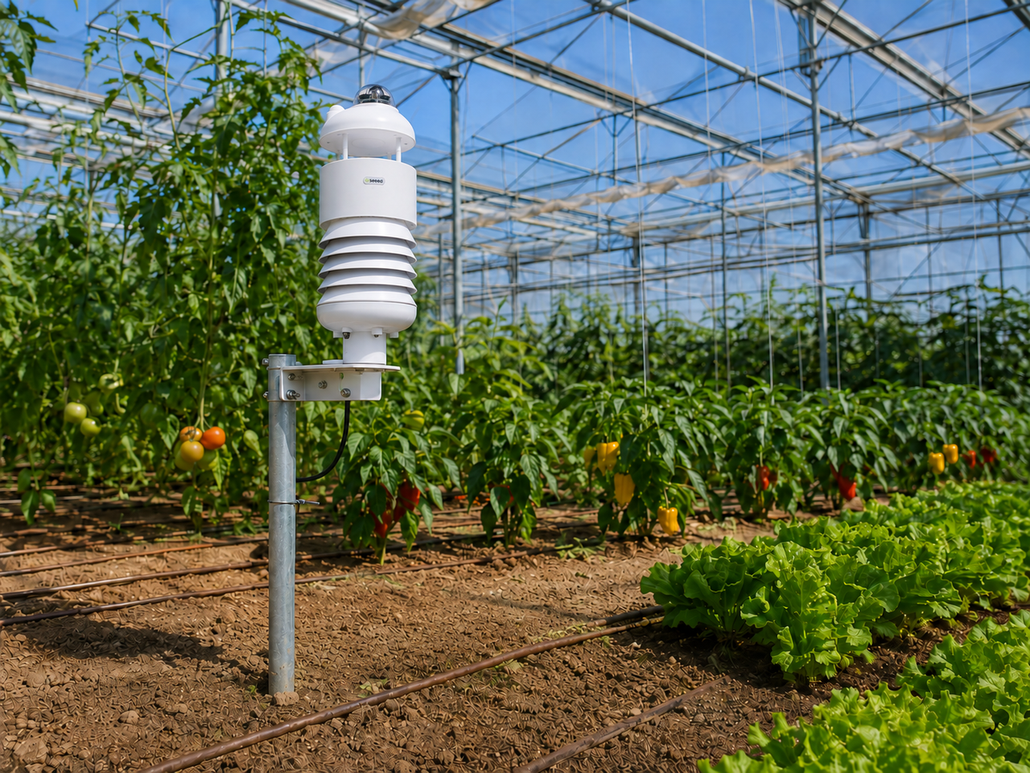
• Deployment in open fields. Mount the station in a representative crop block with open exposure to wind, rain, and solar radiation. Keep it away from trees, buildings, windbreaks, and irrigation equipment that could distort readings. On varied acreage, add stations by elevation, soil zone, crop type, or irrigation block rather than assuming one point represents the entire farm. Keep mounting height and orientation consistent when comparing multiple sites.
SenseCAP S700-C 7-in-1 Compact Weather Station – For Orchards and Remote Agricultural Estates
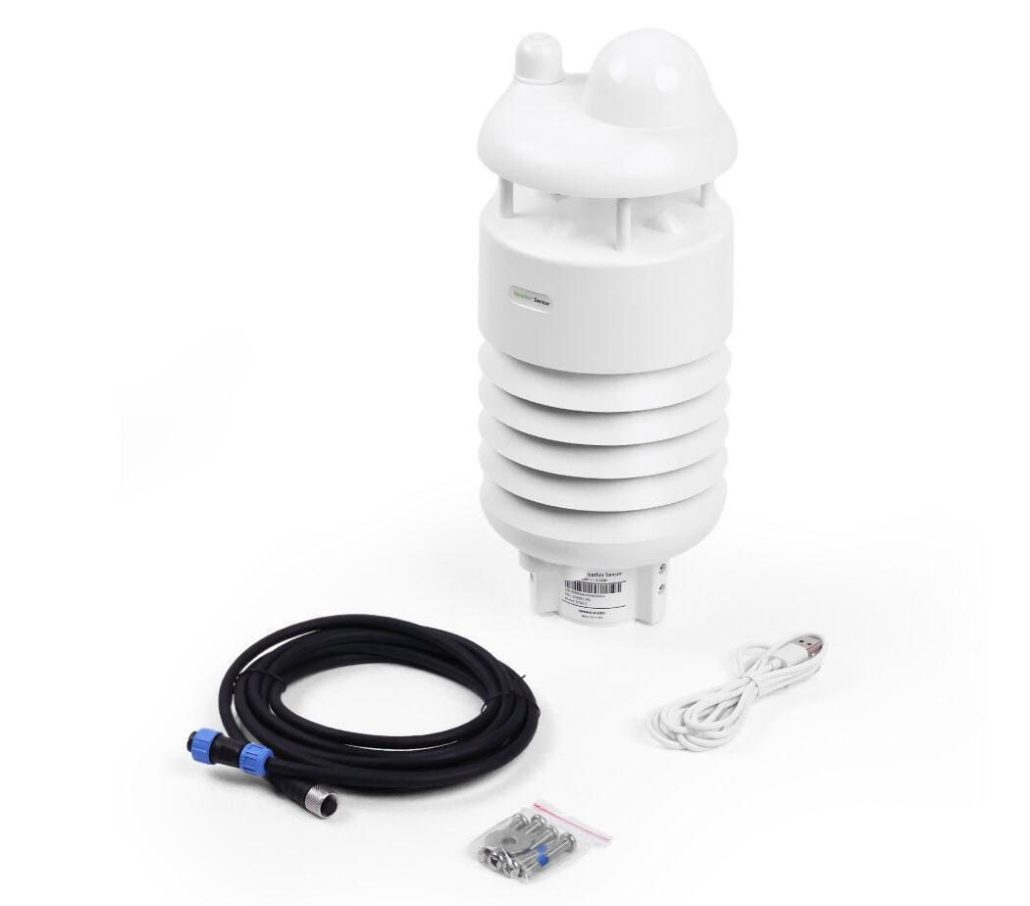
• Built-in measurements. S700-C measures air temperature, relative humidity, barometric pressure, ultrasonic wind speed and direction, 60 GHz radar rain intensity, global solar radiation, and sunshine duration. Its rain range is 0 to 300 mm/h with 0.01 mm/h resolution, and global solar radiation covers 0 to 2,000 W/m². This makes rainfall detail easier to evaluate alongside wind and incoming energy at the same site.
• Connectivity architecture. RS485 Modbus RTU and SDI-12 outputs support industrial systems and external loggers. Use the SenseCAP S2100 LoRaWAN Data Logger where a LoRaWAN network covers the estate, or the SenseCAP Sensor Hub 4G Data Logger where cellular service offers the simpler backhaul.
• Power planning. S700-C requires 12 to 24 V DC at approximately 1 W. A compatible logger, battery, and solar supply can create a remote monitoring node, while an optional 24 V heater supports cold-weather deployments. Size the power system around the logger’s transmission interval, local climate, solar exposure, and the heater requirement rather than the sensor alone.
• Installation and maintenance. The IP66-rated compact design includes a 3 m cable and uses radar rain sensing with ultrasonic wind measurement. With no tipping bucket, wind cups, or vane in the measurement path, the station reduces routine mechanical attention. Its -40 to 85°C operating range supports demanding outdoor settings when the logger, connectors, cable routing, and power system are protected to the same deployment standard.
• Best fit. Choose S700-C for orchards, vineyards, high-value perennial crops, remote agricultural estates, agrivoltaics, and projects that analyze rainfall and solar input together. It is especially relevant where rainfall detail affects irrigation or field access and where seasonal debris or difficult site access makes a low-maintenance solid-state design valuable.
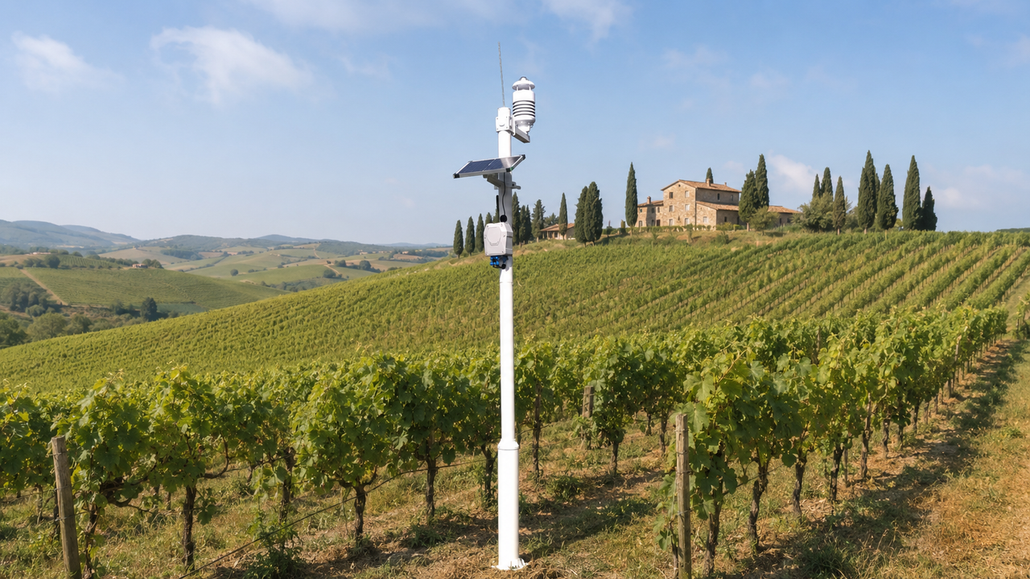
• Deployment in orchards and remote fields. Install the station above the nearby canopy with open exposure to the sky and prevailing wind. Avoid placing the head directly beside irrigation emitters or beneath overhanging vegetation, and plan safe access for occasional inspection even when routine mechanical servicing is limited.
Three SenseCAP Agricultural Weather Stations Options at a Glance
| Decision factor | SenseCAP Combo 5-in-1 with 4G | SenseCAP S700-B | SenseCAP S700-C |
| Best fit | Greenhouses and protected cultivation | Open-field crops and irrigation planning | Orchards, vineyards, remote estates |
| Built-in measurements | Temperature, humidity, pressure, light, CO₂ | Temperature, humidity, pressure, ultrasonic wind, optical rain, solar radiation, sunshine duration | Temperature, humidity, pressure, ultrasonic wind, radar rain, solar radiation, sunshine duration |
| Rain measurement | Add through an external RS485 sensor if required | Optical, 0 to 200 mm/h; 0.2 mm/h resolution | 60 GHz radar, 0 to 300 mm/h; 0.01 mm/h resolution |
| Solar or light channel | Light intensity | Global solar radiation, 0 to 2,000 W/m² | Global solar radiation, 0 to 2,000 W/m² |
| Data connection | Integrated 4G Cat.1 and MQTT | RS485 Modbus RTU or SDI-12; add LoRaWAN or 4G data logger | RS485 Modbus RTU or SDI-12; add LoRaWAN or 4G data logger |
| Power | Integrated solar panel, 5,200 mAh battery, or DC input | 12 to 24 V DC, about 1 W; remote system depends on selected data logger and solar supply | 12 to 24 V DC, about 1 W; remote system depends on selected data logger and solar supply |
| Local resilience | Caches up to 500,000 records and uploads after 4G returns | Determined by the connected data logger | Determined by the connected data logger |
| Protection | IPX5, UV-resistant; intended operating range 0 to 40°C | IP66; -40 to 85°C | IP66; -40 to 85°C |
| Installation | Hanging or pole mount | Compact pole mount with included 3 m cable | Compact pole mount with included 3 m cable |
Quick Pick for Your Farm Weather Station
Start with the growing environment and the operating decision, then confirm measurement coverage, network availability, power, data integration, and maintenance access.
• Greenhouse or protected cultivation – Choose SenseCAP Combo. It combines temperature, humidity, pressure, light, and CO2 with integrated 4G, MQTT, solar charging, battery backup, and local caching. Choose it when fast deployment and direct remote access matter, especially if no LoRaWAN gateway or external logger is in place. Add compatible RS485 sensing if the project also needs soil or irrigation data.
• Open-field agriculture – Choose SenseCAP S700-B. It brings wind, optical rainfall, solar radiation, and core atmospheric measurements into one compact head. Choose it for irrigation planning, evapotranspiration workflows, spray assessment, and crop-energy analysis when routine optical rainfall measurement is sufficient. Pair it with LoRaWAN or 4G according to field coverage and the farm’s existing data architecture.
• Orchards, vineyards, and remote estates – Choose SenseCAP S700-C. It combines solar radiation with finer, wider-range radar rain measurement and ultrasonic wind sensing. Choose it when rainfall detail, hard-to-reach installation points, and reduced mechanical maintenance are central to the project. Use multiple stations where terrain, shelterbelts, row orientation, or elevation create distinct microclimates.
Need Weather Stations for an Agriculture Project?
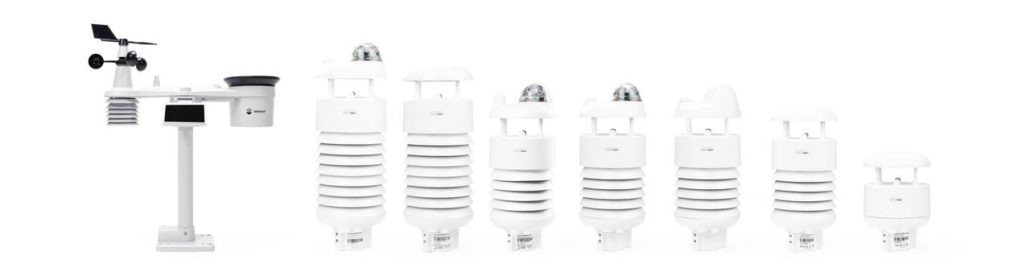
Reliable agricultural weather stations should connect a field condition to a decision. The right configuration can support irrigation scheduling, spraying safety, greenhouse ventilation, crop protection, and remote inspection, but only when the sensor package and deployment architecture match the site.
For a cultivation project, that may mean the integrated SenseCAP Combo with 4G and local caching. For open fields, the S700-B can combine wind, optical rainfall, and solar radiation with the farm’s preferred LoRaWAN or 4G data path. For orchards, vineyards, and remote estates, the S700-C adds fine-resolution radar rain sensing and a solid-state design suited to lower-maintenance monitoring.
When planning a larger deployment, also note the number of greenhouse zones or field blocks, terrain changes, irrigation divisions, and the platform or private server that will receive the data. These details determine whether one station is representative, where additional stations should be placed, and which backhaul option is practical.
Contact our team to discuss your application, deployment needs, and potential customization options.
Seeed Studio is helping lead this transition through the SenseCAP weather station portfolio. SenseCAP combines industrial-grade sensing, compact all-in-one hardware, open communication protocols, flexible data paths, and a repeatable deployment architecture. Seeed Studio works with more than 200 partners and over 1,000 customers across 120+ countries, with SenseCAP deployments spanning greenhouse and vineyard monitoring, smart-city observation, renewable-energy sites, environmental research, and industrial facilities. This is the direction professional weather monitoring is taking, and SenseCAP is building the products and integration ecosystem needed to move it forward.
>> Read more
About Author
