Seeed reBot Arm Successfully Integrates with LeRobot V0.6.0, Completing the Robot Learning Loop in NVIDIA Isaac Simulation
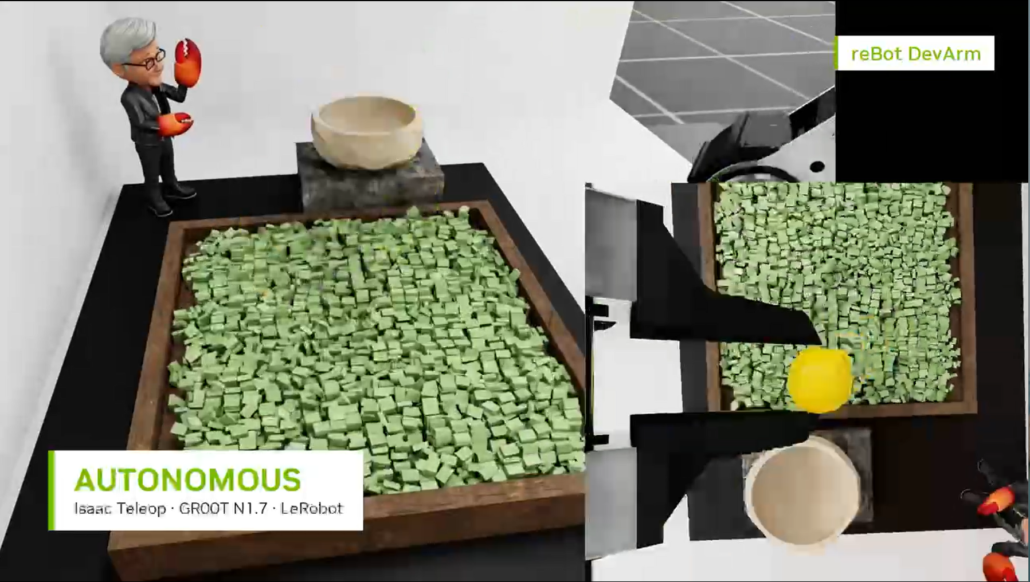
One-sentence summary: NVIDIA has natively integrated its most powerful open-source humanoid robot brain, GR00T 1.7, and the teleoperation tool NVIDIA Isaac Teleop, into Hugging Face LeRobot. Seeed’s reBot DevArm (7 DOF) has successfully adopted this technology stack. Developers can now use a reBot and a VR headset to record data in simulation, train a model, and deploy it directly to the real robot—completing the entire loop in a single night.
On July 6, 2026, NVIDIA and Hugging Face officially announced:
- Isaac Teleop (teleoperation data collection framework) is natively integrated into LeRobot.
- GR00T N1.7 (a 3-billion parameter open-source VLA foundation model) is natively integrated into LeRobot.
- The Cosmos 3 physical world generation model will also join the LeRobot ecosystem in the future.
This means that the world’s 3 million NVIDIA robotics developers and 16 million Hugging Face AI developers now have a standardized, open-source, and commercially viable end-to-end robotics development pipeline: Teleoperation → Data Standardization (LeRobot) → Model Fine-tuning (GR00T N1.7) → Simulation Validation (Isaac Sim/Lab) → Real-world Deployment (Jetson)
More importantly, Seeed’s reBot DevArm has successfully adapted to every layer of this development stack, becoming one of the first physical hardware platforms for this new paradigm.
🤖 Seeed reBot Arm: A Key Launch Validation Tool for NVIDIA Isaac Teleop
Asier Arranz, Senior Developer Advocate for Robotics & Physical AI at NVIDIA, shared the complete validation process on LinkedIn:
“We ported the Isaac Teleop + GR00T N1.7 stack from the SO-ARM101 to a brand new robot arm—the reBot DevArm—and teleoperated it in Isaac Lab via XR. The task was ‘Save the Hugging Face Emoji’: pick the emoji out of a sandpit and place it in a wooden bowl. 40 demonstrations (with Quest 3) were packaged into a standard LeRobot dataset. After fine-tuning GR00T N.7 as a new embodiment, it could autonomously complete the task the next morning. The entire learning loop was completed entirely in simulation.”
(Video source: Asier Arranz LinkedIn)
| Key Point | Significance |
| 7 DOF | Higher degrees of freedom make the arm more suitable for delicate manipulation and complex poses, with high end-effector flexibility. |
| Quest 3 + CloudXR + Isaac Lab | Represents the cutting-edge workflow of “VR Teleoperation → Simulation Training → Real-world Deployment”. |
| 40 demos → Policy overnight | Compresses the time from data collection to a usable policy to an hourly scale. |
Payload: 2.5kg, Repeatability: ±0.1mm. Learn more about the reBot Arm:https://www.seeedstudio.com/reBot-Arm-B601-RS-Bundle-p-6898.html
📚 What Do GR00T N1.7 + Isaac Teleop + LeRobot Mean?
- GR00T N1.7: The “Open-Source Brain” for Humanoid Robots
GR00T N1.7 is NVIDIA’s first open-source and commercially usable Vision-Language-Action (VLA) foundation model. With 3 billion parameters, its core capability is translating “what it sees + the instruction it hears” directly into “robot actions.”
Key upgrades over the previous generation:
- Long-horizon Reasoning: Can autonomously break down multi-step tasks like “pick material → assemble → store” without “forgetting” midway.
- Finger-level Dexterity: Supports independent control of five fingers, handling small part assembly and reagent manipulation with ease.
- EgoScale Pre-training: Trained on over 20,800 hours of human first-person video. The more human data, the smarter the robot (following a predictable “dexterity scaling law”).
- New Backbone: Cosmos-Reason2-2B (Qwen3-VL architecture) with native resolution processing, eliminating forced padding.
- Apache 2.0 Commercial License: Enterprises can deploy it directly in production lines without legal risk.
- Isaac Teleop: The “VR Remote” for Data Collection
Teleop solves the most painful part of robotics development: where to get high-quality demonstration data.
Isaac Teleop is an open-source robot data collection framework that supports efficiently capturing human demonstrations from external devices in standardized, interoperable formats. It can be easily expanded and shared with the community, with all processes seamlessly integrated into LeRobot.
- Before: Hiring people for motion capture suits, renting labs, writing custom data collection code—high cost, long cycle.
- Now: Put on a Quest 3 headset, remotely control a simulated or real robot arm with controllers, and the system automatically outputs a standard LeRobot dataset (Parquet format).
The collected trajectories include:
- Binocular camera images
- Joint angle sequences
- End-effector poses
- Natural language instruction annotations
- LeRobot: The Open-Source Training Ground for Robotics
LeRobot v0.6.0 is a major upgrade from Hugging Face for Embodied AI. By introducing world models, VLA models, reward models, automated data processing, and evaluation tools, it further打通s the complete learning loop of “Robot Data Collection → Model Training → Deployment → Feedback Optimization.” It unifies:
- Dataset format (Parquet structured trajectory files)
- Model training scripts (supporting mainstream policies like GR00T, Pi, SmolVLA)
- Evaluation and visualization tools (built-in Rerun for real-time replay)
NVIDIA’s native integration of Isaac Teleop and GR00T into LeRobot means developers no longer need to write their own data conversion scripts or build their own training frameworks—a single command-line toolchain handles everything from collection to deployment.
🛠️ Practical Guide: How to Run This Stack with reBot Arm
If you already have a reBot DevArm (or plan to get one), here is the recommended hands-on path:
Step 1: Environment Setup
| Component | Recommended Configuration |
| Robot Arm | Seeed reBot Arm DM/RS (7 DOF) |
| Compute Platform | NVIDIA Jetson AGX Thor / x86 PC + RTX GPU |
| VR Device | Meta Quest 3 (for Isaac Teleop teleoperation) |
| Software Stack | Isaac Sim / Isaac Lab + LeRobot v0.6.0 + Isaac Teleop |
Tip: The reBot Arm’s drivers and ROS 2 interface are open-source and can be directly connected to Isaac Teleop’s control interface.
Step 2: Complete the First Loop in Simulation
We strongly recommend completing the full process in simulation before migrating to the real robot:
- Launch Isaac Lab + reBot simulation model
- Load the reBot DevArm USD model in Isaac Lab (or use the SO-101 model to understand the process).
- Configure the simulation environment (sandpit, wooden bowl, objects to be grasped).
- Record demonstration data with Isaac Teleop
- Connect Quest 3 and start CloudXR streaming.
- Teleoperate the simulated robot arm in first-person view to complete the task.
- Record 30-50 trajectories, which are automatically exported as a standard LeRobot dataset.
- Load GR00T N1.7 in LeRobot for fine-tuning
- Pull the
nvidia/GR00T-N1.7weights from Hugging Face. - Use the LeRobot training script to load your custom dataset for post-training.
- Key parameters: action prediction horizon, camera input configuration, language prompt template.
- Pull the
- Evaluate the policy in simulation
- Run batch evaluations in Isaac Lab-Arena.
- Focus on metrics: grasp success rate, task completion time, action smoothness.
- Export and deploy to the real robot
- GR00T N1.7 supports ONNX / TensorRT export.
- Deploy to edge devices like Jetson Thor.
- Reuse the calibration parameters from Teleop data collection to reduce Sim-to-Real error.
Step 3: Migrate from Simulation to the Real reBot
Once the simulation policy is stable, key points for migrating to the physical reBot Arm:
- Calibration Alignment: Ensure the joint zero points and DH parameters in the simulation model match the real robot.
- Latency Compensation: Real robot communication latency (CAN/USB) needs to be time-aligned in the inference loop.
- Safety Margins: For the first real-world run, it is recommended to lower the speed limit and set up an emergency stop switch.
- Incremental Iteration: If real-world performance is poor, go back to Teleop to collect demonstration data for failure scenarios.
Why is this the “iPhone Moment” for Embodied AI?
Before GR00T N1.7 + LeRobot, training a robot arm policy for autonomous grasping typically required developers to:
- Write their own teleoperation code (2-4 weeks)
- Design a private data format and clean it (1-2 weeks)
- Hack open-source VLA models to fit their own robot (3-6 weeks)
- Build a simulation environment and do Sim-to-Real (2-4 weeks)
Total cycle: 2-4 months, and hard to reproduce.
Now, with the combination of NVIDIA + Hugging Face + Seeed hardware:
- Record data with a VR headset in one night.
- Start LeRobot training with a single command.
- GR00T N1.7 pre-trained weights mean you don’t need to train from scratch.
- Isaac Sim simulation validation lets you know if the policy is good before touching the real robot.
Individual developers, university labs, and SMEs—no longer need million-dollar budgets and ten-person teams. One person, one reBot, one weekend, and you can create a robot demo that used to take months.
🚀 Seeed Continues to Improve the Open-Source Embodied AI Ecosystem for Developers
Seeed has always adhered to the philosophy of “lowering the barrier for developers and making technology accessible” in the fields of AI and robotics hardware:
- NVIDIA Jetson Ecosystem: From Jetson Orin Nano to AGX Thor, Seeed continues to launch NVIDIA-certified high-compute carrier boards and edge computing kits.
- Support for ROS 2 and other open-source stacks: The reBot series of robot arms natively supports ROS 2/Pinocchio and other robot motion control stacks.
- LeRobot Adaptation: The reBot Arm has successfully been made compatible with the GR00T N1.7 + Isaac Teleop framework.
Next, Seeed will release more adaptation content around this technology stack, including:
- Detailed tutorials for reBot Arm × Isaac Teleop
- Pre-configured LeRobot datasets and fine-tuning scripts
- Community events and technical live streams (Stay tuned!)
📎 Get Started Resources
| Resource | Link |
| GR00T N1.7 Model Weights | huggingface.co/nvidia/GR00T-N1.7 |
| LeRobot Official Docs | huggingface.co/docs/lerobot/groot |
| Isaac Teleop + LeRobot + SO-101 Guide | nvidia.github.io/IsaacTeleop/main/getting_started/lerobot/index.html |
| NVIDIA Official Blog | blogs.nvidia.com/blog/hugging-face-lerobot-models-frameworks-open-robotics/ |
| Fine-tune GR00T N1.7 for reBot Arm & Deploy to Jetson Thor | wiki.seeedstudio.com/cn/fine_tune_gr00t_n1.7_for_rebot_arm_and_deploy_on_robotics_j601/ |
About Author
