LoRa Modules: How to Choose the Right One for Your IoT Project
Introduction
The burgeoning landscape of Internet of Things (IoT) demands robust and efficient wireless communication solutions. Among these, LoRa technology stands out for its long-range, low-power capabilities, making it ideal for a myriad of applications. This comprehensive guide delves into the Wio LoRa module ecosystem, presenting a detailed analysis of five key modules: SX1262, E5, S3, LR1121, LR2021, LR1110, and SX1302. Wio LoRa module ecosystem provides a diverse and robust selection of modules, each tailored to specific roles within a LoRa network. From end-node sensing to advanced location tracking and high-capacity gateway operations, the Wio modules offer specialized solutions that cater to a broad spectrum of IoT applications. The strategic collaboration between Seeed Studio and Semtech ensures that these modules are at the forefront of LoRa technology, offering reliable performance and future-proof compatibility. By carefully considering the functional requirements and protocol needs of a project, developers can leverage the strengths of the Wio lineup to optimize their LoRa-based deployments, ensuring efficiency, scalability, and long-term viability.
LoRa Module Types at a Glance
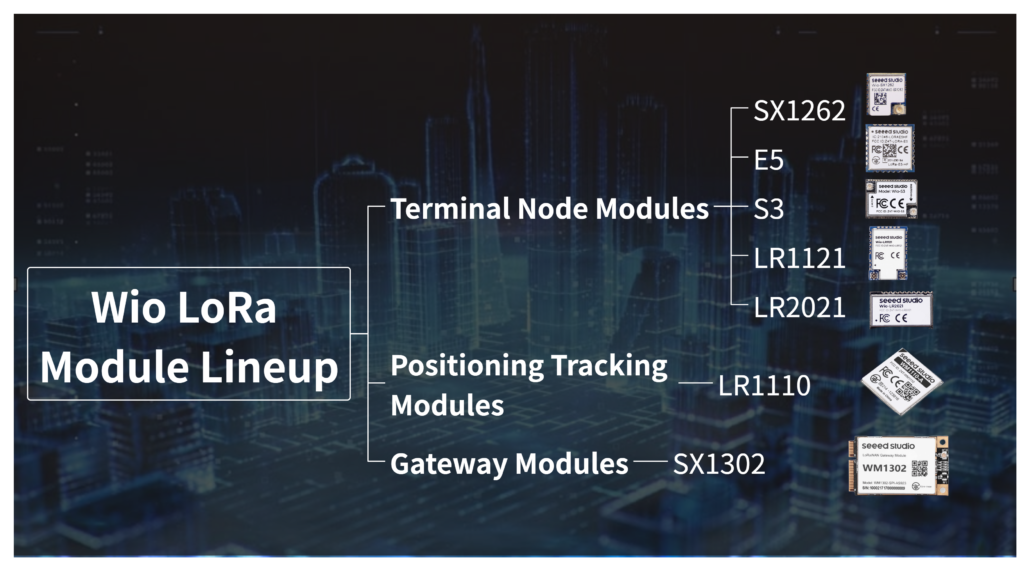
When selecting a LoRa module for IoT applications, focus on the device’s role in the network rather than isolated chip specifications. A typical LoRa system includes three main categories: terminal nodes (data collection and transmission), positioning tracking modules (communication + location), and gateway modules (network infrastructure). Classification is based on network function, not just performance.
Terminal Node Modules
Terminal nodes are the smallest units in an IoT network. They collect sensor data, perform basic processing, and transmit packets wirelessly — used in temperature sensors, agricultural monitors, smart meters, and industrial devices. Designed for battery-powered, remote, long-life operation, they emphasize low power, long range, compact size, and low cost.
- SX1262: Classic low-power transceiver ideal for sending small data packets over long distances. It periodically wakes, transmits, and sleeps, suiting simple battery sensors and basic LoRaWAN devices.
- E5: Compact and highly integrated module based on STM32WLE5JC, providing easy-to-use LoRaWAN support with strong low-power characteristics, ideal for rapid development of battery-powered end devices.
- S3: A versatile terminal node solution that integrates LoRa with a powerful microcontroller, offering excellent performance for custom IoT applications requiring more processing power and flexibility.
- LR1121: Enables global use with multi-band support (sub-GHz LoRa, 2.4 GHz LoRa, S-band satellite), removing the need for region-specific variants while maintaining core edge-device functionality.
- LR2021: Supports multiple protocols (LoRaWAN, Amazon Sidewalk, W-MBUS, FLRC) for greater versatility, enabling firmware updates, complex data exchange, and compatibility in smart locks, trackers, and industrial terminals.
Positioning Tracking Module
Positioning modules combine data communication with location awareness. Traditional solutions adding separate GPS modules increase cost, size, power use, and complexity. LR1110 integrates LoRa transceiver, GNSS, and Wi-Fi passive scanning in one chip. It collects raw positioning data and offloads computation to the cloud via LoRaWAN, saving power and resources. Key applications include logistics tracking, smart agriculture, wildlife monitoring, and asset management. Though it can communicate normally, its defining feature is location intelligence.
Gateway Modules
Gateways act as infrastructure, aggregating traffic from hundreds or thousands of nodes. The SX1302 is a high-concurrency baseband processor for continuous operation and large network capacity. It handles simultaneous multi-channel, multi-spreading-factor receptions and forwards data to the server — a role incompatible with the low-duty-cycle, intermittent operation of terminal chips. Gateways must listen constantly and manage overlapping packets, unlike terminals that only handle their own sporadic data.
Summary
LoRa modules are functionally classified by their position in the IoT hierarchy: terminal modules for device connectivity, positioning modules for location-aware operations, and gateways for network aggregation. This specialization ensures hardware matches operational needs, enabling efficient system design and better module selection.
Wio-SX1262 Lora Module
【Overview】Wio SX1262 RF Performance and Hardware Architecture
The Wio-SX1262 is a compact LoRa wireless module from Seeed Studio centered on the Semtech SX1262 transceiver. It operates in the 868–915 MHz bands (with regional variants), delivering up to +22 dBm transmit power and exceptional receiver sensitivity of approximately –148 dBm. Key hardware features include an onboard TCXO for frequency stability across temperature variations, an IPEX antenna connector, and a minimal 12-pin SMT footprint that facilitates integration into space-constrained designs. This module prioritizes pure RF performance for long-range, low-power communication without an integrated host MCU, making it ideal as a flexible transceiver component paired with external microcontrollers.
【Application】Wio SX1262 Battery Powered Monitoring and Mesh Networking Solutions
The Wio-SX1262 excels in battery-powered terminal nodes for industrial monitoring, smart agriculture, and environmental sensing, where ultra-low sleep currents and robust link budgets enable years of maintenance-free operation. Its mature ecosystem and community support make it the preferred choice for Meshtastic deployments, enabling resilient off-grid mesh networks for hikers, remote teams, or disaster-response scenarios. The module’s simplicity and RF excellence also suit rapid prototyping of custom LoRaWAN end devices when combined with development boards.
Wio-E5 Lora Module
【Overview】Wio E5 Module Technical Architecture and Performance
The Wio-E5 represents an integrated System-on-Chip (SoC) solution based on the STM32WLE5JC, which embeds an Arm Cortex-M4 MCU alongside the SX126x LoRa transceiver in a single ultra-compact 12 × 12 × 2.5 mm 28-pin SMT package. Compared to the standalone Wio-SX1262, the E5 offers a self-contained platform with built-in processing, peripherals (UART, I²C, ADC, SPI, etc.), and factory-programmed AT-command firmware, substantially reducing external component count and design complexity while maintaining comparable RF performance (up to +22 dBm TX, –136.5 dBm sensitivity). A low-power variant (Wio-E5-LE) further optimizes consumption for extended battery life.
【Application】Wio E5 Smart Metering and Industrial Sensor Deployments
The Wio-E5 is optimized for high-volume, ultra-low-power sensor nodes in smart metering, agriculture, and industrial IoT, where its integrated MCU and AT commands accelerate development and deployment. Exceptional sleep currents (as low as 2.1 µA) and industrial temperature range (–40 °C to +85 °C) make it suitable for long-term battery or energy-harvesting deployments, such as environmental monitoring stations or wireless utility meters, delivering reliable long-range connectivity with minimal engineering overhead.
Wio-S3 Lora Module
【Overview】Wio S3 High Performance Computing and Multi Radio Integration
The Wio-S3 integrates the Semtech SX1262 LoRa transceiver with the powerful ESP32-S3R8 dual-core Xtensa LX7 MCU (up to 240 MHz), 16 MB Flash, and 8 MB PSRAM in a 38-pin SMT package (approximately 21.6 × 16.5 × 3.3 mm). Unlike the pure transceiver-focused Wio-SX1262 or the ultra-low-power SoC Wio-E5, the S3 adds significant computational capability, 2.4 GHz Wi-Fi, and Bluetooth 5.0 LE, enabling hybrid connectivity and edge processing while preserving the SX1262’s long-range LoRa performance (up to ~+22 dBm TX, –137 dBm sensitivity). Variants with or without IPEX connectors provide antenna flexibility.
【Application】 Wio S3 Advanced Edge Intelligence and Hybrid IoT Solutions
The Wio-S3 targets sophisticated edge-IoT nodes requiring local intelligence, such as AI-enhanced environmental sensors, smart city gateways with hybrid backhaul, or advanced trackers combining LoRa long-range with Wi-Fi/BLE for configuration and short-range data offload. Its ample memory and processing power support complex firmware, over-the-air updates, and edge analytics, making it ideal for applications where pure LoRa nodes lack sufficient compute or multi-radio capabilities.
Wio-LR2021 Lora Module
【Overview】Wio LR2021 Multi Protocol Flexibility and High Speed Capabilities
LR2021 is Semtech’s fourth generation LoRa IP chip, the first product in the LoRa Plus family, launched in March 2025 with customer sampling beginning in April 2025, so its ecosystem is comparatively new.
Built on Semtech’s revolutionary switchless architecture, it delivers Sub-GHz/2.4GHz/S-band coverage with 2.6Mbps FLRC transmission, enabling live video streaming and world-class receive sensitivity of -141.1 dBm. Native multi-protocol agility, spanning LoRaWAN, Amazon Sidewalk, Wi-SUN, Z-Wave to W-MBUS, empowers seamless worldwide deployment — from asset tracking to real-time imaging.
【Application】Wio LR2021 Smart Door Lock Connectivity and Amazon Sidewalk Integration
In the North American market, Amazon Sidewalk utilizes the existing Echo device infrastructure to create a low power neighborhood network, eliminating the need for user configured gateways. The LR2021 serves as a unified hardware platform that can switch between Sidewalk for North America, W-MBUS for European metering, or Z-Wave for smart homes via software configuration. This capability removes the necessity for multiple PCB revisions, significantly reducing certification costs and inventory complexity. The module’s efficiency ensures that battery life remains a primary advantage for smart lock applications, allowing devices to operate for years without maintenance.
Wio-LR1121 Lora Module
【Overview】 Wio LR1121 Global Multi Band Support and LR FHSS Modulation
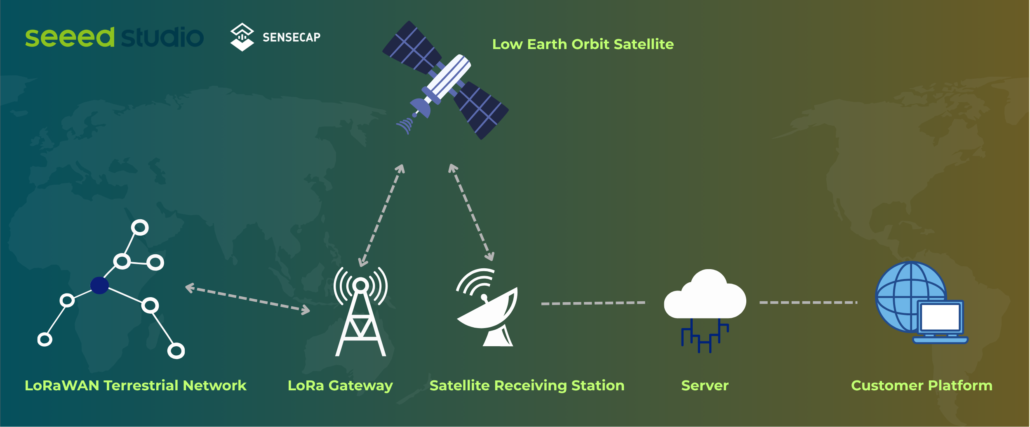
LR1121 is Semtech’s third generation LoRa transceiver, and its defining feature is that a single chip covers both sub-GHz (150 to 960 MHz) and 2.4 GHz ISM bands, with an additional S-band (1.9 to 2.1 GHz) option reserved for satellite uplink. In practice, that means one PCB can cover the sub-GHz spectrum used by conventional LoRaWAN while also switching to license free 2.4 GHz global communication, without an external RF switch and without a separate hardware revision for every country’s frequency regulations.
Beyond multi band coverage, LR1121 also supports LR-FHSS (Long Range, Frequency Hopping Spread Spectrum), a frequency hopping modulation purpose built for high density networks and satellite links, which resists Doppler shift and channel collisions effectively.
【Application】Wio LR1121 Direct to Satellite IoT and Global Connectivity
Satellite IoT faces challenges from Doppler shift and channel contention due to the high speed of Low Earth Orbit satellites. The LR1121 utilizes LR-FHSS to provide a stable link by hopping between frequencies, which inherently resists frequency offsets. Its multi band capability allows for a single SKU that complies with European, American, and Asian regulations. Furthermore, the integrated S-band support provides a dedicated satellite uplink path without requiring additional RF front end components, making large scale global asset tracking technically and economically viable.
Wio-LR1110 Lora Module
【Overview】Wio LR1110 Integrated Location Intelligence and Asset Management
LR1110 belongs to Semtech’s LoRa Edge product line, and its design goal is asset management rather than plain transceiving. It integrates three functions on a single chip: a LoRa transceiver, a multi constellation GNSS scanner (GPS and BeiDou), and a passive 802.11b/g/n Wi-Fi scanner.
LR1110 does not compute position itself. It only scans locally for GNSS pseudorange data or nearby Wi-Fi AP MAC addresses, then relays that raw data over LoRaWAN to the cloud, where Semtech LoRa Cloud or a partner positioning engine performs the actual location calculation. Keeping the heavy computation off chip and in the cloud is the core reason LR1110 sustains such low power draw.
Sleep current is around 7.6 µA, higher than a pure transceiver node, but reasonably restrained given that the chip integrates a GNSS front end, a Wi-Fi front end, and a crypto engine.
【Application】Wio LR1110 Precision Agriculture and Asset Tracking Applications
Conventional agricultural weather nodes tend to run into a familiar set of problems. A plain LoRaWAN sensor node only reports readings and has no idea which field it is sitting in; once dozens of identical devices are spread across a site, tracking down a single misbehaving unit often requires manually cross referencing a paper log. Bolting on a standalone GPS module can restore that positioning capability, but it adds another chip and another slice of the power budget, a real burden for a battery powered device expected to last two or three years in the field. Layer on the fact that many designs run their RF link budget fairly tight, and rainy season humidity or field vegetation growing up around the antenna can visibly erode link stability, showing up as more dropped uplinks, which users often misread as a hardware fault.
LR1110 combines a LoRa transceiver, a multi constellation GNSS scanner, and a Wi-Fi passive scanner on one chip, with sleep current around 7.6 µA. For an agricultural sensor node, that means the device spends the overwhelming majority of its time asleep, waking hourly to transmit a few dozen bytes before returning to sleep, so radio on time across the whole duty cycle stays extremely short. LR1110’s transmit power of 21 dBm and sensitivity of -141 dBm provide comfortable link margin over a three to four kilometer field distance.
Wio-SX1302 Lora Module
【Overview】Wio SX1302 High Capacity Gateway Processing and Concurrency
SX1302 is Semtech’s second generation LoRa gateway baseband processor, designed from the outset to listen to many conversations at once. It receives on 8 channels in parallel, and according to its datasheet can detect packets across 8 spreading factors (SF5 to SF12) over 10 channels and demodulate up to 16 packets concurrently, roughly double the concurrency of its predecessor, SX1301. Where SX1301’s overall power draw sat around 1.5 W, SX1302 brings that down to roughly 110 mW, substantially easing thermal design, one of the reasons commercial gateways today can ship as fanless designs. Paired with an SX1250 RF front end, receive sensitivity reaches -141 dBm, with +26 dBm transmit power.
【Application】Wio SX1302 Enterprise Private Networks and Infrastructure Solutions
A private LoRaWAN network in an enterprise campus typically includes tens to hundreds of sensor nodes distributed across floors, equipment rooms, and parking areas, each reporting temperature, humidity, energy use, access control events, and similar data on its own schedule. Because node report times are randomly distributed, the gateway needs to be able to process many concurrent uplinks and still capture data completely. On top of that, the network server side typically needs to interface with a standard LoRaWAN platform such as ChirpStack or The Things Network for downstream data routing and device management; and if the gateway can also handle building control protocol translation, that further reduces the number of devices and the integration complexity on site.
The bottleneck in this scenario is not coverage distance. Campus building density is high, and the physical distance between nodes and gateway is typically within a few hundred meters, leaving ample link margin. The real pressure sits at the RF layer’s concurrent processing capacity: when multiple nodes report within a similar time window, a gateway that cannot demodulate multiple signals in parallel will drop packets to collisions at the radio layer, and no amount of application layer optimization can recover from that.
SX1302 is Semtech’s second generation LoRa gateway baseband processor, designed from the start to listen to many conversations at once. It receives on 8 channels in parallel, and according to Semtech’s datasheet can detect packets across 8 spreading factors (SF5 to SF12) over 10 channels while demodulating up to 16 packets concurrently, without one signal blocking another. Semtech’s published FAQ figures put a single SX1302 8 channel gateway at roughly 1.5 million received packets per day (50 byte payloads); for nodes reporting once per hour, that theoretically covers on the order of 62,500 devices. Overall power draw is around 110 mW, easing thermal design pressure, one reason today’s commercial gateways can ship fanless.
How to Choose the Right LoRa Module
| Module | Chip / Core | Primary Role | Frequency Bands | Max TX / Sensitivity |
| Wio-SX1262 | Semtech SX1262 | Terminal Node | Sub-GHz (868/915 MHz primary; regional variants) | +22 dBm / ~–148 dBm |
| Wio-E5 | STM32WLE5JC (Cortex-M4 + SX126x) | Terminal Node | Sub-GHz (EU868/US915 + global plans) | +22 dBm / –136.5 dBm |
| Wio-S3 | ESP32-S3 + SX1262 | Advanced Terminal Node | Sub-GHz (868/915 MHz) | ~+22 dBm / –137 dBm |
| Wio-LR1121 | Semtech LR1121 | Terminal Node (Global) | Sub-GHz + 2.4 GHz + S-band (satellite) | +22 dBm / –141 dBm (boost) |
| Wio-LR2021 | Semtech LR2021 (LoRa Plus) | Versatile Terminal Node | Sub-GHz + 2.4 GHz | +22 dBm / –141.5 dBm |
| Wio-LR1110 | Semtech LR1110 (LoRa Edge) | Positioning Tracking | Sub-GHz (LoRa) + GNSS + Wi-Fi scan | +21 dBm / –141 dBm |
| Wio-SX1302 | Semtech SX1302 | Gateway | Multi-channel (8+ channels) | Up to +26 dBm (with front-end) / –141 dBm |
| Module | Key Features & Integration | Protocols & Modulations | Typical Applications | Power Profile |
| Wio-SX1262 | Standalone transceiver; TCXO; IPEX; minimal footprint | LoRa, (G)FSK; LoRaWAN; Meshtastic mesh | Meshtastic off-grid mesh, basic sensors, industrial/agriculture nodes | Ultra-low sleep; battery-optimized |
| Wio-E5 | Integrated MCU + LoRa; AT commands; peripherals (UART/I²C/ADC) | LoRaWAN (A/B/C); (G)FSK, BPSK | Smart metering, environmental sensors, long-life nodes | Extremely low (2.1 µA sleep) |
| Wio-S3 | Dual-core MCU (240 MHz), 16MB Flash + 8MB PSRAM, Wi-Fi + BLE | LoRaWAN, Meshtastic; Wi-Fi/BLE hybrid | Edge AI nodes, hybrid connectivity trackers, smart devices | Moderate (higher due to MCU) |
| Wio-LR1121 | Multi-band (no external switch); LR-FHSS | LoRa, LR-FHSS; LoRaWAN | Global deployment, direct-to-satellite IoT, dense networks | Low power |
| Wio-LR2021 | High-speed FLRC (up to 2.6 Mbps); multi-protocol | LoRaWAN, Sidewalk, W-MBUS, FLRC, Wi-SUN, Z-Wave | Smart locks, metering, OTA-heavy apps, multi-ecosystem | Low power, higher data support |
| Wio-LR1110 | Integrated GNSS + Wi-Fi passive scanner; cloud positioning | LoRaWAN + positioning | Asset tracking, logistics, agriculture, wildlife monitoring | Low (7.6 µA sleep) |
| Wio-SX1302 | High-concurrency baseband; 8 channels + 8 SFs; low power | LoRaWAN gateway processing | Private/enterprise LoRaWAN networks, campus/industrial gateways | Continuous operation (~110 mW) |
Overview
The Wio LoRa module lineup offers a comprehensive suite of solutions that addresses the full spectrum of modern IoT requirements. With seven distinct modules covering every role from terminal sensing to high capacity infrastructure, the ecosystem provides unparalleled flexibility for developers.
These modules are deployed in powerful scenarios including smart city management, industrial automation, global logistics, and direct to satellite communication. The strategic integration of multi protocol support and multi band frequency coverage ensures that Wio modules can serve as a unified platform for global markets.
Looking forward, the continuous evolution of the Wio ecosystem, supported by the partnership between Seeed Studio and Semtech, promises to deliver even greater integration and performance. The potential for future development remains vast, ensuring that the Wio lineup will continue to lead the expansion of the global Internet of Things.
About Author
